To request further details about this lot, please email [email protected]

Jacob Coley
Senior Vice President, Head of Department, Antiquities and Ancient Art
Sale 1343
| Chicago
| Chicago
To request further details about this lot, please email [email protected]
Jacob Coley
Senior Vice President, Head of Department, Antiquities and Ancient Art
Estimate$30,000 – $50,000
Provenance:
Art Market, France, 1980s. [by repute]
Christie’s, New York, Antiquities, 7 December 2006, Lot 122.
Private Collection, United States.
Christie’s, New York, Antiquities, 3 June 2009, Lot 127.
Private Collection, Dallas, Texas.
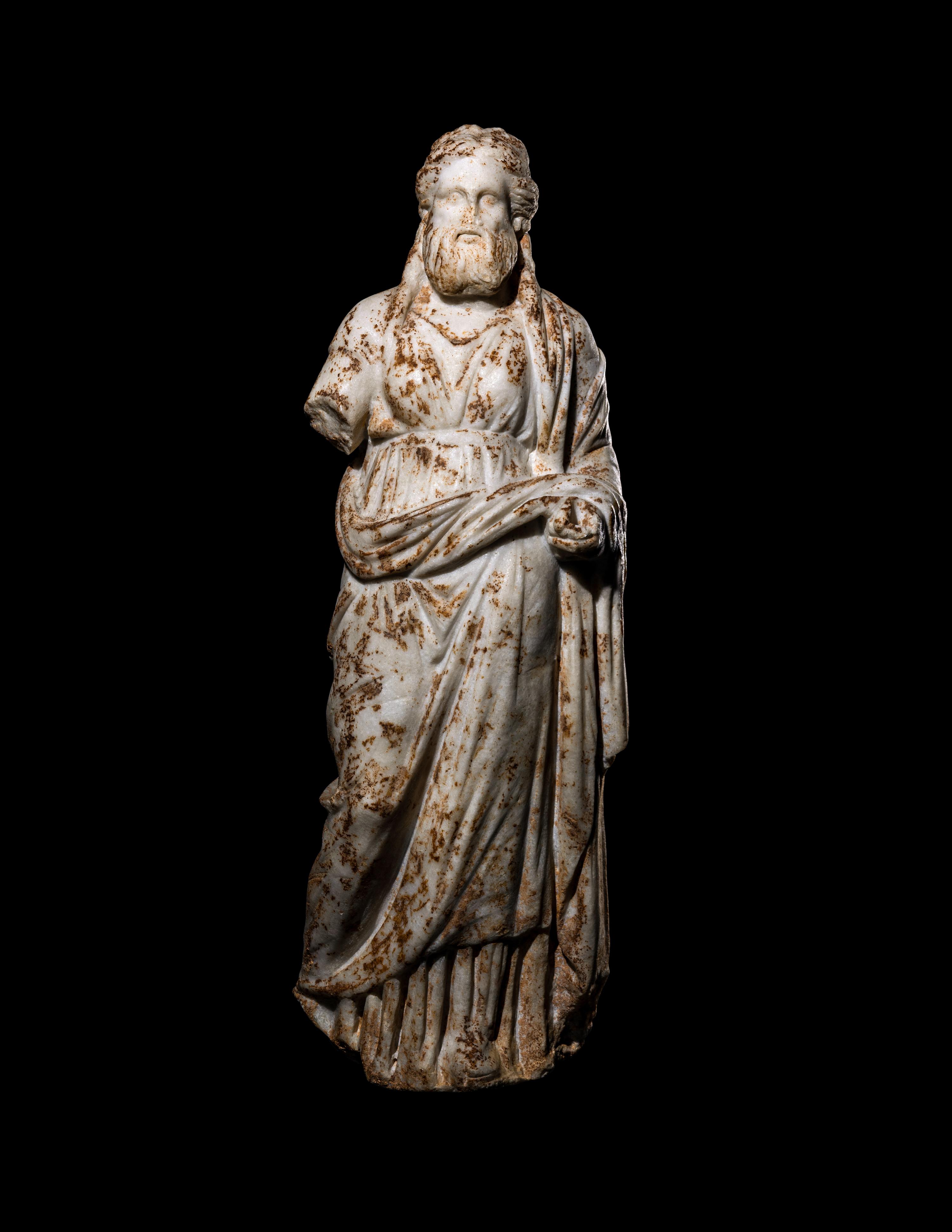
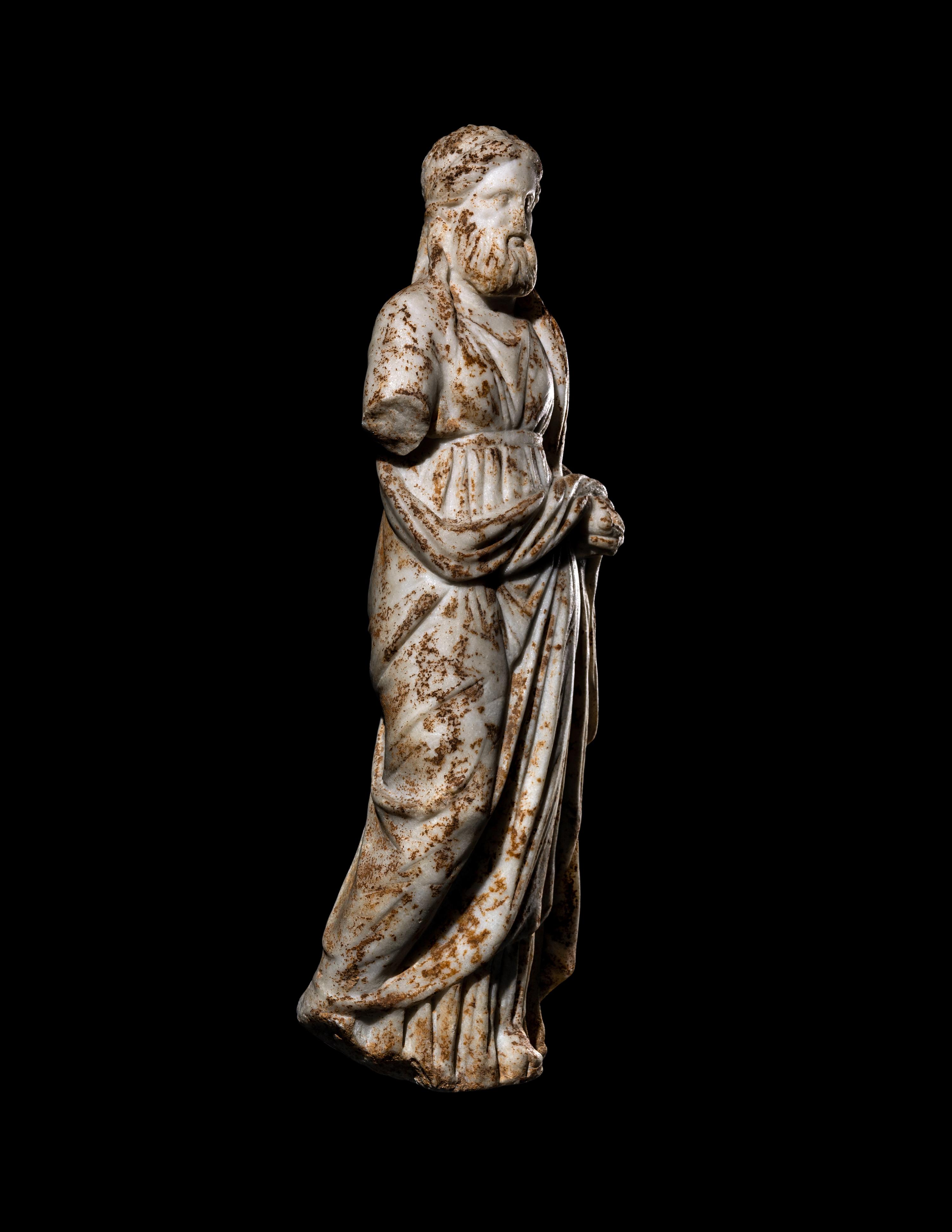
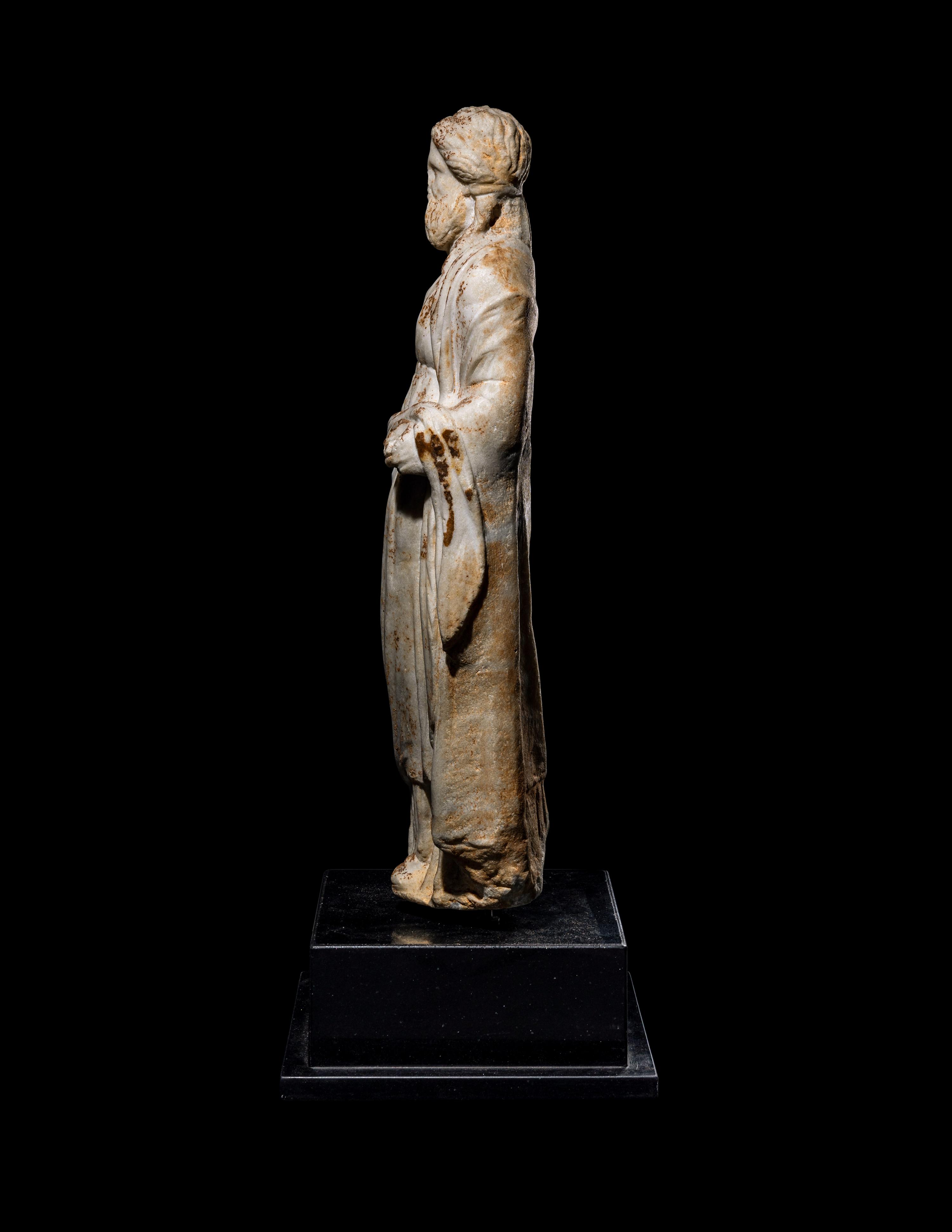
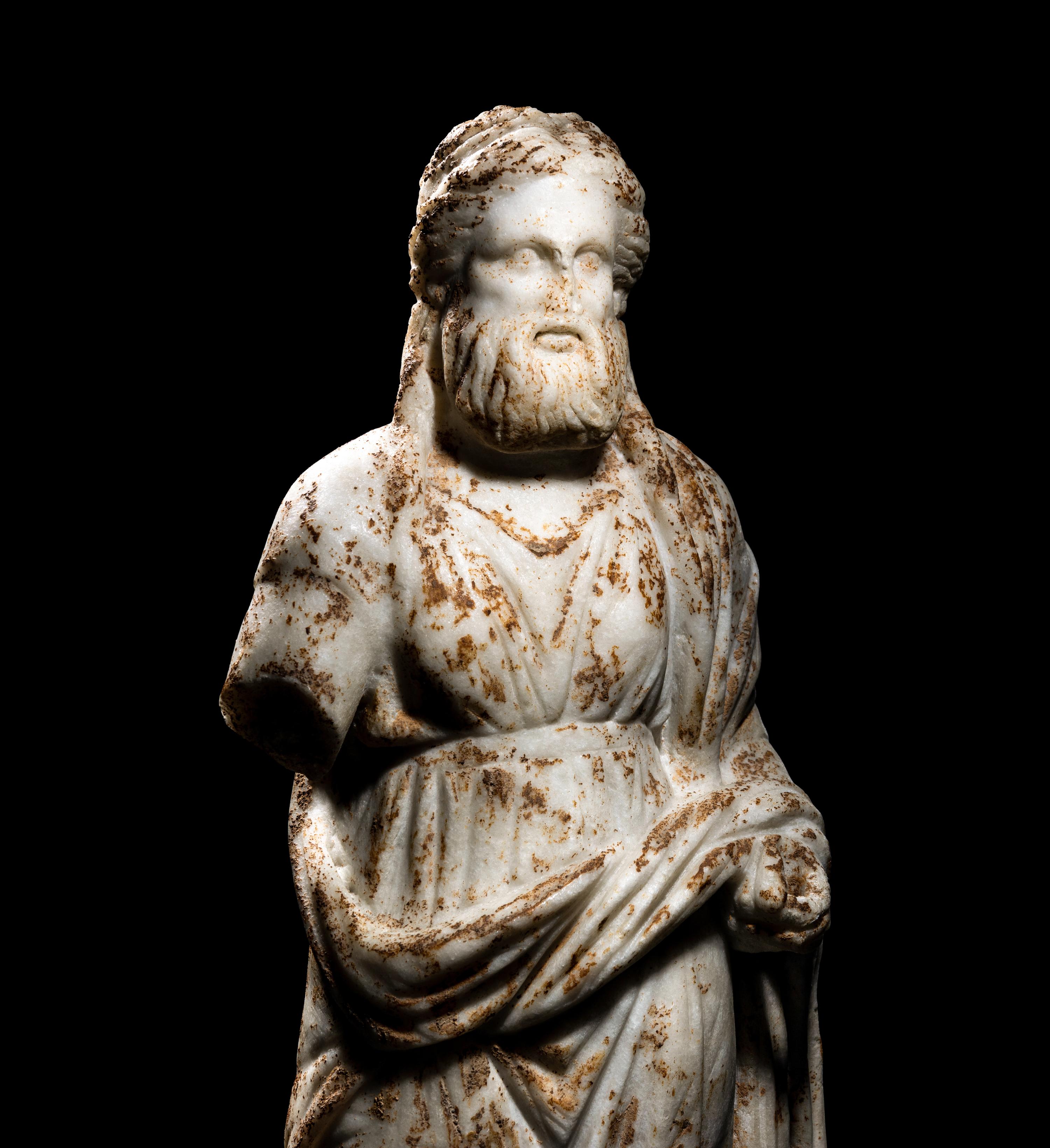
Unlike his followers who were easily enthused by wine and his presence, Dionysos remained a perennial observer of the (occasionally debauched) frenzy he inspired. The god’s languid standing posture here falls within this tradition, with movement implied only by a bent right leg beneath the voluminous folds of his mantle. The mantle is draped over the left shoulder to encircle the body and terminates over the left arm, which is bent at the elbow to hold a now missing attribute. The sculptor’s caliber is readily apparent in the textural interplay between the thick overlaying mantle (complete with pressed lateral creases) and the crinkled pleats of the chiton beneath it.
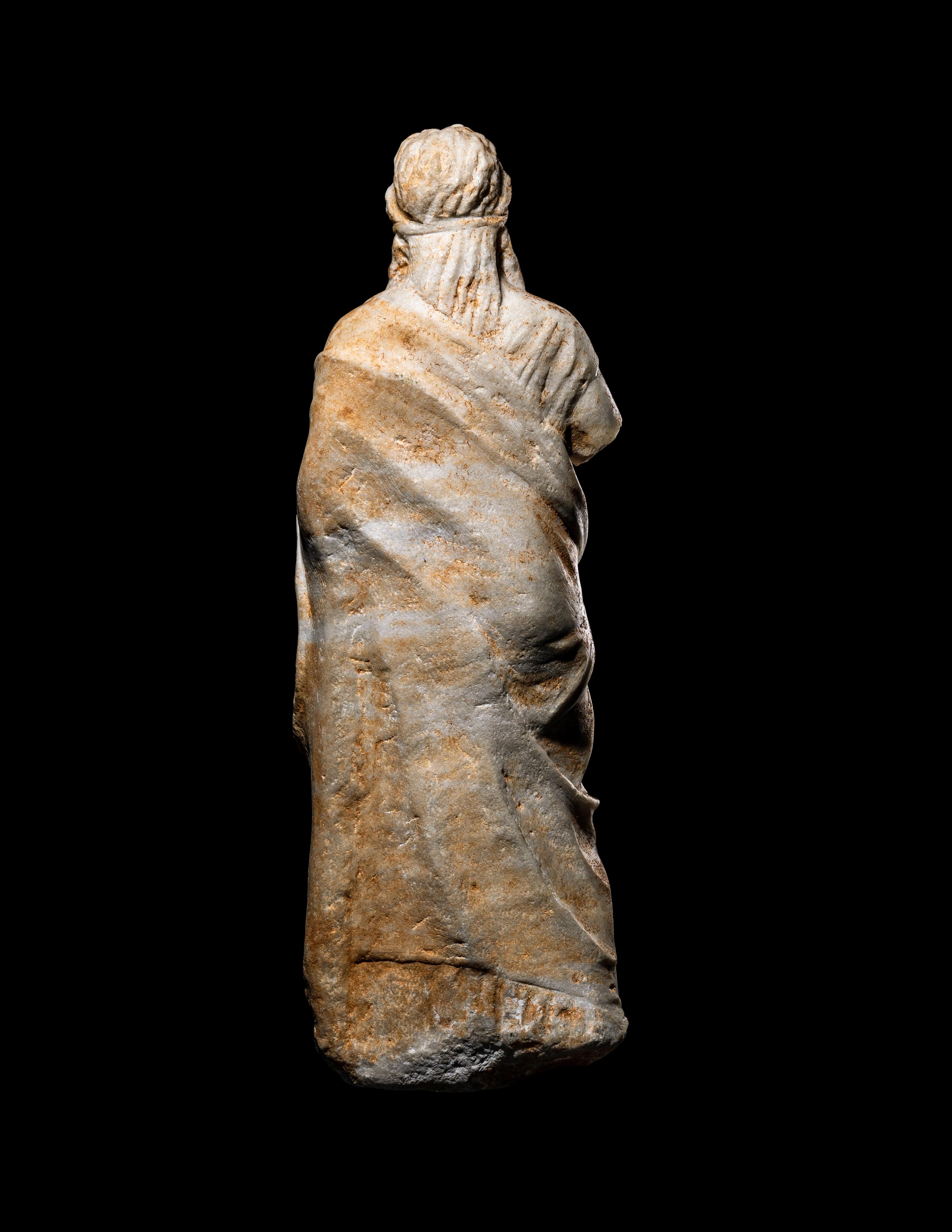
The god’s hair is brushed back from the brow and centrally parted, with long corkscrew curls falling over his shoulders and down the back. The lower half of his face is engulfed by a prodigious beard, bucking the post-Classical trend towards showing Dionysos as a beardless, nude youth, marked by an almost feminine softness. While the tendency towards androgyny that marked most images of Dionysos after the fifth century B.C. is ostensibly flouted here, the garment tells a more complicated story: the finely pleated chiton girt high on his chest was commonly associated with Greek maidens. The drapery falls in v-shaped folds from the neckline, creating an illusion of female breasts that has prompted some scholars to interpret the present statue as a rare ‘hermaphroditic’ presentation of the god.
A more plausible interpretation places this unusual representation within a broader trend in the Greek world of portraying Eastern foreigners as feminine and softened by luxury. High-girt chitons worn by men can be found on Attic pottery since the early 5th century B.C., showing high-spirited scenes during the symposium (all-male drinking parties), during which temporary decadent excesses were permitted and this type of femininization seen as a nod to Dionysos’ Eastern roots. As the last god to join the Olympian pantheon, this wayward son of Zeus was first required to prove himself in the East, winning over India before returning to Mt. Olympus in triumph and his image frequently retained perceived foreign elements. In the present extraordinary statue, Dionysos’ feminine garment celebrates his origin myth while at the same time highlighting the ambiguities of his cult so celebrated in the Hellenistic period.
For a comparable representation, see the Hellenistic seated statue of a bearded and heavily draped Dionysos wearing a chiton in St. Petersburg, Hermitage Museum (18.832): Lexicon Iconographicum Mythologiae Classicae (LIMC) Vol. 3 (Zürich and Munich 1986) under “Dinoysos”, no. 136, illus. (C. Gasparri). For a critical examination of the subject in so-called ‘Anacreontic vases’ see S.D. Price, “Anacreontic Vases Reconsidered” in Greek, Roman and Byzantine Studies: Cambridge, Mass., etc. Vol. 31, Iss. 2, (Summer 1990): 133 – 173.
See additional images. Height with stand 31 1/2 inches (80.01 cm).
The physical condition of lots in our auctions can vary due to age, normal wear and tear, previous damage, and restoration/repair. All lots are sold "AS IS," in the condition they are in at the time of the auction, and we and the seller make no representation or warranty and assume no liability of any kind as to a lot's condition. Any reference to condition in a catalogue description or a condition report shall not amount to a full accounting of condition. Condition reports prepared by Freeman's staff are provided as a convenience and may be requested from the Department prior to bidding.
The absence of a posted condition report on the Freeman's website or in our catalogues should not be interpreted as commentary on an item's condition. Prospective buyers are responsible for inspecting a lot or sending their agent or conservator to inspect the lot on their behalf, and for ensuring that they have requested, received and understood any condition report provided by Freeman's.
Please email [email protected] for any additional information or questions you may have regarding this lot.