To request further details about this lot, please email [email protected]
Please email [email protected] for any additional information or questions you may have
Sale 3147
| Philadelphia
| Philadelphia
To request further details about this lot, please email [email protected]
Please email [email protected] for any additional information or questions you may have
Estimate$60,000 – $100,000
Robert Indiana
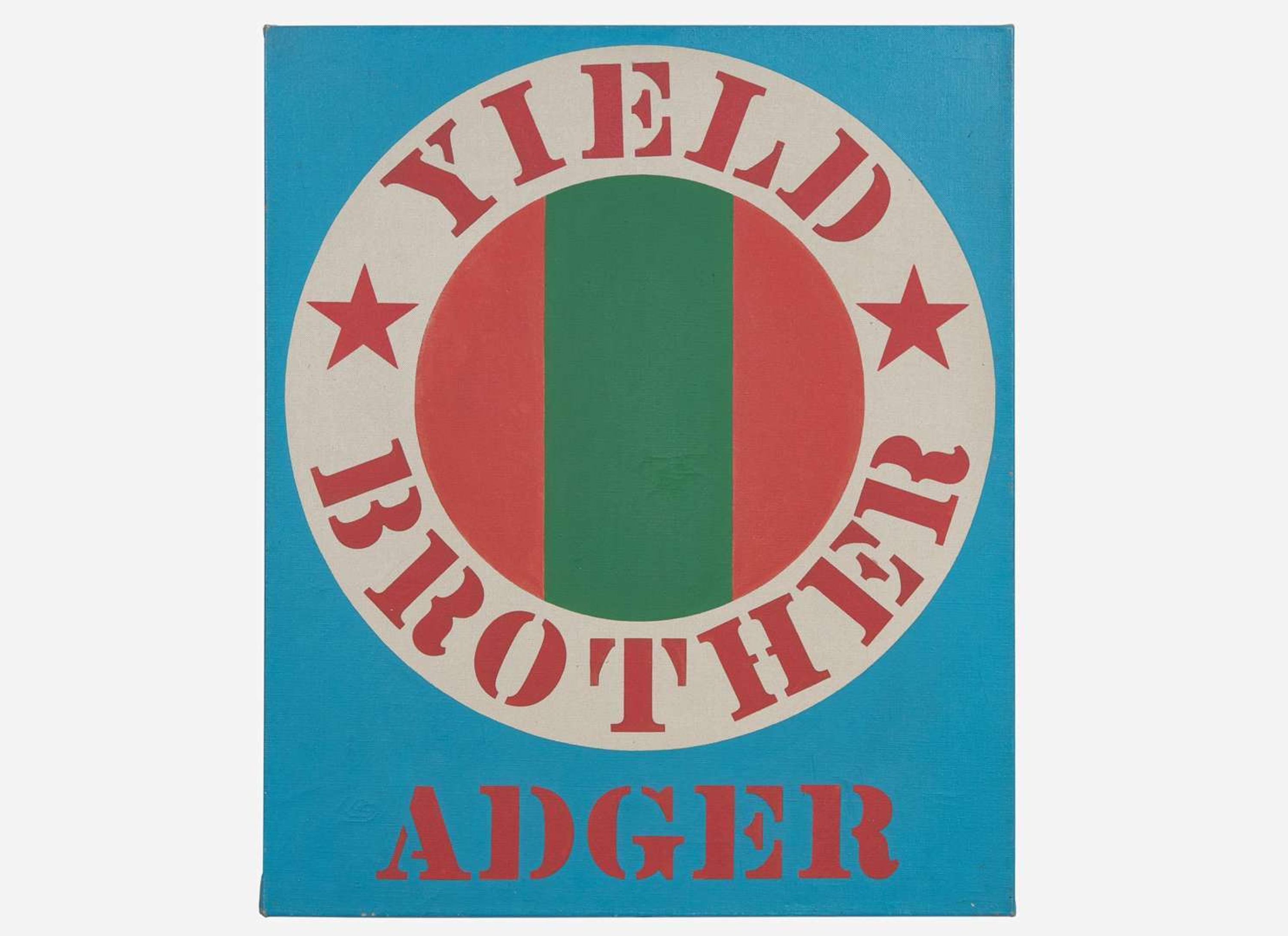
Robert Indiana’s Yield Brother painting series began in 1963 with a work made for a benefit exhibition hosted by the Bertrand Russell Peace Foundation, in the year of their founding. The forms in the painting reference symbolism gleaned from Indiana’s time living and working at Coenties Slip, on the wharves in New York City. As the artist’s website states: “The vertical bar inside the circle references both the cartographic plans of the Manhattan wharves found in Indiana’s ‘The Melville Triptych (1962), and the central element of the Campaign for Nuclear Disarmament’s (peace) symbol, the D (for disarmament) based on the letters of the semaphore system.” After the first Yield Brother, he painted three large diamond-shaped canvases and a series of smaller works, which all share the same composition, dedicated to friends, such as composer Virgil Thomson.
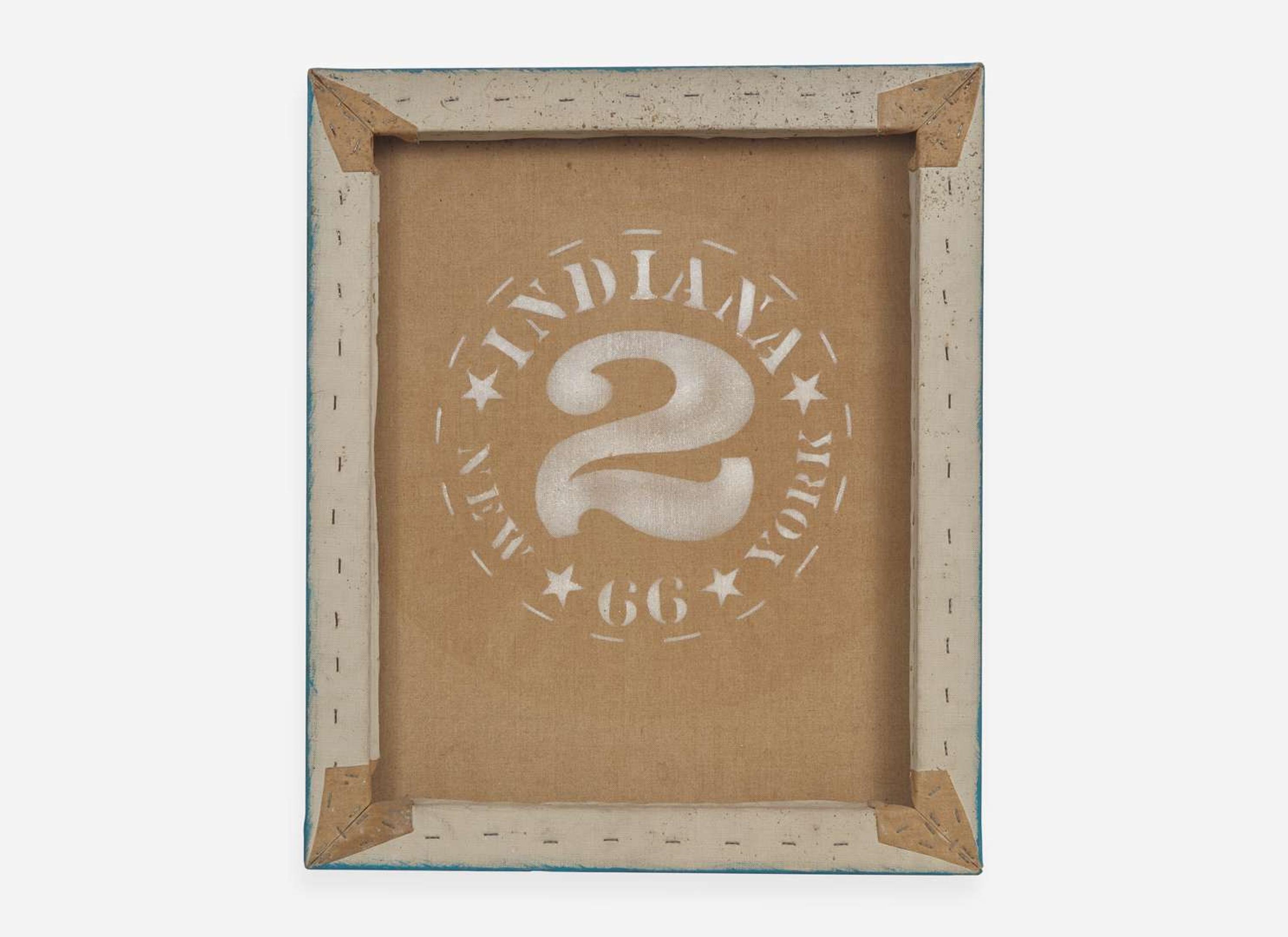
Indiana painted the present canvas for his friend Adger Cowans in 1966. The two met when Cowans took a series of photographs of Indiana in his studio for a project. Indiana then introduced Cowans to the artist and weaver Lenore Tawney, among other artists downtown, who became close friends. Often associated with the Pop Art movement, Indiana’s personal works like this one helped differentiate him from the movement, as his subject matter did not rely on pop culture, but his own individual themes and relationships.
Adger Cowans
The prolific photographer, painter and musician Adger Cowans is also a prominent art collector in his own right. Like his artistic output, his collection is a testament to his relationships, strong friendships and the crucial importance of these connections in his life. Cowans was born in Ohio in 1936 and became a talented musician at a young age. In his teenage years, his attention shifted to photography and he enrolled as one of the first African American students in the Ohio State University photography program. There he was greatly influenced by his teacher Clarence White, Jr., the son of photographer Clarence White, Sr., an early champion of photography as a fine art medium. The Whites shared their extensive photography collection with the young Cowans, introducing him to photographers like Ansel Adams, Edward Weston, Alfred Stieglitz, Minor White, and W. Eugene Smith who would serve as major influences moving forward.
Steeped in current events and the news of the day from a young age, Cowans was drawn to create representations of everyday life around him, particularly as it related to the African American experience in the 1950s and 1960s. Cowans moved to New York City in 1958, where he worked at Life Magazine as an assistant to photographer Gordon Parks. Parks would become a supporter and friend of the younger artist, referring to him later as “one of America’s finest photographers.” Cowans’ most readily recognizable images are film stills from Hollywood movie sets, portraits of jazz musicians and fellow artists and scenes capturing life around him. Concurrently, Cowans experimented with more abstract compositions in photography and painting, mastering techniques of light and form that produce stirring images. In a 2022 exhibition catalogue the artist said: “I take a picture with my heart, not with my eyes. The eyes see what the heart feels. You must be there first – recognizing pain, joy, or whatever – to show it to the viewer. That is the artist’s job.” [1]
Cowans’ avid collecting and support of his fellow artists comes from the heart as well. From his early days in New York City, Cowans collaborated with other artists to create venues and audiences for their work. Along with renowned Black photographers Roy DeCarava, Anthony Barboza, Daniel Dawson, Louis Draper, Albert Fennar, Ray Francis, Herman Howard, James Mannas, Herbert Randall, Herb Robinson, Beuford Smith, Ming Smith, Shawn Walker and Calvin Wilson, Cowans helped found The Kamoinge Workshop, a Civil Rights art collective. “Kamoinge” references a word from the Kikuyu people of Kenya that means “working together,” and the group sought to disrupt racist stereotypes and promote artists in the Black Art Movement. He later joined the AfriCOBRA (African Commune of Bad Relevant Artists) group based in Chicago, an artists’ collective that created and promoted a specifically “Black aesthetic.” Now in his late 80s, Cowans continues to be a force in the art world, painting with his signature tools and layers of color, and advocating for an inclusive and equitable history of art.
[1] “Adger Cowans: Sense and Sensibility,” Fairfield University Museum, Fairfield, Connecticut, January 28-June 18, 2022, exh. cat.
The Artist.
The Collection of Adger Cowans (gifted directly from the above).