To request further details about this lot, please email [email protected]
Please email [email protected] for any additional information or questions you may have
Sale 2720
| Philadelphia
| Philadelphia
To request further details about this lot, please email [email protected]
Please email [email protected] for any additional information or questions you may have
Estimate$10,000 – $15,000
Born in 1860 to Irish parents in Scotland, Kane emigrated to the United States in 1880, settling in Pittsburgh where he worked several manual jobs, including painting boxcars, signs, houses, before eventually deciding to make a living out of his art. When his Scene from the Scottish Highlands was accepted by the jury for the annual international exhibition of the Carnegie Institute in Pittsburgh in 1927, Kane’s name became a sensation despite his lack of formal training. Considered to be “the find of the generation” by The New York Times, Kane rose to fame quickly, though his art was difficult to classify. Even Dr. Barnes, who intensely collected the artist’s work, struggled to display his cheerful scenes of rural life in his Lower Merion home.
Known for his panoramic landscapes (either of the Scottish highlights or of Pittsburgh, in which green pastures coexist with industrial buildings), his self-portraits, as well as some patriotic subjects that often involved Abraham Lincoln, Kane used art to reflect on the difficult world around him. It may also have been an outlet to counter the many difficulties life brought him. The following two works, both incredibly personal, present a window into Kane’s thought process and personal biography.
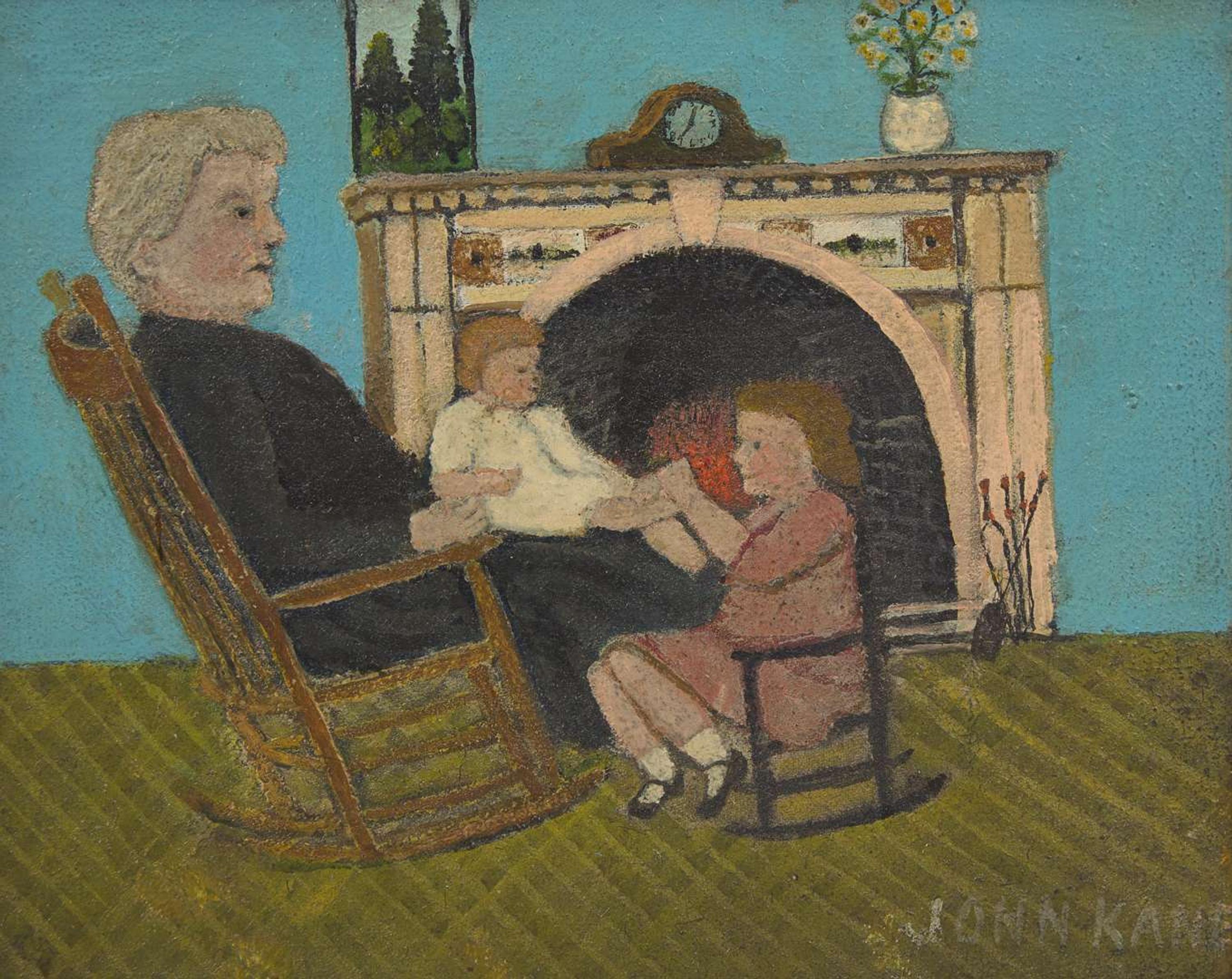
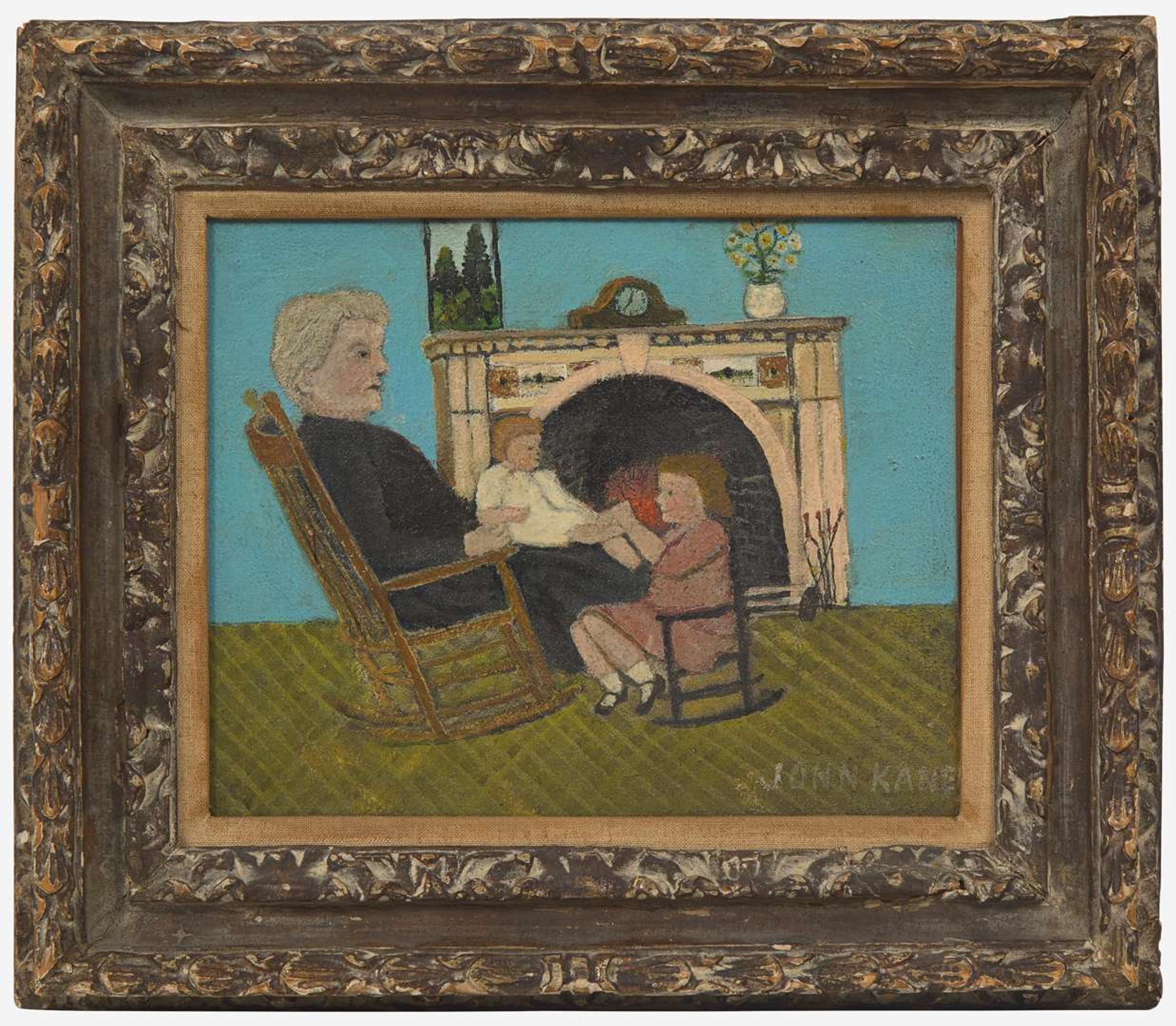
In Grandma at the Fireside, Kane opens a very personal door, and brings us forward in his life. The central figure in the painting is the artist’s wife, Mrs. Kane, portrayed as the focal point. Created around 1928-29, this scene likely depicts the early days of their reconciliation following a tumultuous marriage. Married in 1897, John Kane and Maggie Halloran faced adversity after the loss of their infant son, leading to Kane’s deep depression and exacerbated drinking issues. The couple separated, and Kane remained estranged from his wife and children until the late 1920s, when news of his success and whereabouts reached her through newspapers. The two eventually reconciled and remained together for the rest of Kane’s life.
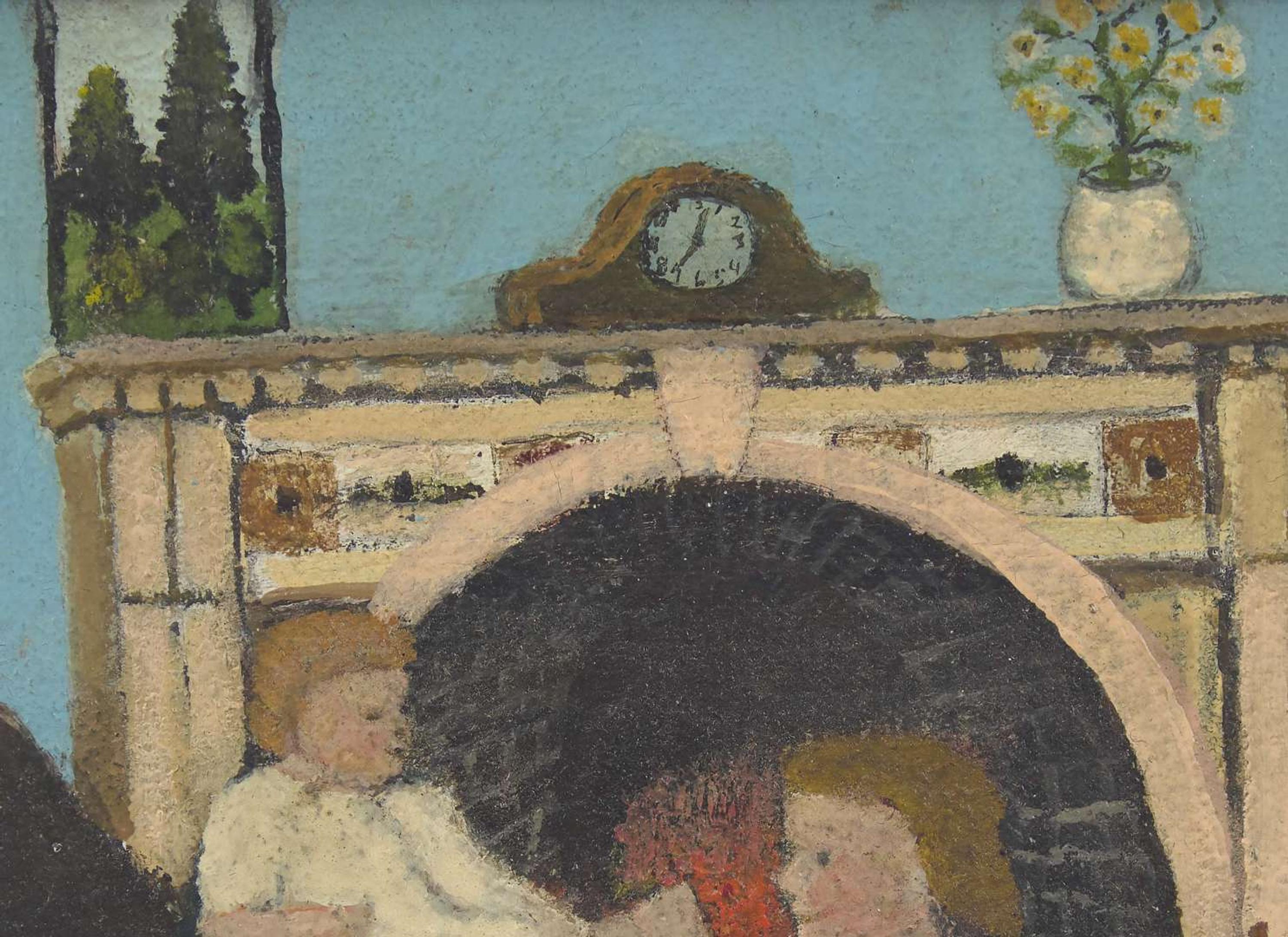
With the fireplace enhancing the overall warmth and intimacy of the scene, Grandma at the Fireside embodies domestic harmony. The inclusion of a small child on Mrs. Kane’s lap conveys a tender and affectionate quality. In this painting, Kane reveals his contentment at being back home, portraying a poignant narrative of familial reunion and domestic bliss.
My Birthplace, on the other hand, likely portrays a scene from the artist’s childhood hometown in West Calder, Scotland. As an expatriate, Kane frequently depicted landscapes reminiscent of his Scottish roots, despite his life and artistic career unfolding in the United States. In this artwork, Kane invites the viewer to reflect on themes of identity, memory, and the passage of time, evoking a sense of nostalgia for the artist’s origins. An intriguing element is the floating head in the upper left corner, a self-portrait which adds a surreal and dreamlike quality to the piece. Here, the floating head reinforces the intimate nature of the artwork and his connection to the depicted scene. The foreground of the painting features train tracks, possibly alluding to Kane’s artistic origins of painting boxcars, or to the tragic accident that cost him a leg.
Valentine Gallery, New York, New York.
Maynard Walker Gallery, New York, New York.
M. Knoedler & Co., New York, New York.
Collection of Joseph H. Hirshhorn, New York, October 21, 1958-1966.
Sotheby's Arcade, New York, sale of January 24, 1989, lot 281.
Acquired directly from the above sale.
The Collection of Sidney Rothberg, Philadelphia, Pennsylvania.