To request further details about this lot, please email [email protected]
Please email [email protected] for any additional information or questions you may have
Sale 2720
| Philadelphia
| Philadelphia
To request further details about this lot, please email [email protected]
Please email [email protected] for any additional information or questions you may have
Estimate$40,000 – $60,000
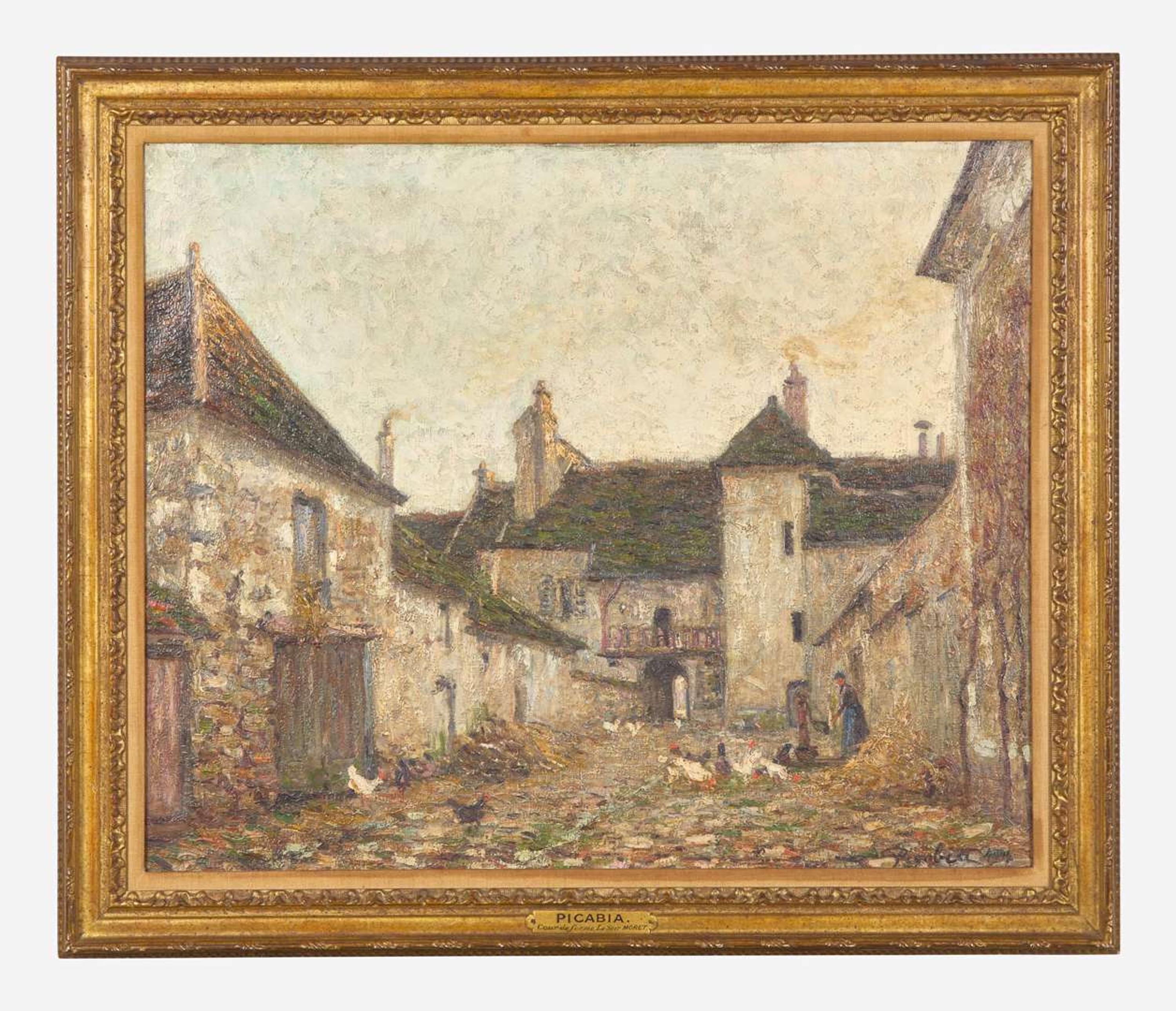
Cour de Ferme, Le Soir, Moret is a wonderful example of Francis Picabia’s early Impressionist period, executed just five years before he met, and became a part of, a group of artists that would form the Cubist group (among them, Marcel Duchamp, Fernand Léger and Juan Gris). The scene reveals the interior of a farmyard at dusk. It is quiet, save for an anonymous peasant woman to the right, about to feed the nearby chickens their dinner. Set in a restricted, muted palette of sand-tones, grays, and browns enlivened only by anecdotal greens and oranges, the canvas conveys a sense of serenity, stillness almost. This is echoed by the imposing farmyard structure, which almost traps the viewer in the picture plane. This feeling is somewhat contrasted with the overall energetic brushstrokes dispatched throughout the canvas, as well as this timid ray of sunshine highlighting the rooftop at left – a beautiful atmospheric reminder that the day is about to end, as revealed by the rest of the composition entirely set in the shadows.
The influence of Picabia’s Master and mentor, Alfred Sisley, is blatantly evident in this work. Beyond the characteristic Impressionistic technique, the subject matter is intended as a direct reference, and in fact homage, to the British-born Master. Around the time the painting was executed, Picabia would frequently visit Moret, the town where Sisley had spent the last decade of his life and the two companions would often depict the same views side by side. This specific farmyard was well-known to Sisley, who depicted it at several different times of the day throughout the 1880s. Our work is a direct citation from Cour de Ferme à Saint Mammès (1884, Musée d’Orsay): although Picabia offers a larger view of the Estate and dots the scene with singular characters, the vantage point is the same, and depicts identical buildings, all easily identifiable with their characteristic white-lime walls, terracotta roof tiles and the singular presence of a wooden outdoor passageway on the second floor of the main edifice.
Although he was often blamed for adopting a style too close to Sisley’s, contemporary critics applauded Picabias’s oils, sensing his own sensitivity at work. The year following the completion of the present work, in 1905, during Picabia’s first one-man exhibition at Galerie Hausmann in Paris, critic Louis Vauxcelles declared: “There may be suggestions in him of similarities with Pissarro, and especially with Sisley,… but while so many dishonest followers plagiarize Monet, Sisley and Pissarro, and steal their effects, M. Picabia, who already possesses a very individual technique, expresses, year after year, a temperament that is his own, and his alone.
Perhaps even more than any other artists represented in the Rothberg Collection, Francis Picabia was one of the greatest, and most versatile avant-garde artists of his time, mastering nearly every major artistic movement in the first half of the twentieth century. Alternating between Impressionism, Pointillism, Fauve, Cubism, Dadaism and Surrealism, he represented the entire 20th century alone. Picabia himself once pronounced: “If you want to have clean ideas, change them as often as your shirt." This changing personality is what appealed to Sidney Rothberg. This work in particular was important to him; not only did it satisfy Rothberg's collecting philosophy, as it reveals Picabia's artistic debt to Sisley, but it also acted as an Impressionistic swan song, executed just months before Picabia shifted, explored a new phase, and burgeoned into someone new.
The Collector's Corner, New York, by 1963.
Private Collection.
Sotheby's, New York, sale of October 3, 1990, lot 29.
Acquired directly from the above sale.
Collection of Sidney Rothberg, Philadelphia, Pennsylvania.
The unlined canvas in overall very good, close to excellent original condition, with a lush and intact impasto. Slight undulating along the top outer edge of the canvas. Examination under UV light reveals a repaired horizontal tear at center right, on the ground, of about 3 in. long (with corresponding mesh paper patch verso). Other than that, the composition is untouched and presents beautifully. See Specialist's pictures for more details.
To receive more information on this Lot, or to get access to additional images, please email Specialist Raphael Chatroux at [email protected]
The physical condition of lots in our auctions can vary due to age, normal wear and tear, previous damage, and restoration/repair. All lots are sold "AS IS," in the condition they are in at the time of the auction, and we and the seller make no representation or warranty and assume no liability of any kind as to a lot's condition. Any reference to condition in a catalogue description or a condition report shall not amount to a full accounting of condition. Condition reports prepared by Freeman's staff are provided as a convenience and may be requested from the Department prior to bidding.
The absence of a posted condition report on the Freeman's website or in our catalogues should not be interpreted as commentary on an item's condition. Prospective buyers are responsible for inspecting a lot or sending their agent or conservator to inspect the lot on their behalf, and for ensuring that they have requested, received and understood any condition report provided by Freeman's.
Please email for any additional information or questions you may have regarding this lot.