To request further details about this lot, please email [email protected]

Adam Veil
VP, Head of Department, American Art and Pennsylvania Impressionists
Sale 2105
| Philadelphia
| Philadelphia
To request further details about this lot, please email [email protected]
Adam Veil
VP, Head of Department, American Art and Pennsylvania Impressionists
Estimate$60,000 – $100,000
The Andrew & Betsy Wyeth Study Center of the Brandywine Museum of Art confirms that this object is recorded in Betsy James Wyeth’s files.
Provenance:
Private Collection, Cashiers, North Carolina, 1963.
Private Collection, Alabama.
Lot Essay:
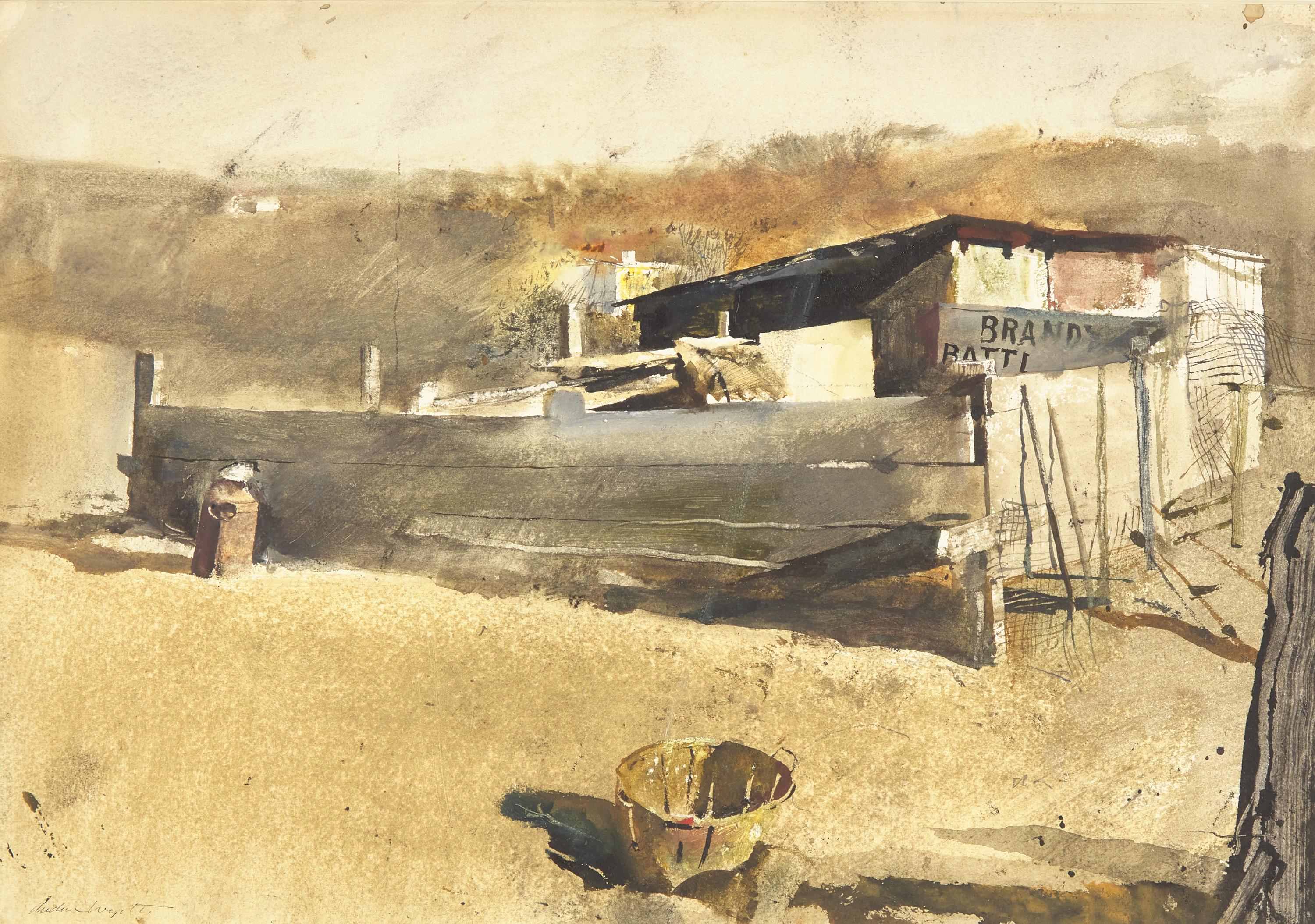
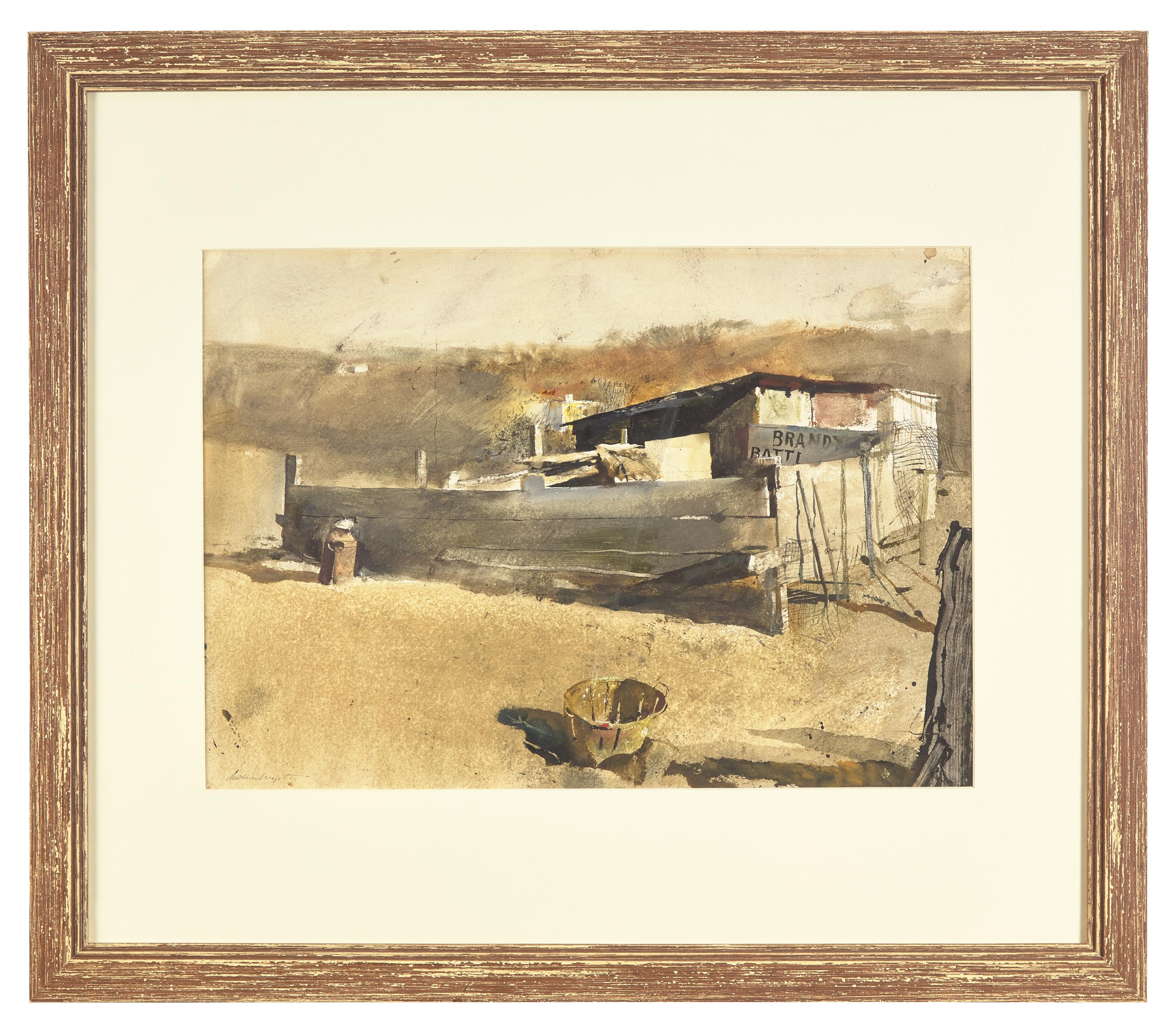
As a prominent member of the American Regionalist movement, Andrew Wyeth made familiar locations an essential element of his aesthetic. Chadds Ford, Pennsylvania, the artist’s hometown, was depicted in countless works. Park Sign depicts the farm of Adam Johnson, a member of the African American community in Chadds Ford who lived along the path from Wyeth’s studio to Kuerner farm, also an endless source of inspiration for the artist. Johnson’s farm, where he raised pigs and chickens, consisted of rickety, make-shift buildings, far from picturesque, but incorporating peculiar elements from nearby venues, such as the Brandywine Battlefield sign partially visible on the façade, making them inherent products of the local. While Wyeth portrayed the farmer several times throughout his career, in this instance, Johnson’s imposing figure is eliminated from the composition, yielding to the ramshackle edifice.
The erasure of the figure allows for the exploration of an abstract dimension, with personal and idiosyncratic details subtly morphing into a sweeping, timeless meaning. Of Johnson’s farm, Wyeth said: "All those shapes of the pigpen…I found a tremendous charge of energy in that strange shack.” The structure is composed of sharply contrasting hues of cream, brown and grey as well as strong intersecting lines, in complete opposition to the more visually uniform and muted background. The gaze is drawn instantly to this striking structure. But there is in fact little to be seen on the surface, a notion reinforced by the building’s humble appearance. It is eerily quiet and still, as if suspended in time, as if an empty shell. In an unsettling cognitive twist, the portrayed object, the farm at the heart of the composition, reveals itself to be less an explicit subject, and more a repository for deeper themes. There is a lot to be seen, surely, but beneath what meets the eye at first glance.
The farm thus becomes a vessel for profound, yet elusive, meaning. One could speculate that Wyeth is reflecting on the enduring presence of his community through the decades, on timeless kinship, with the unstable—but still standing—farm working as a vessel for lifelong memories. But several clues, including the empty basket, barren foreground, and purposeless wire fencing, complicate this work of memorialization, as they suggest that while there is meaning to be seized, it may be just out of reach, seeping away. The plain and bare aspect of the farm and of its setting may ultimately refer to the inexorable passing of time, to loss and grief, emotions that Wyeth personally experienced and which became a pervasive theme in his oeuvre.
In overall very good, close to excellent original condition, with no sign of repair, or restoration. The sheet is loose. Minor evidence of handling and smudging along the extreme outer edges of the sheet. The sheet generally bows out, due to its medium. We also notice a slightly creased upper left corner. Minor remnants of watercolor drops in the upper right quadrant near the top edge, which are part of the artist's working technique. Additional images available upon request.
The physical condition of lots in our auctions can vary due to age, normal wear and tear, previous damage, and restoration/repair. All lots are sold "AS IS," in the condition they are in at the time of the auction, and we and the seller make no representation or warranty and assume no liability of any kind as to a lot's condition. Any reference to condition in a catalogue description or a condition report shall not amount to a full accounting of condition. Condition reports prepared by Freeman's staff are provided as a convenience and may be requested from the Department prior to bidding.
The absence of a posted condition report on the Freeman's website or in our catalogues should not be interpreted as commentary on an item's condition. Prospective buyers are responsible for inspecting a lot or sending their agent or conservator to inspect the lot on their behalf, and for ensuring that they have requested, received and understood any condition report provided by Freeman's.
Please email [email protected] for any additional information or questions you may have regarding this lot.