Sale 6329
| New York
| New York
Estimate$40,000 – $60,000
Provenance:
Rose Fried Gallery, New York
The Lydia Winston Malbin Collection, 1958
Gifted by the above within the family in 1962
Thence by descent to present owner
Exhibited:
New York, New York, Rose Fried Gallery, Esteban Vicente, February 10 - March 5, 1958
Lydia Winston Malbin (1897-1989)
The present work comes from the highly esteemed collection of Lydia Winston Malbin (1897-1989), a visionary collector best known for her engagement with the Italian Futurists. Her holdings, however, extended far beyond a single movement, encompassing artists whose practices reshaped modernism across the Atlantic. Born in 1897 to the famed industrial architect Albert Kahn and Ernestine Kahn, Winston Malbin inherited a natural sensibility for the arts. Based for much of her life near Detroit, Michigan, she built one of the most significant private collections of European modern art in the mid-twentieth century and was a driving force behind introducing these movements to the upper Midwest.
What distinguished Lydia Winston Malbin was not only her discerning eye, but her commitment to the artists themselves. She cultivated lasting relationships with many of them and worked tirelessly to bring their work to broader public attention. At a time when abstraction remained contentious, she co-organized—with Hilla Rebay, director of the Museum of Non-Objective Painting (now the Guggenheim Museum)—Detroit’s first exhibition of abstract art in the early 1940s. Through decades of travel, study, and meticulous correspondence, she and her husband Harry Winston traced the currents of modernism across Europe, forging ties with artists and their surviving family members. Her friendships extended beyond the studio as well, encompassing art world luminaries like Alfred Barr, Rose Fried, Peggy Guggenheim, and Alfred Stieglitz—establishing her as a key figure in the global modernist network.
After the death of her husband in 1965, Lydia married Dr. Barnett Malbin in 1966. The Malbins decided to move to an apartment in Manhattan. LWM loved New York City, the center of art activity, and had always wanted to live there. (The Lydia Winston Malbin Papers, Yale University, Beinecke Rare Book and Manuscript Library)
Lydia Winston Malbin died in New York City in 1989 at the age of 91, leaving an indelible mark on the art world and setting a lasting standard for what it means to collect with purpose and conviction.
Lot Essay:
Esteban Vicente (Spanish, 1903-2001) was among the few artists who carried the DNA of European modernism directly into the heart of American Abstract Expressionism. Born in Segovia in 1903 and trained in Madrid, Vicente arrived in New York in the 1930s, bringing with him a nuanced understanding of color, structure and surface. As one of the first-generation New York School painters, he occupied a quieter but no less essential position in the movement.
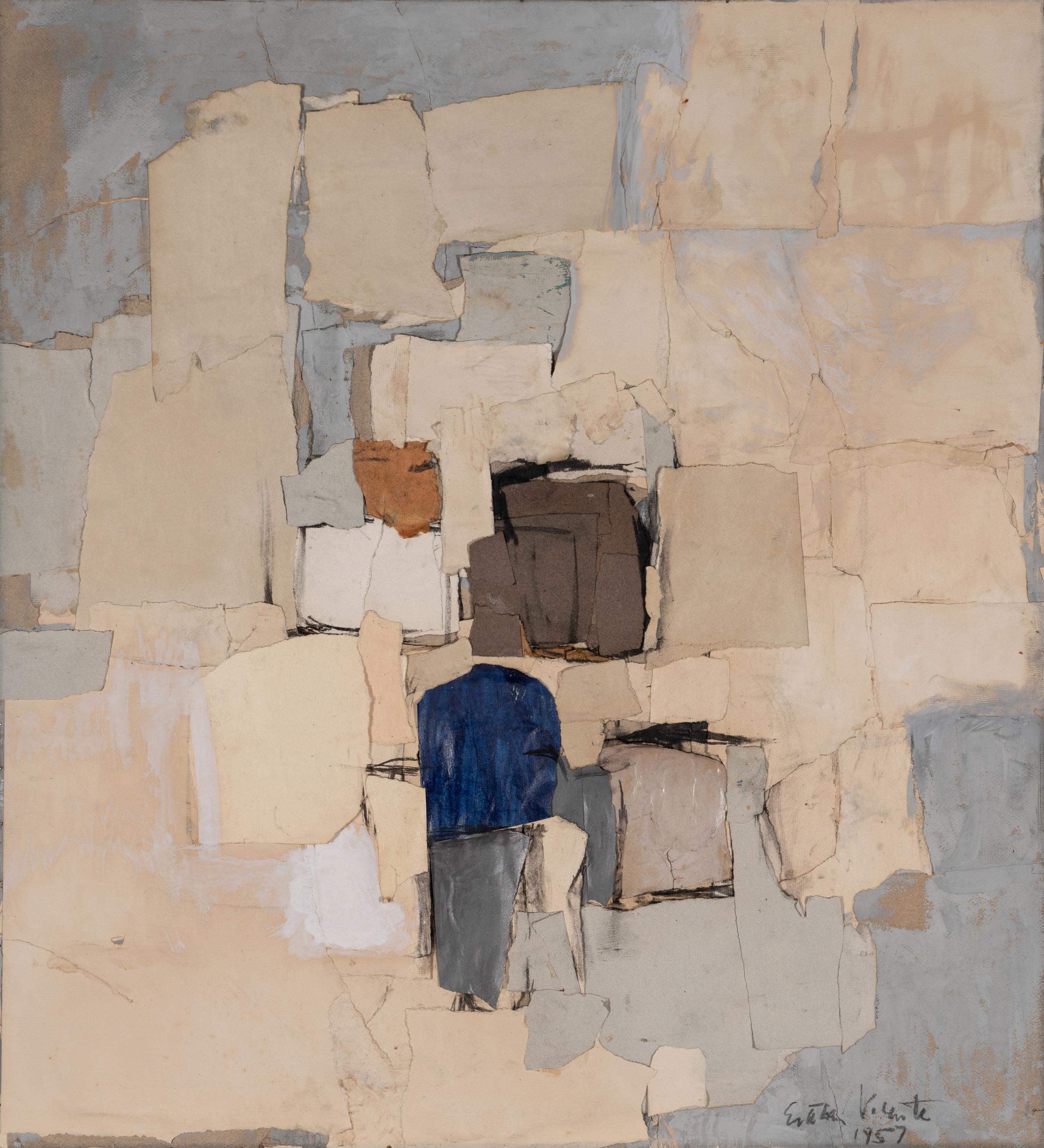
We are honored to offer two exceptional collage works by Vicente in this sale: Composition (1957), a cool-toned, contemplative jewel of subtle force; and Untitled (1957), its warmer counterpart, buzzing with soft tans, grays, and a touch of delicate blue. Though more modest in scale, each stands as a testament to Vicente’s sophisticated material sensitivity.
In the midst of Abstract Expressionism’s rise, Vicente stood shoulder-to-shoulder with some of its most notable figures. He was a core member of the New York School, counted among colleagues and friends such as Franz Kline, Jackson Pollock, Mark Rothko and Barnett Newman. A voting member of The Club and, for a time, a studio-mate of Willem de Kooning, Vicente moved within the center of postwar American art while maintaining a distinct voice.
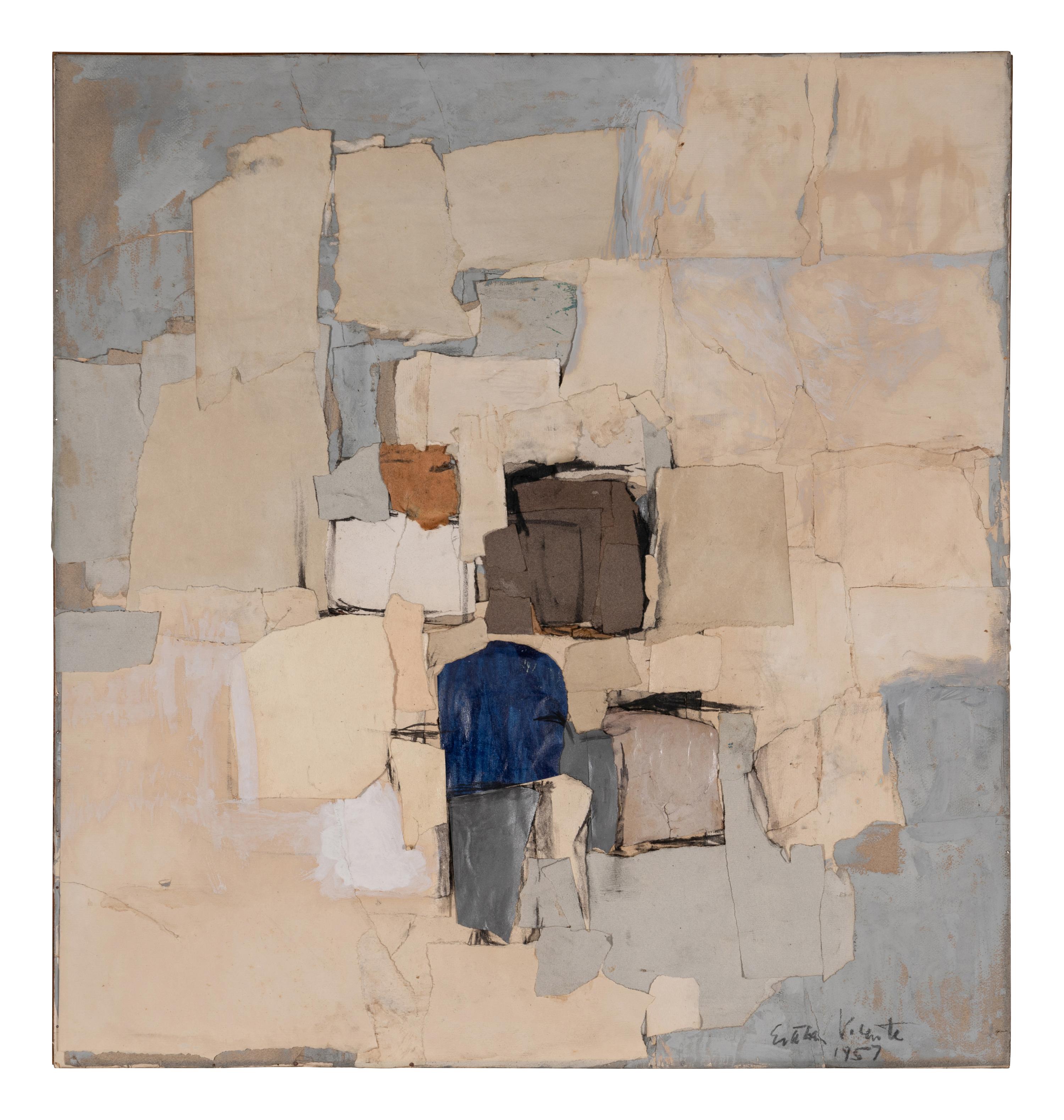
This individuality is realized in Composition (1957). In contrast to the gestural movement so often associated with Abstract Expressionism, Vicente arranges ripped paper fragments—layered with oil, charcoal and gouache—into a work that feels somewhat calculated and architectural. In a palette of ash, ivory and burnt umber, with a single pulse of deep ultramarine anchoring the lower half, the surface evokes a weathered wall or remembered landscape.
The work comes from the highly esteemed collection of Lydia Winston Malbin (1897-1989), a visionary collector best known for her engagement with the Italian Futurists. Her holdings, however, extended far beyond a single movement, encompassing artists whose practices reshaped modernism across the Atlantic, and her acquisition of Vicente’s collage places him firmly within that narrative. She acquired Composition from the acclaimed Rose Fried Gallery in New York in early 1958, a leading venue for avant-garde abstraction. Winston Malbin maintained a long-standing relationship with Fried and built much of her collection through the gallery. “Rose helped me understand 20th Century abstract art and took a great interest in her artists,” said Winston Malbin of Fried’s meaningful influence on her collecting practice and how intently the gallerist cared about her roster.
Like Composition, Untitled also created in 1957 shares Vicente’s language of torn planes and quiet balance but with a softened palette, providing a thoughtful counterpoint. A depth of tan dominates the surface, layered with ashen grays and soft blues. Where Composition leans cool, Untitled elicits warmth. Together, the two works operate as tonal variations. As Vicente said himself, “any one of my paintings is part of a sequence, part of a total…Each painting is solved in its own way, yet the continuation, the process, envelops all of them.”1
Untitled, comes from an equally distinguished American lineage. First handled by Leo Castelli Gallery in New York, it later entered the collection of Chicago dealer and collector Bud C. Holland, passing by descent to the present owner. Its trajectory speaks to the enduring resonance of Vicente’s practice within both private and institutional circles.
Bibliography:
1. Esteban Vicente, “Painting Should Be Poor,” Location (1964), reprinted in Esteban Vicente, Pinturas y Collages 1925-1985 (Madrid: Fundacion Banco Exterior, 1987), 167.
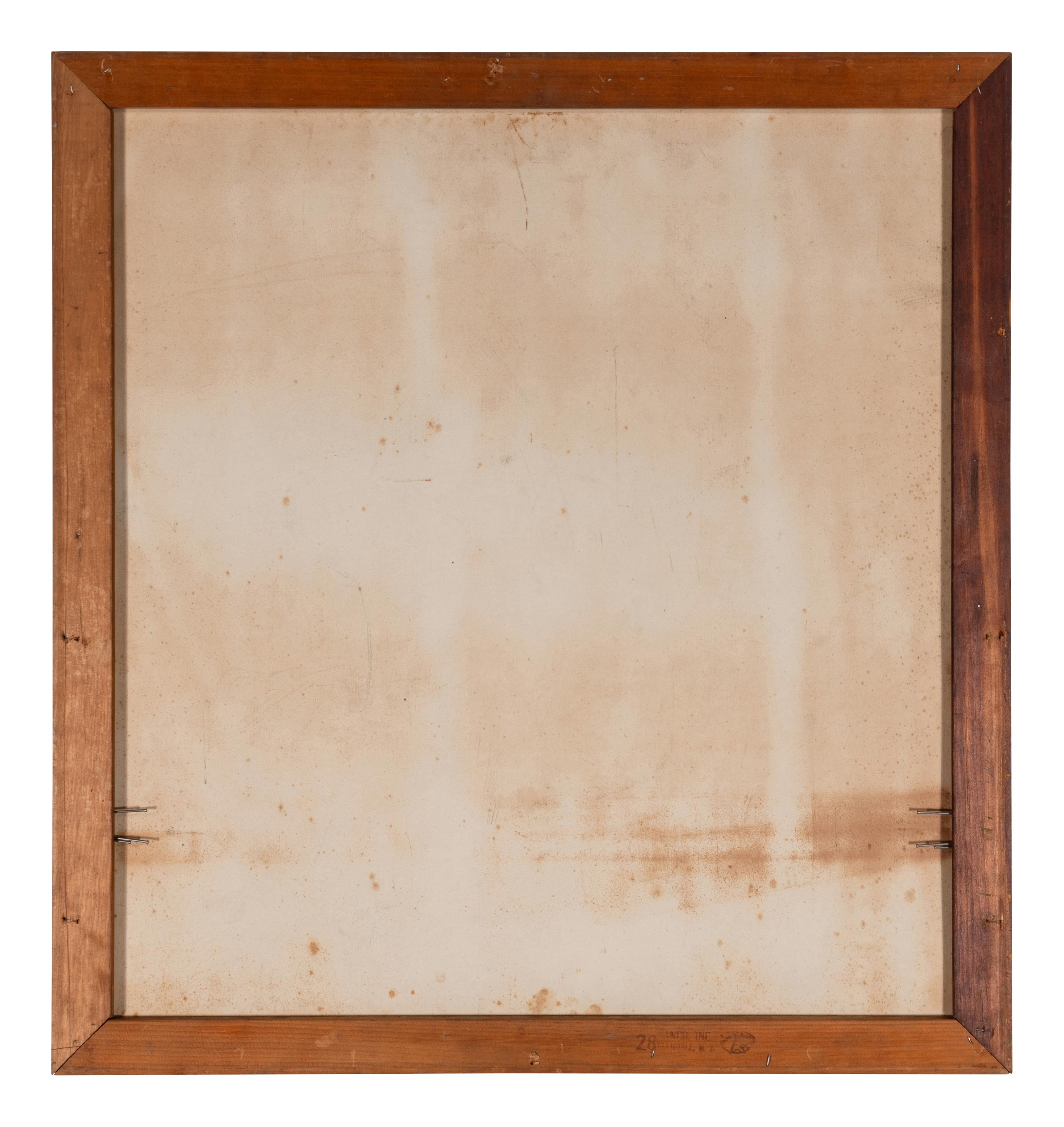
Framed: 31 1/4 x 29 1/4 inches.
The physical condition of lots in our auctions can vary due to age, normal wear and tear, previous damage, and restoration/repair. All lots are sold "AS IS," in the condition they are in at the time of the auction, and we and the seller make no representation or warranty and assume no liability of any kind as to a lot's condition. Any reference to condition in a catalogue description or a condition report shall not amount to a full accounting of condition. Condition reports prepared by Freeman's staff are provided as a convenience and may be requested from the Department prior to bidding.
The absence of a posted condition report on the Freeman's website or in our catalogues should not be interpreted as commentary on an item's condition. Prospective buyers are responsible for inspecting a lot or sending their agent or conservator to inspect the lot on their behalf, and for ensuring that they have requested, received and understood any condition report provided by Freeman's.
Please email [email protected] for any additional information or questions you may have regarding this lot.