Sale 6329
| New York
| New York
Estimate$50,000 – $70,000
We are grateful for the research conducted by Susan Weininger, Professor Emerita, Roosevelt University.
Provenance:
The Artist
Acquired from the above by a Private Collector, Chicago
Thence by descent to the present owner
Lot essay:
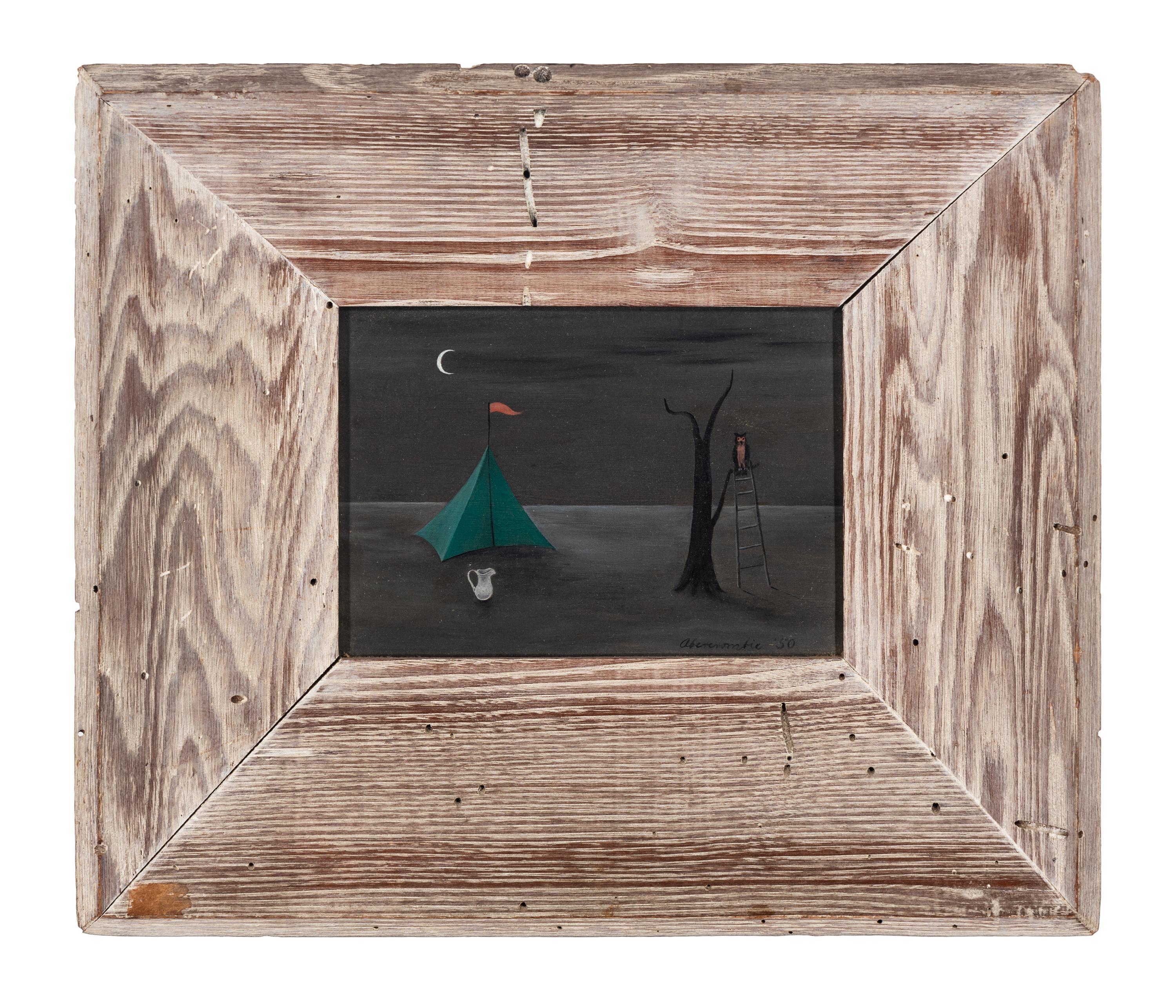
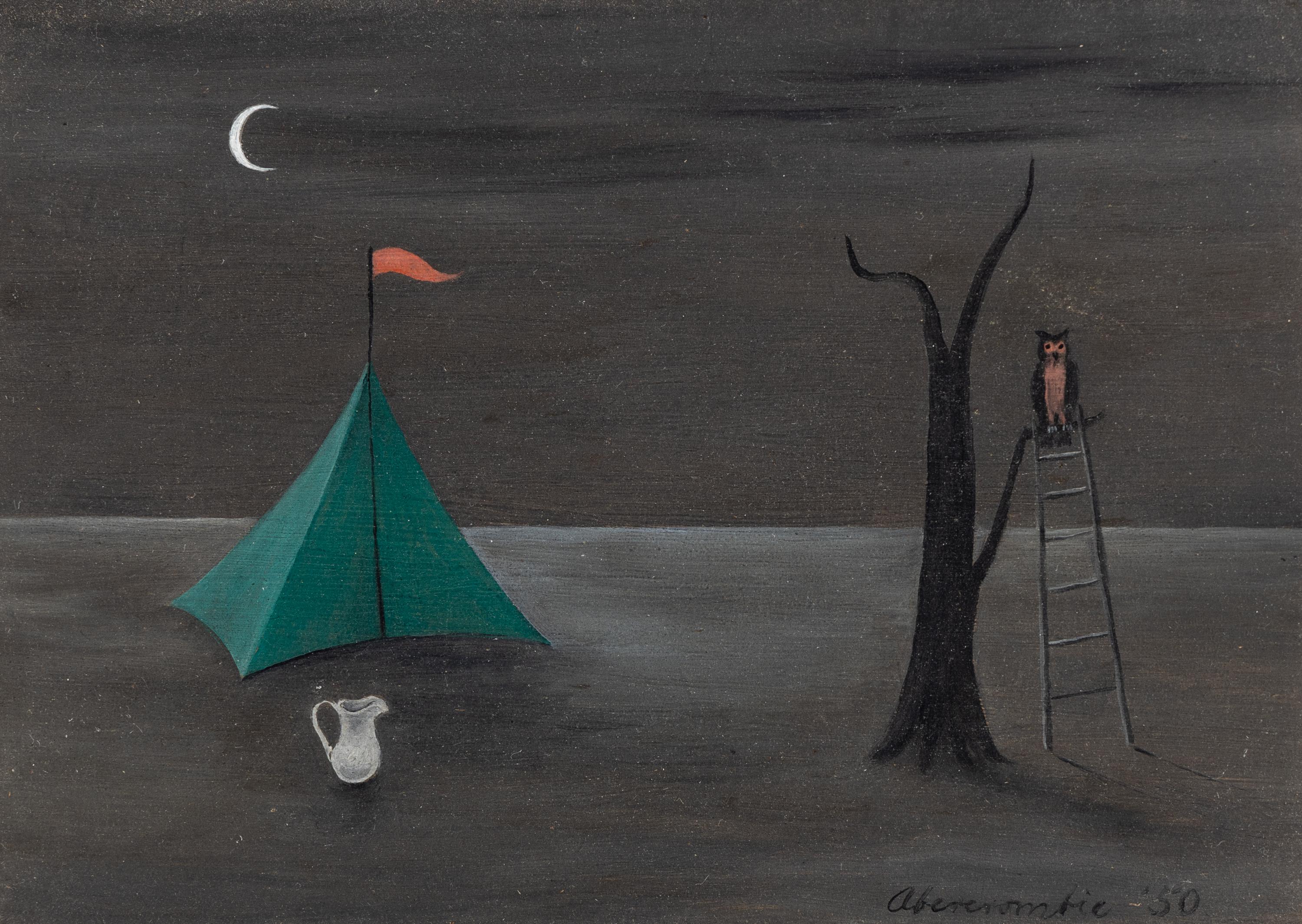
Set for the Night shows a lunar landscape replete with objects frequently used by Gertrude Abercrombie in her works. It includes a tent flying a pink flag, a leafless tree with an owl on a branch it has reached by ascending a ladder, a white stoneware pitcher in front of the tent, and a crescent moon in the sky. Insight into the meaning of the tent can be gained from a work called Between Two Camps (Illinois State Museum, Springfield), a larger work painted in 1948, the year tents began to appear in her work. This painting was explained by Abercrombie as a reference to her divorce from her first husband Bob Livingston and marriage to Frank Sandiford, both of which occurred in 1948. Between Two Camps includes a small red tent topped by a drooping white pennant of surrender on the left side of the composition, which contrasts with a solid white staircase on the right; attached to the staircase is a small black half tent. Abercrombie is depicted standing at the top of the staircase waving a triumphant pink pennant. The tent represents, like the interiors she painted so frequently, a kind of enclosure, a space that is inaccessible, impenetrable, and often empty. The tent is less solid but is clearly a parallel to the rooms that are metaphorical self-portraits. Her former marriage is represented by a temporary dwelling while the staircase symbolizing her new marriage appears to have a more solid foundation, yet is still insecure, the stairs leading nowhere except to a perilous drop to oblivion; the small tent attached to the stairs is another precarious structure. While the tent in Set for the Night does not have an explicit connection to Abercrombie’s divorce and remarriage, it represents a temporary and ephemeral refuge, undependable, and subject to the whims of nature.
While tents in other paintings from this period are a bit more open and welcoming, the tent in Set for the Night is closed and inaccessible. The owl, a reliable visual surrogate for Abercrombie, stands watch in the leafless tree, attesting to her presence, while the artist’s white vase, seen in innumerable paintings serving a variety of roles, is another indicator that she is there. If the identification with the artist is not clear enough, the owl has a pink chest (a color Abercrombie began to use when her daughter requested a pink picture) and anatomy that suggests a human female, characteristic of the artist’s owls. Although it is not clear why an owl would need a ladder to access a tree when flying would be considerably easier, Abercrombie did use this device at least once in a slightly earlier painting called Owl About to Climb a Ladder (1945, Private Collection) in which the owl stands on the ground before a ladder leading up to a tabletop. In both cases, the mystery and humor characteristic Abercrombie are present. Although the tent is tightly closed, and her surrogate watches outside from the tree for protection, the pitcher, a source of sustenance, lies outside the tent and suggests its occupant may not have all she needs to survive.
Like most of her work, the painting is composed so that it radiates calm and peace. The tent, placed in the left center, and the tree and owl in the right foreground, connect on a diagonal axis. The pink of the owl and the pink pennant on the tent resonate with each other as do the white of the pitcher sitting in front of the tent and the moon above, another personal emblem used frequently by Abercrombie. All of this creates a balance both on the surface and in space. Despite the overall serenity of the image, there is a mysterious and enigmatic quality that pervades the painting, part of the magnetic pull of the artist’s work. The question of whether the tent is a secure haven, or a prison, keeps the viewer guessing, deepening and complicating the meaning of this seemingly simple composition.
Framed: 10 1/2 x 12 1/2 x 2 1/2 inches.
The physical condition of lots in our auctions can vary due to age, normal wear and tear, previous damage, and restoration/repair. All lots are sold "AS IS," in the condition they are in at the time of the auction, and we and the seller make no representation or warranty and assume no liability of any kind as to a lot's condition. Any reference to condition in a catalogue description or a condition report shall not amount to a full accounting of condition. Condition reports prepared by Freeman's staff are provided as a convenience and may be requested from the Department prior to bidding.
The absence of a posted condition report on the Freeman's website or in our catalogues should not be interpreted as commentary on an item's condition. Prospective buyers are responsible for inspecting a lot or sending their agent or conservator to inspect the lot on their behalf, and for ensuring that they have requested, received and understood any condition report provided by Freeman's.
Please email [email protected] for any additional information or questions you may have regarding this lot.