Sale 6342
| Philadelphia
| Philadelphia
Estimate$120,000 – $180,000
The lot is accompanied by an attestation d'inclusion signed by Alec Wildenstein in 1998, confirming the work will be included in the forthcoming Supplément to the Redon Catalogue Raisonné currently being prepared under the sponsorship of the Wildenstein Institute. In 2007, another letter confirming the inclusion.
Provenance:
Christie's Amsterdam, sale of December 1, 1998, lot 229.
Acquired directly from the above sale.
Private Collection.
Sotheby's New York, sale of November 11, 1999, lot 233.
Acquired directly from the above sale.
Private Collection.
Christie's New York, sale of May 10, 2007, lot 259 (as Profil de Lumière).
Acquired directly from the above sale by the present owner.
Lot Essay:
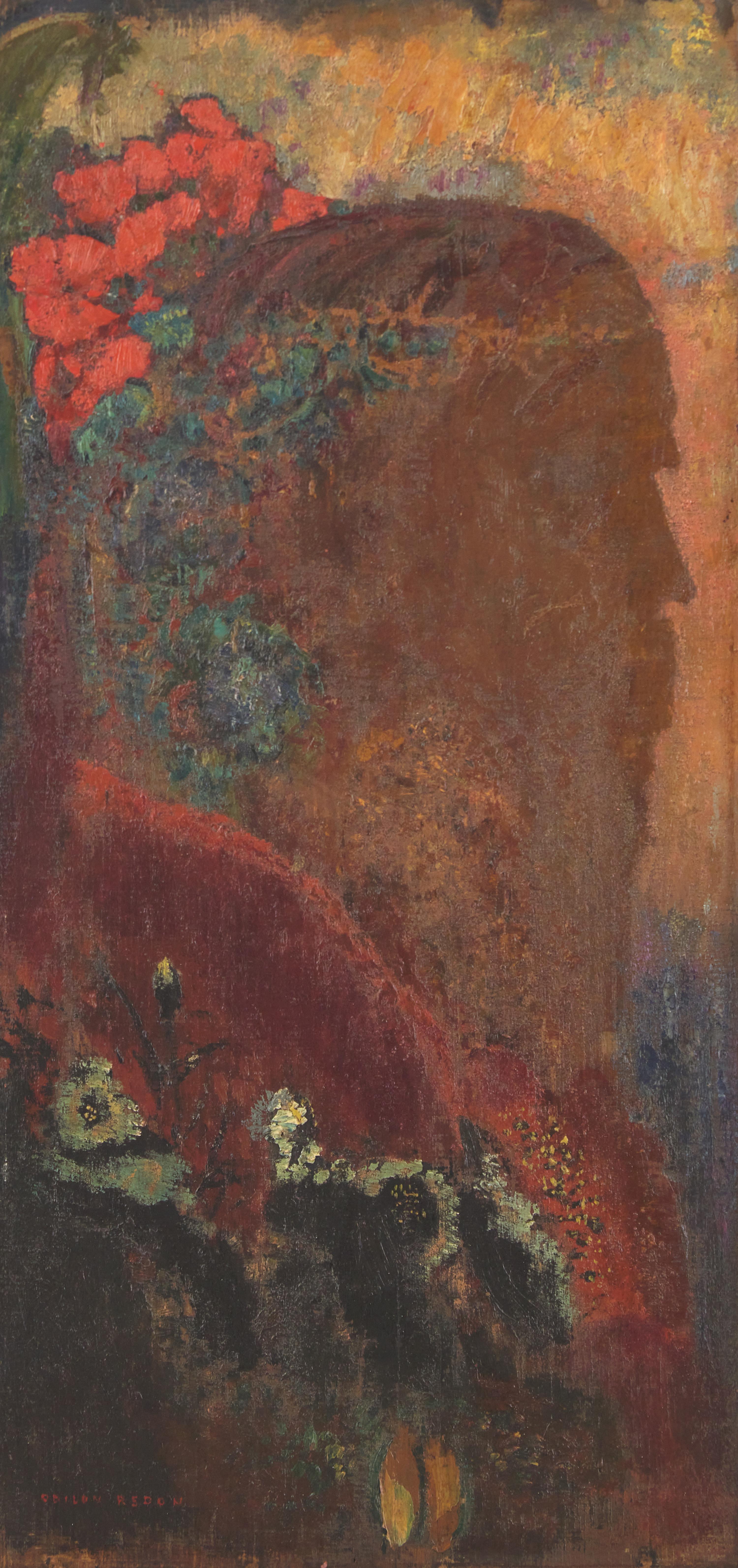
Executed at the height of Odilon Redon’s mature period, Profil d’Ombre Parmi les Fleurs exemplifies the artist’s remarkable transition from the monochromatic world of his early Noirs to the luminous, color-saturated compositions that would define his later style. Around the 1890s, Redon indeed began to move away from the somber charcoal drawings through which he had long explored themes of inner torment and existential anxiety, to slowly embrace color. Initially delicate and vaporous in his early pastels, it soon became more vivid, emotional, and essential to his visual language in oil. By the turn of the 20th century, Redon had fully embraced color as both a medium and a metaphor for his otherworldly thoughts.
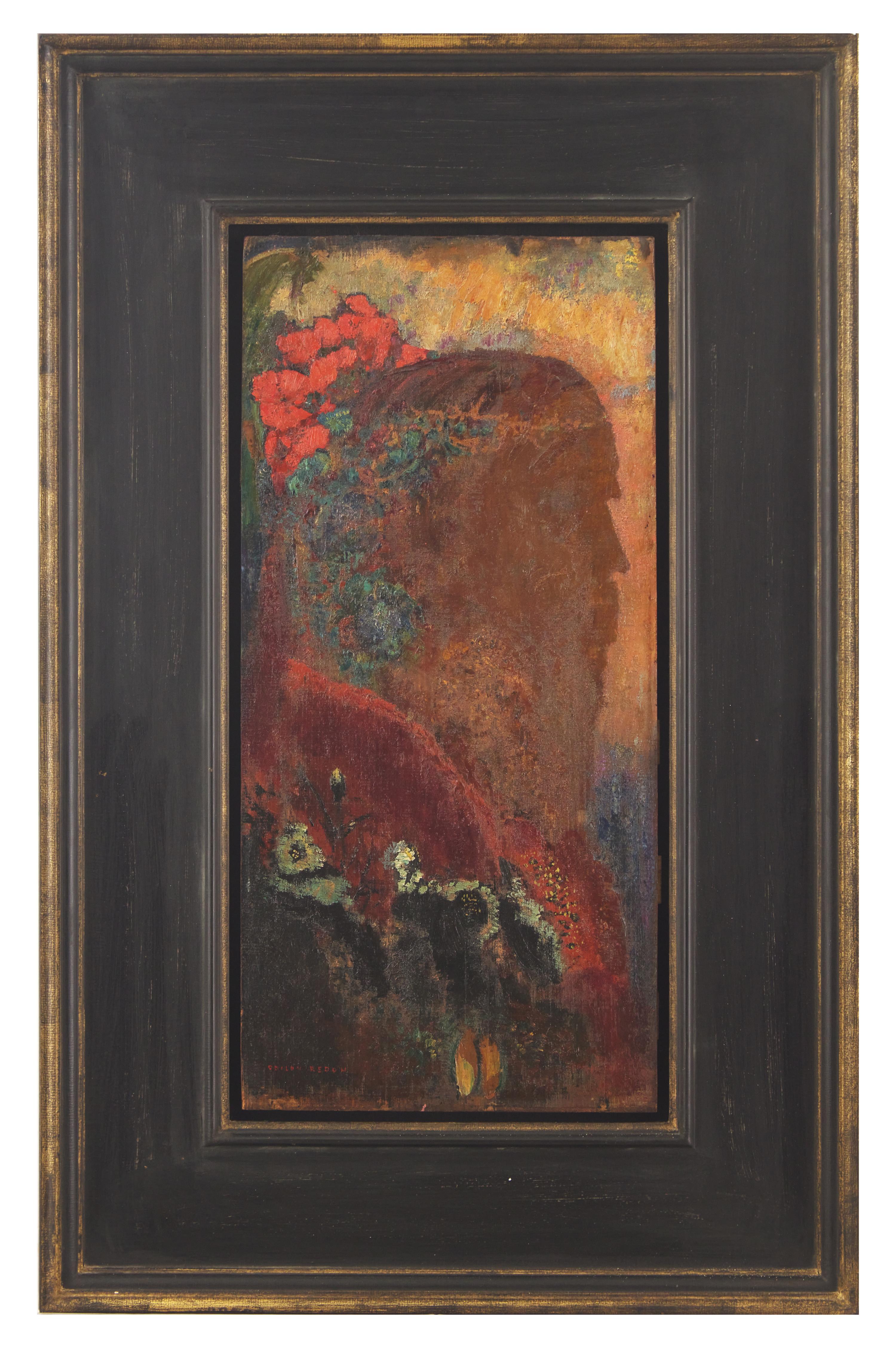
Started in 1908 and finished at the onset of WWI, Profil d’Ombre Parmi les Fleurs, encapsulates this profound shift. At its center is a dark, enigmatic male profile rendered in a featureless and austere silhouette turned away from the viewer. This retreat from direct gaze is characteristic of Redon’s fascination with the profile portrait, a motif he explored extensively throughout the 1900s. For Redon, the profile offered a way to convey introspection and restraint, avoiding the emotional exposure traditionally associated with frontal depictions. A modest painter himself, Redon favored profile views (especially left-facing ones) to conceal the eyes, those classic mirrors of the soul. In turning away, the present figure creates distance and excludes us from his inner thoughts. The absence of modeling or detailing intensifies this effect: the man is not an individual, but a mere shadow as the title suggests.
As in many of his most evocative portraits, Redon here pairs the shadowed profile with a profusion of flowers, which float across the fiery background like organic, otherworldly forms. These floral elements—which resemble aquatic flora and therefore also speak to the artist’s fascination with the submarine world— are far from decorative. Instead, they play an important symbolic role, embodying Redon’s unique synthesis of dream and reality, life and rêverie. They surround the figure as if they had come out of his imagination, forming a protective aura, which reinforces the sense of introspection and detachment that defines the composition. Above all, the flowers reflect Redon’s masterful exploration of color. Rendered not as botanical specimens but as radiant swaths of pigment, they dissolve into luminous color fields and shadowy textures. This abstraction flattens the pictorial space, aligning the work with the synthetist ideals of the Nabis, who similarly sought to free painting from naturalistic representation. The result is a dreamlike, floating vision—one in which color, form, and spirit intermingle, evoking a state of suspended meditation.
Though not a portrait in the conventional sense, Profil d’Ombre Parmi les Fleurs acts as an allegory of the human soul and as such carries a deep esoteric gravitas. The closed eyes and the severe expression of the figure, paired with the almost religious quality of the work transform the titular shadow into a symbol—part prophet, part visionary who, as Homer, sees with his eyes shut. The work acts as an invitation to reflect and drift into the artist’s symbolic, metaphysical space. As such, it stands as one of Redon’s most poignant and spiritual works: an icon of interiority produced by a man whose life, according to Alec Wildenstein, “unfolded essentially within himself.”
It is no surprise to find such a powerful work in the collection of Dr. Hagelin. A world-renowned physicist, educator, author, and leading proponent of peace, Dr. Hagelin indeed has spent much of the past two decades leading a scientific investigation into the nature and origin of consciousness, dubbing him a leading authority on the effects of meditation on brain development. President Emeritus of Maharishi International University, and the International President of the Global Union of Scientists for Peace (GUSP.org), he also is known for putting forward the most successful “Theory of Everything” as featured on the cover of Discover Magazine.
In overall very good condition, with a shiny finish. With slight wear to the edges of the panel and two tiny holes at the top left corner, all of which may be intrinsic to the panel itself. With a very rich and textured impasto throughout, causing some hairline craquelure at times (see upper left and upper right, for example). We notice several losses, at bottom center along the white flowers at center, at center left (corresponding to the character's ear) as well as minor localized pinpoint areas in the red blooms at upper left. Examination under UV light reveals a layer of old greenish varnish throughout, and a small repaired crack at upper center right, on the figure's forehead. All the other purplish areas correspond to zones where the panel is bare or to the aforementioned areas of losses. Additional images available upon request.
The physical condition of lots in our auctions can vary due to age, normal wear and tear, previous damage, and restoration/repair. All lots are sold "AS IS," in the condition they are in at the time of the auction, and we and the seller make no representation or warranty and assume no liability of any kind as to a lot's condition. Any reference to condition in a catalogue description or a condition report shall not amount to a full accounting of condition. Condition reports prepared by Freeman's staff are provided as a convenience and may be requested from the Department prior to bidding.
The absence of a posted condition report on the Freeman's website or in our catalogues should not be interpreted as commentary on an item's condition. Prospective buyers are responsible for inspecting a lot or sending their agent or conservator to inspect the lot on their behalf, and for ensuring that they have requested, received and understood any condition report provided by Freeman's.
Please email [email protected] for any additional information or questions you may have regarding this lot.