Sale 6342
| Philadelphia
| Philadelphia
Estimate$20,000 – $30,000
Artist Biography:
Born in Tiblisi, Georgia, then part of the Russian Empire, Olga Sacharoff was a significant figure in the artistic avant-garde in Europe in the first half of the 20th century. She first studied at the Tbilisi State Academy of Art, then moved to Munich to continue her studies. It is probable that Sacharoff was in Munich by 1911 and saw the first exhibition of the group Der Blaue Reiter, which included works by Wassily Kandinsky, Gabriele Münter, Franz Marc and August Macke. Also included was a selection of Henri Rousseau’s paintings, drawn from Kandinsky’s personal collection. Kandinsky venerated Rousseau’s art, whose work he described as an expression of “the highest simplicity,” as the father of “the highest realism,” and as “the root” of “a new reality.” Sacharoff was undoubtedly of the same opinion, as she strove for the rest of her career to be true to the “highest” lessons of Rousseau’s art. She borrowed his formalistic approach to the creation of space, the flawless rhythm of repeating lines of trees, and the communication of depth by means of a confident juxtaposition of planes.
By 1912, Sacharoff and her husband, the photographer and painter Otho Lloyd had settled in Paris. In 1912, she participated in the Salon d'Automne, as well as in other exhibitions such the Salon des Artistes Français, the Salon des Indépendants, and the Salon des Tuileries. During this time, she became friends with many influential artists, such as Pablo Picasso, Chana Orloff, Sonia Delaunay, Albert Gleizes, and Marie Vassilieff. Initially influenced by the art of Paul Cézanne, she gradually became interested in the Cubist construction of space, while also developing her representation of light, in particular the balance between light and objects.
The outbreak of the First World War caused Sacharoff and Lloyd to leave for Spain, eventually landing in Barcelona. There, she met the great Remedios Varo and soon became part of a web of illustrious women artists (including Maruja Mallo, Delhy Tejero and Norah Borges in Madrid as well as Ángeles Santos in Valladolid and María Blanchard in Paris) who would make their mark on the history of Spanish art. While in Spain, Sacharoff still held strong ties with the Paris avant-garde, participating in several exhibitions. From 1917 to 1924, the artist collaborated with Francis Picabia on the magazine 391, which is considered representative of Dadaism. Among the writers and artists that appeared in the four issues of the magazine were Guillaume Apollinaire and Marie Laurencin, who strongly inspired Sacharoff.
At the onset of the Second World War, the artist stayed in Barcelona, where she was to remain for the rest of her life. The Galería Syra in Barcelona mounted exhibitions of her work in 1950 and 1955, and in February 1960, she was the focus of a solo show organized by the Dirección General de Bellas Artes and on view in the department's exhibition hall in Madrid. She was awarded the Medalla d'or de Barcelona in 1964, an honor that established her connection to Spain and commemorated her contribution to Catalan culture.
Her work is included in the Museu Nacional d’Art de Catalunya, Barcelona, and the Museo de Art Noveau y Art Decó, Salamanca.
Lot Essay:
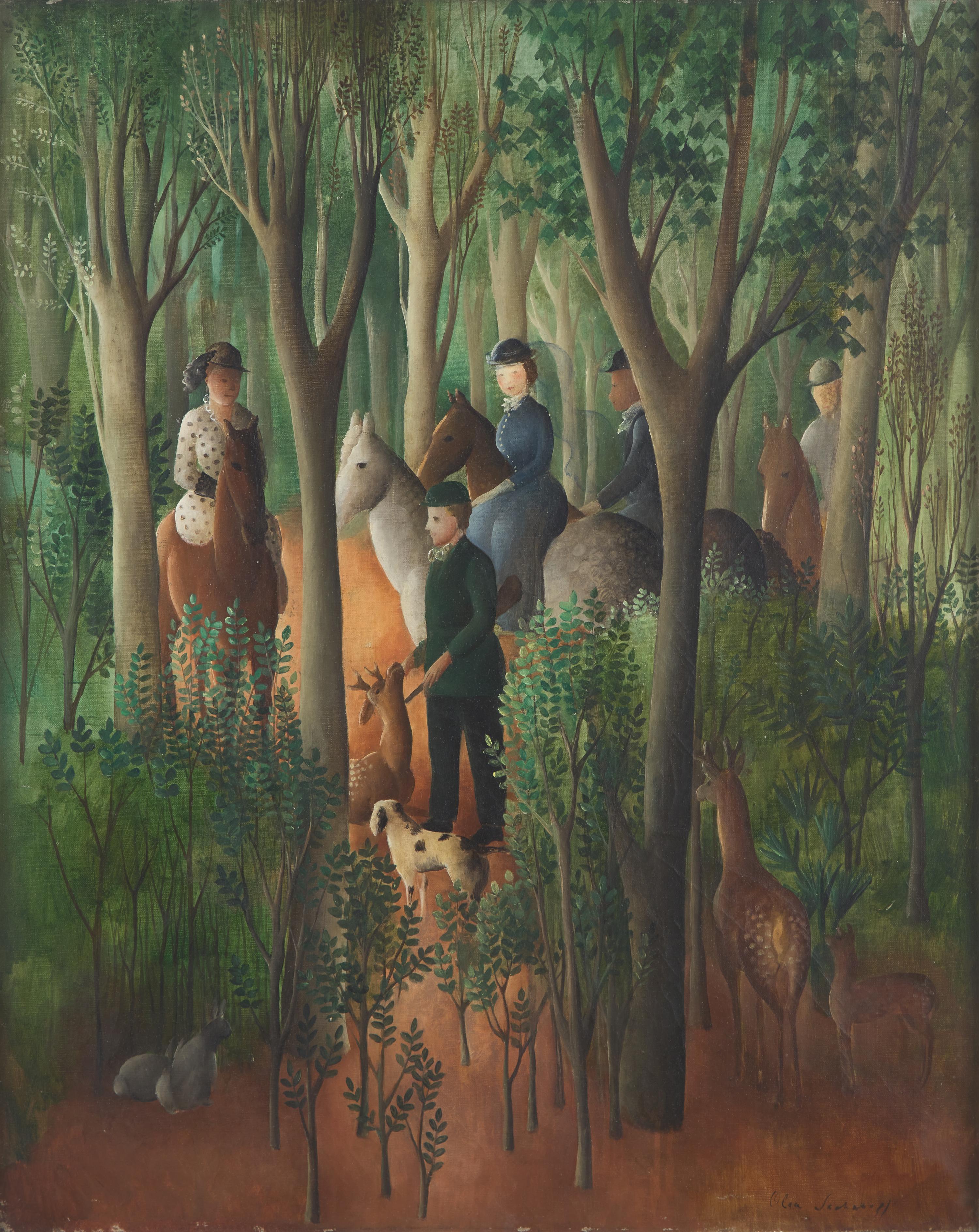
Characterized by rounded forms and an overall sculptural treatment of volumes, La Chasse exemplifies Sacharoff’s mature style of the 1920s - a period during which her work aligned with the aesthetic sensibilities of Parisian cubist circles.
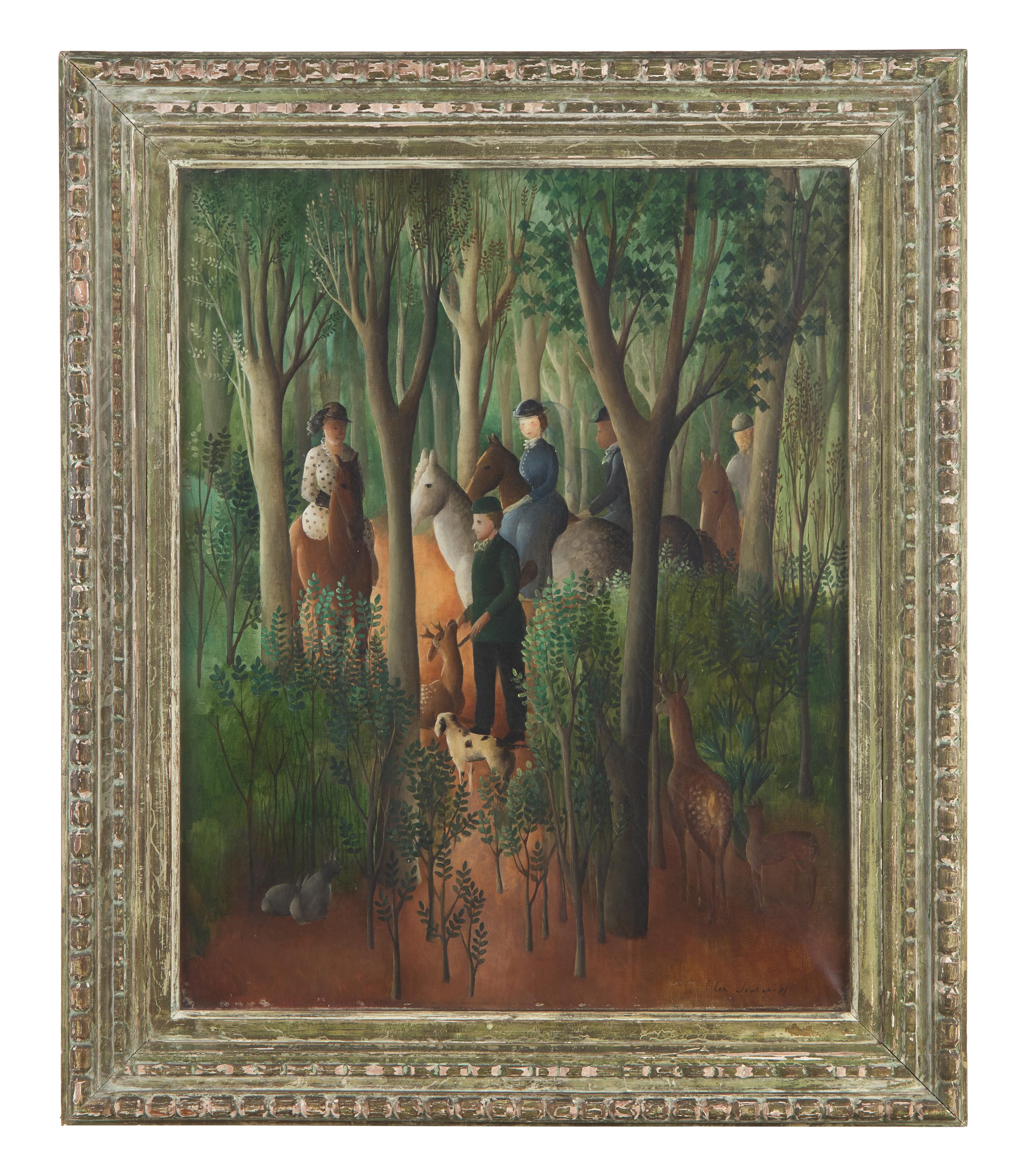
Set within a dense, verdant forest, the scene captures a curious moment: a group of elegant, formally dressed riders on horseback gathered around a solitary hunter accompanied by his dogs. The forest teems with life: deer emerge softly from the underbrush, birds perch unusually low, and the warm red-brown of the soil contrasts vividly with the enveloping sea of greens. The viewer is drawn into the composition almost involuntarily, caught in the steady gaze of both animals and humans. With no visible sky and no apparent exit, the spectator feels enclosed, as if the forest has swallowed them whole. This claustrophobic sensation is heightened by the verticality of the trees, the layered positioning of figures, and the subdued interplay of light filtering through the foliage. A profound stillness is at play, balanced with an unsettling sense of surveillance, as if the viewer is both intruder and witness.
The painting’s surreal, dreamlike quality recalls the work of Le Douanier Rousseau—particularly in the stylized flora and theatrical composition. It also resonates with other works Sacharoff produced during this period, in which the forest becomes the scene of everyday activities: a stroll in La Promenade (1923, Museum de Fundatie, Zwolle, Netherlands), a wedding venue in Le Marriage (1919–1923, Museu Nacional d’Art de Catalunya, Barcelona), or a photo studio in Les Jeunes Mariés (1929, Museu Nacional d’Art de Catalunya, Barcelona). In some respects, the painting even anticipates the perceptual play found in Henri Matisse’s Le Blanc Seing (1965), with its veiled tension between what is seen, hidden, and imagined. Here too, the forest is more than a setting—it is a psychological landscape, a space of ambiguity, ritual, and quiet unease.
It is no surprise that La Chasse belonged to Helen Scott and her husband, Robert Montgomery Scott. During his tenure as President of the Philadelphia Museum of Art (1982-1996), Scott worked tirelessly to grow its collection, specifically Surrealist and Dadaist works. He was also responsible for notable exhibitions, including a major show of great French paintings from the Barnes Foundation in 1995, as well as a Cézanne retrospective the following year.
Framed: 40 x 34 x 2 inches.
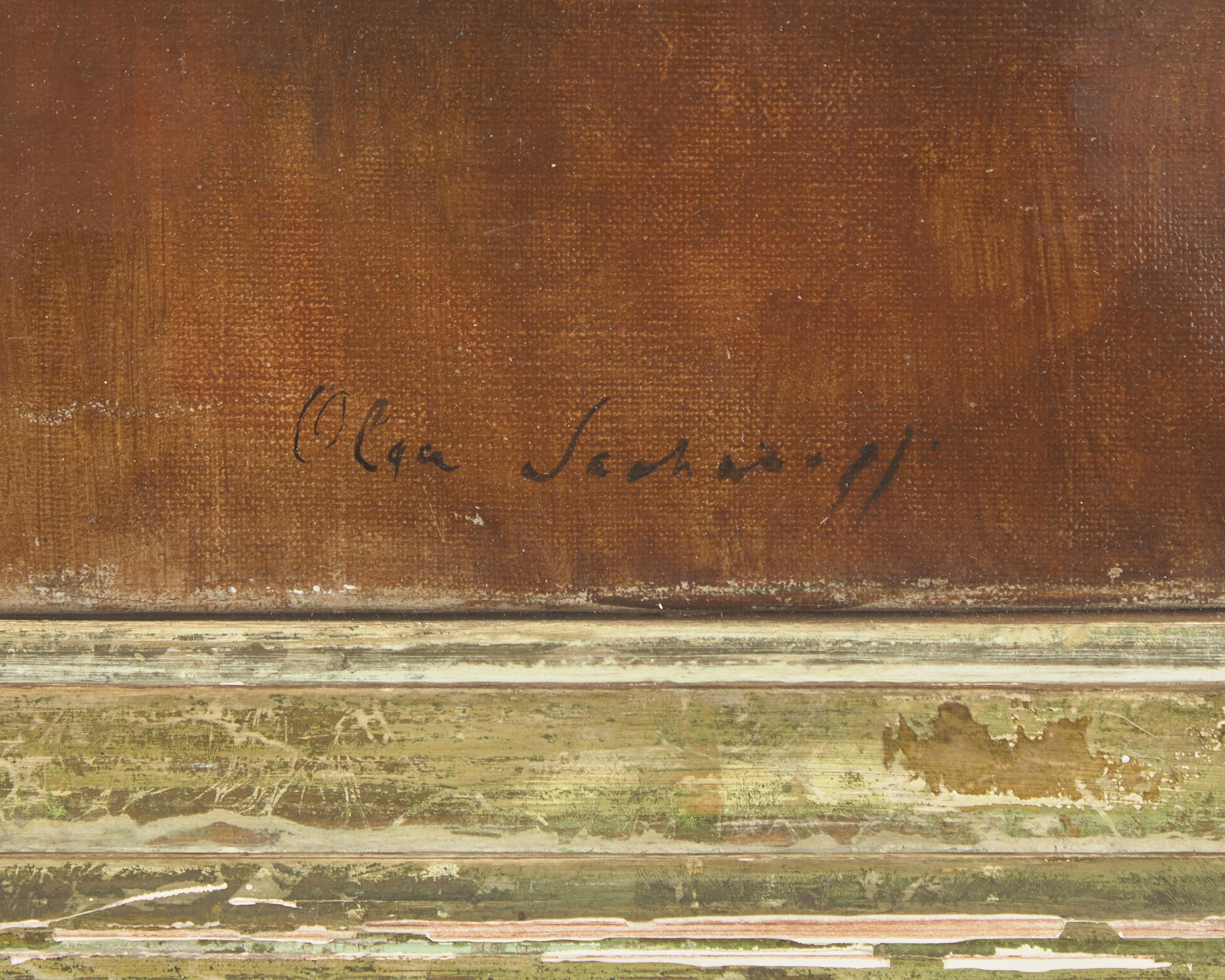
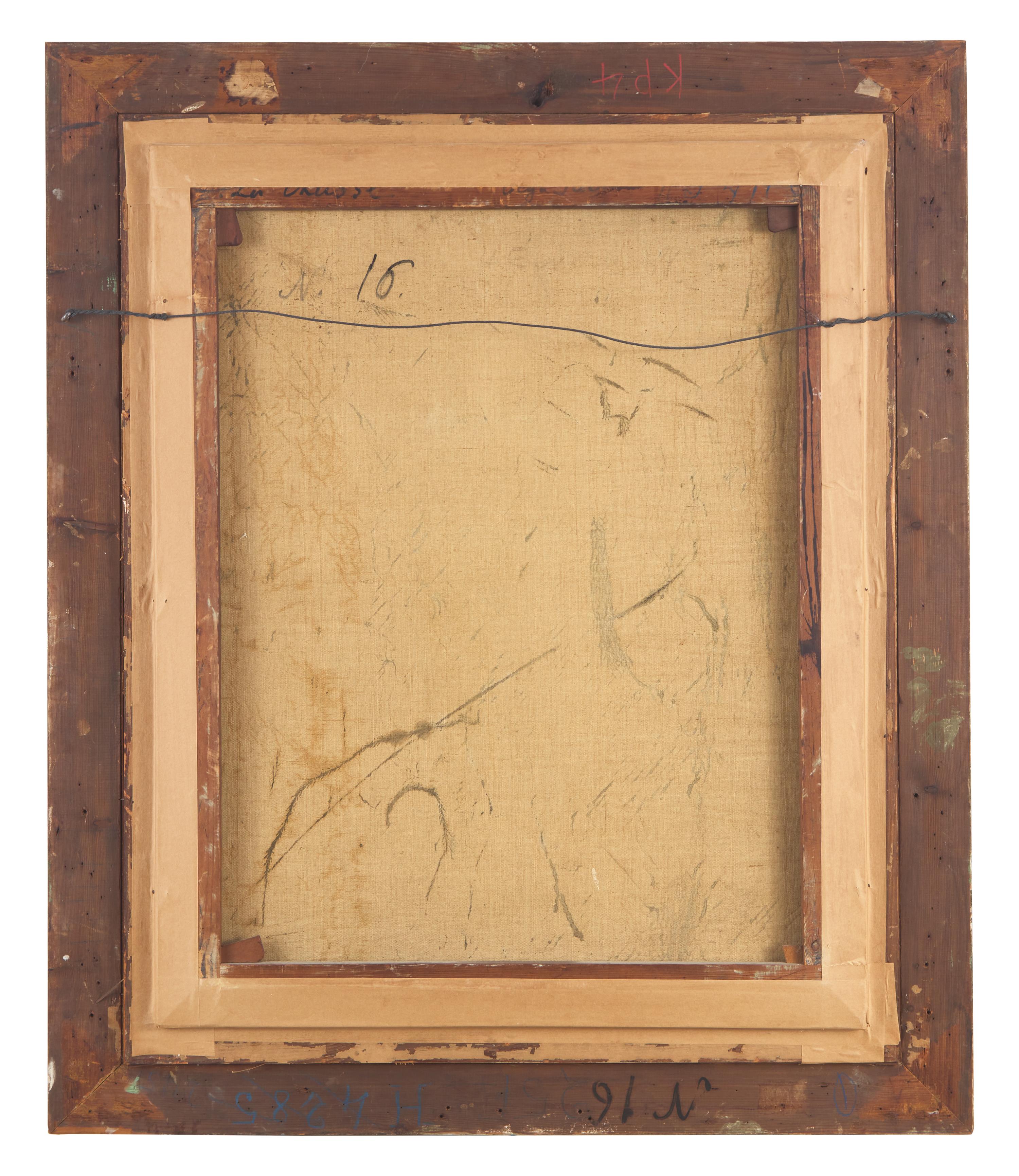
Please note the painting is framed under glass and was not unframed for the completion of the present condition report. The unlined canvas is in overall very good condition. It shows some light craquelure and there are small areas of surface loss at the top and bottom edges, presumably from the framing, areas are no larger than 1/2 in. at largest. There are a few other tiny surface losses, for instance at the top left in the trees, in the left side horse, at the center figure's shoulder and in the trees at bottom right. There is no evidence of inpainting under UV light. See Specialist's photos for more details.
The physical condition of lots in our auctions can vary due to age, normal wear and tear, previous damage, and restoration/repair. All lots are sold "AS IS," in the condition they are in at the time of the auction, and we and the seller make no representation or warranty and assume no liability of any kind as to a lot's condition. Any reference to condition in a catalogue description or a condition report shall not amount to a full accounting of condition. Condition reports prepared by Freeman's staff are provided as a convenience and may be requested from the Department prior to bidding.
The absence of a posted condition report on the Freeman's website or in our catalogues should not be interpreted as commentary on an item's condition. Prospective buyers are responsible for inspecting a lot or sending their agent or conservator to inspect the lot on their behalf, and for ensuring that they have requested, received and understood any condition report provided by Freeman's.
Please email [email protected] for any additional information or questions you may have regarding this lot.