To request further details about this lot, please email [email protected]

Jacob Coley
Senior Vice President, Head of Department, Antiquities and Ancient Art
Sale 6344
| Chicago
| Chicago
To request further details about this lot, please email [email protected]
Jacob Coley
Senior Vice President, Head of Department, Antiquities and Ancient Art
Estimate$60,000 – $80,000
Provenance:
Private Collection, Europe, 18th Century. [based on restoration technique]
Art Market, Rome, by 1934.
Galerie Altmann Antiquité, Nice, France.
Sotheby's, New York, Egyptian, Classical, and Western Asiatic Antiquities, 5 June 2013, Lot 39.
Phoenix Ancient Art, New York, 2016 (Phoenix Ancient Art, vol. 32, p. 46, no. 12).
Sotheby's, London, Ancient Sculpture and Works of Art, 4 December 2018, Lot 31.
Acquired by the present owner from the above.
Published:
For 'Rome's Photograph Library Record' (neg. no. 34.1677) at the Deutsches Archäologisches Instituts, see Arachne Online Database: 1104914
[https://arachne.dainst.org/entity/1104914?fl=20]
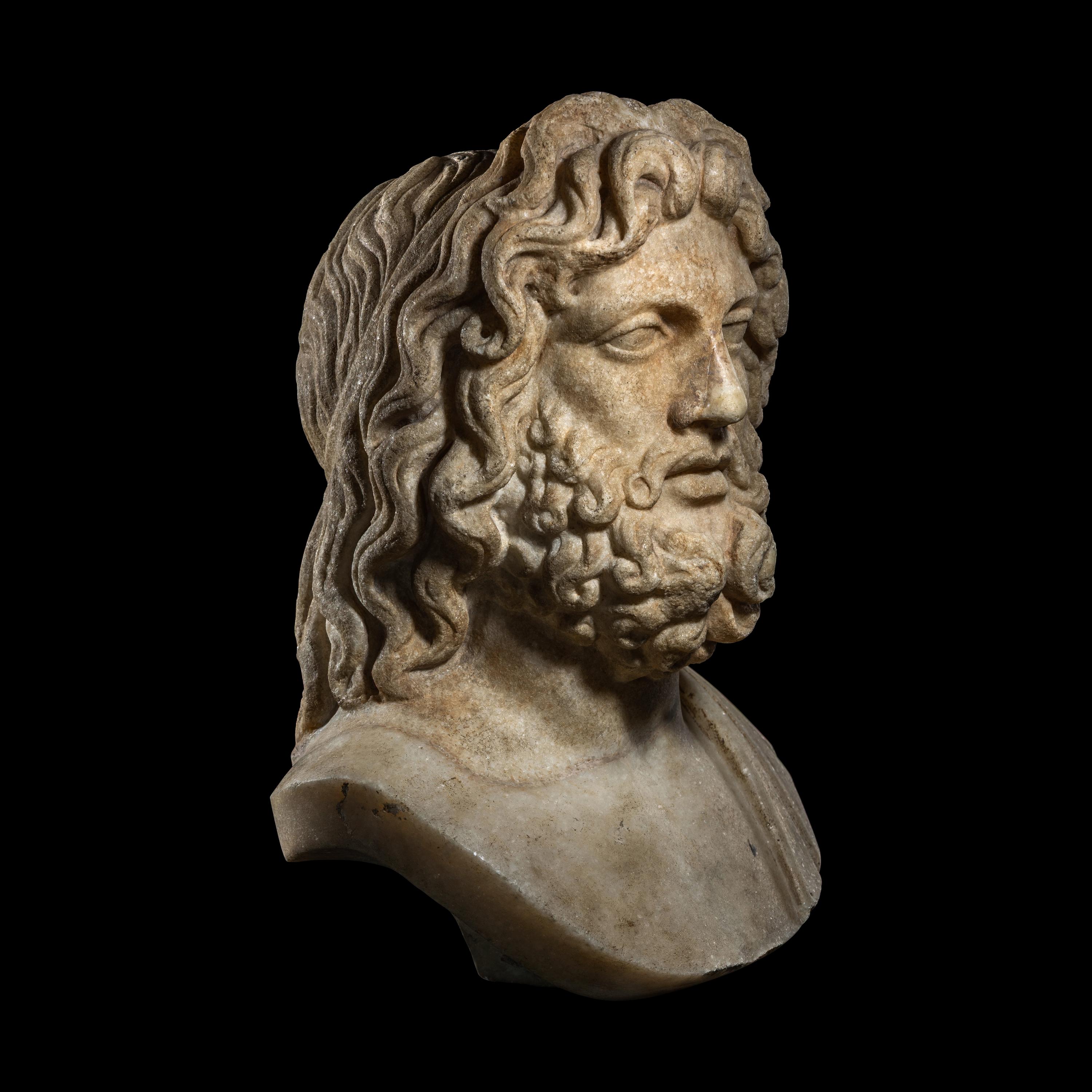
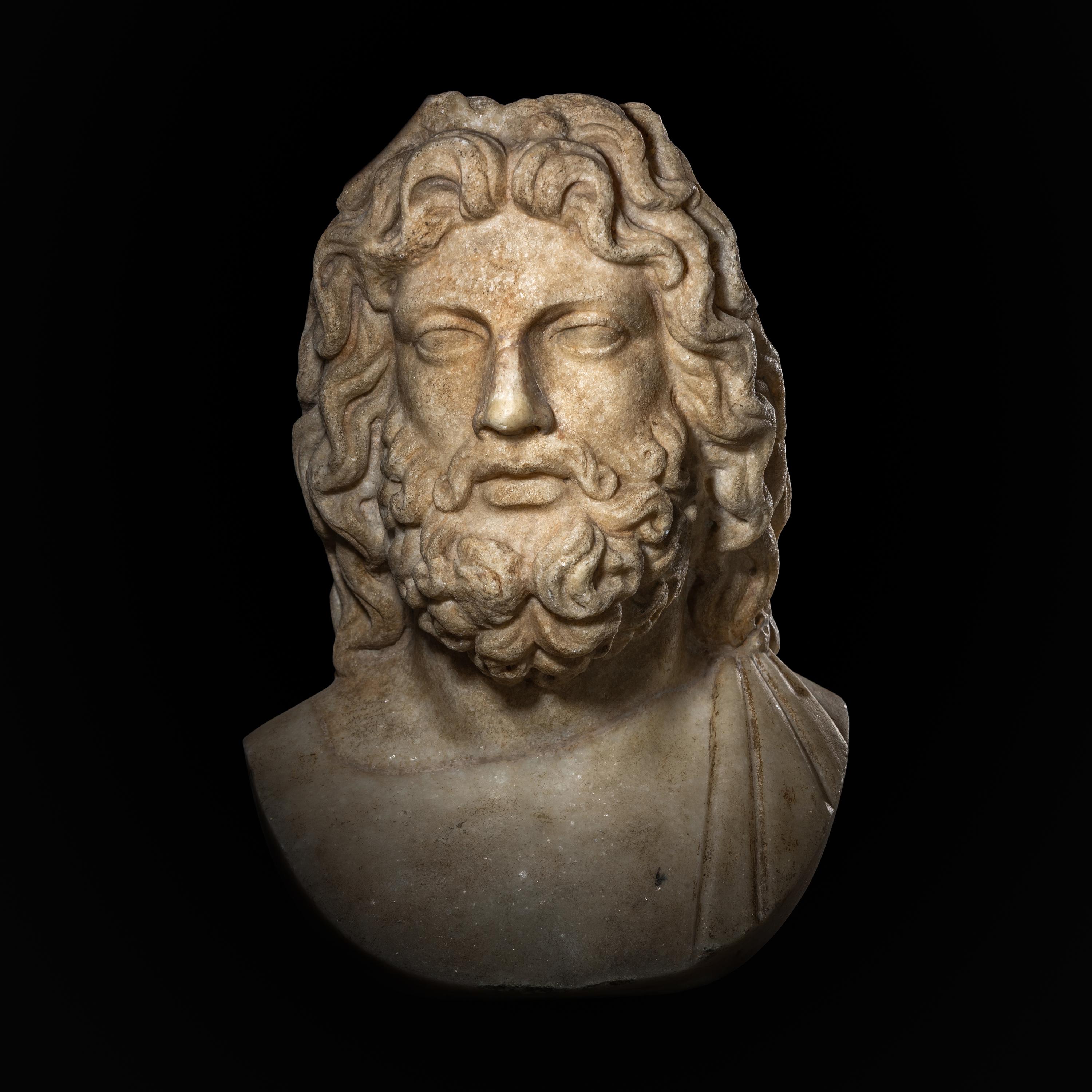
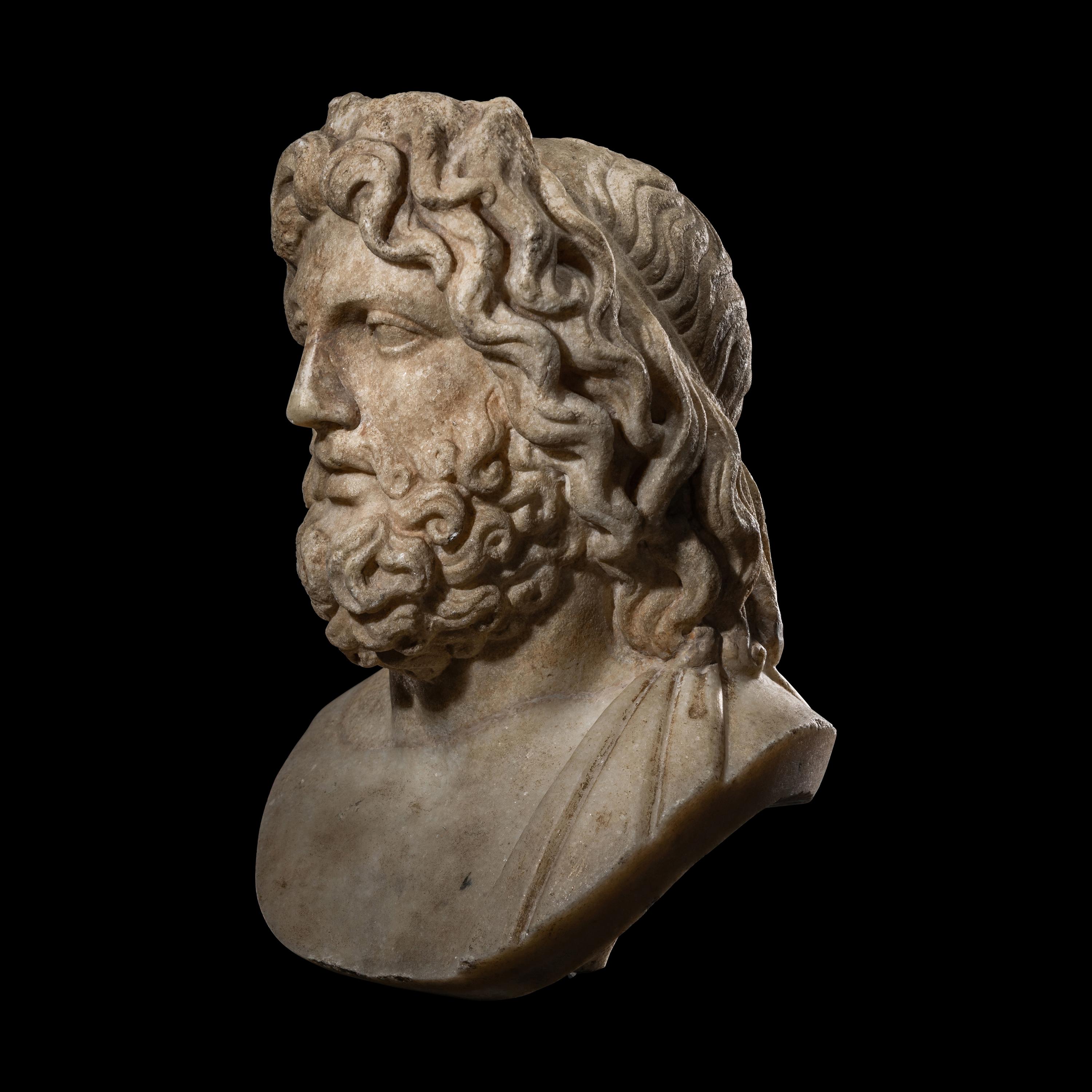
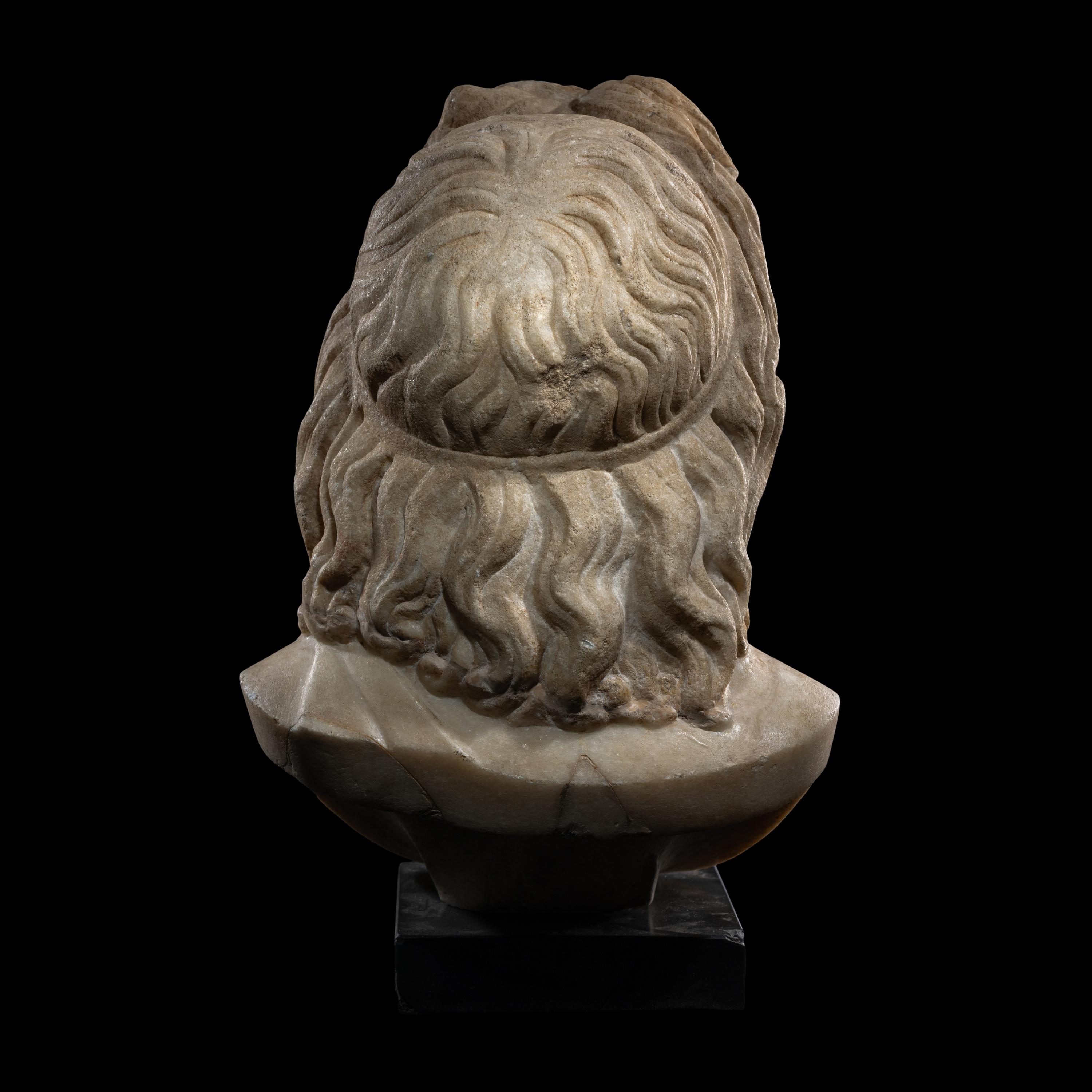
This finely carved Roman marble head, datable to the 1st–2nd Century A.D., represents an Olympian deity—likely Jupiter or Neptune—modeled in a tradition rooted in Classical Greek prototypes yet distinctly Roman in execution. The voluminous hair, centrally parted with two anastole-like locks and encircled by a diadem, along with the luxuriant beard ending in voluted curls, aligns closely with known monumental types. Secure identification remains elusive without the addition of attributes such as the eagle or trident. Nevertheless, the present sculpture embodies the Roman tendency to imbue divine figures with a tempered majesty—an aesthetic choice reflecting broader cultural values under the early Empire. As Cicero observed, "We behold the majesty of the gods through the image of serene countenance and noble form" (De Natura Deorum 2.70), a sentiment materialized in this work's idealized yet approachable features.
Typologically, the head exemplifies a hybridization of iconographic traditions: while Greek portrayals of Zeus emphasized overwhelming grandeur, Roman representations like this introduced a subtle introspection, aligning divine power with Imperial ideals of wisdom and clemency. The mounting of the head onto an 18th-century bust, coupled with its documentation by the Deutsches Archäologisches Institut in 1934, underscores its long presence within the European art market.
For a closely related type, see Staatliche Museen, Berlin (Inv. no. SK291), and Louvre, Paris (Inv. no. Ma 13).
Inspected under UV light and 10x loupe. Minor scratches, gouges and chips commensurate with age. Some visible root marks. Generally warm, even, old collection patina. Old restoration to nose. Modern portion of bust below neck with significant break line visible. Overall in very fine and attractive condition with many preserved details. Not affixed to stand. Height with stand 12 1/2 inches (31.75 cm).
The physical condition of lots in our auctions can vary due to age, normal wear and tear, previous damage, and restoration/repair. All lots are sold "AS IS," in the condition they are in at the time of the auction, and we and the seller make no representation or warranty and assume no liability of any kind as to a lot's condition. Any reference to condition in a catalogue description or a condition report shall not amount to a full accounting of condition. Condition reports prepared by Freeman's staff are provided as a convenience and may be requested from the Department prior to bidding.
The absence of a posted condition report on the Freeman's website or in our catalogues should not be interpreted as commentary on an item's condition. Prospective buyers are responsible for inspecting a lot or sending their agent or conservator to inspect the lot on their behalf, and for ensuring that they have requested, received and understood any condition report provided by Freeman's.
Please email [email protected] for any additional information or questions you may have regarding this lot.