To request further details about this lot, please email [email protected]

Jacob Coley
Senior Vice President, Head of Department, Antiquities and Ancient Art
Sale 6344
| Chicago
| Chicago
To request further details about this lot, please email [email protected]
Jacob Coley
Senior Vice President, Head of Department, Antiquities and Ancient Art
Estimate$80,000 – $120,000
Provenance:
Private Collection, Rome, by 1929.
Sotheby's, London, Antiquities, 9 December 1974, Lot 126.
Art Market, New York.
Sotheby's, New York, Antiquities, 23 June 1989, Lot 130.
Acquired by the present owner from the above.
Published:
For 'Rome's Photograph Library Record' (neg. no. 29.360) at the Deutsches Archäologisches Instituts, see Arachne Online Database: 1124916
[https://arachne.dainst.org/entity/1124916?fl=20&q=1124916&resultIndex=1]
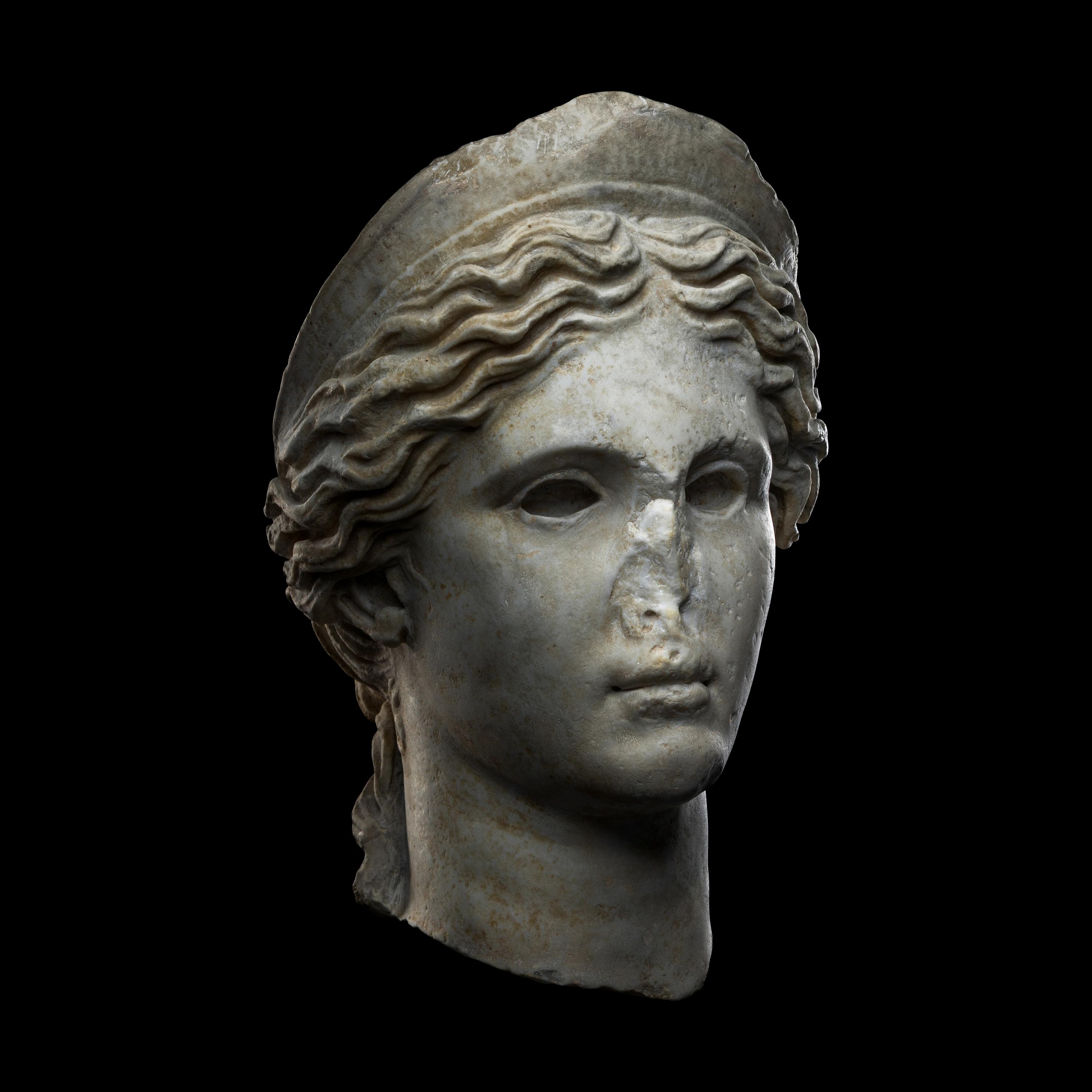
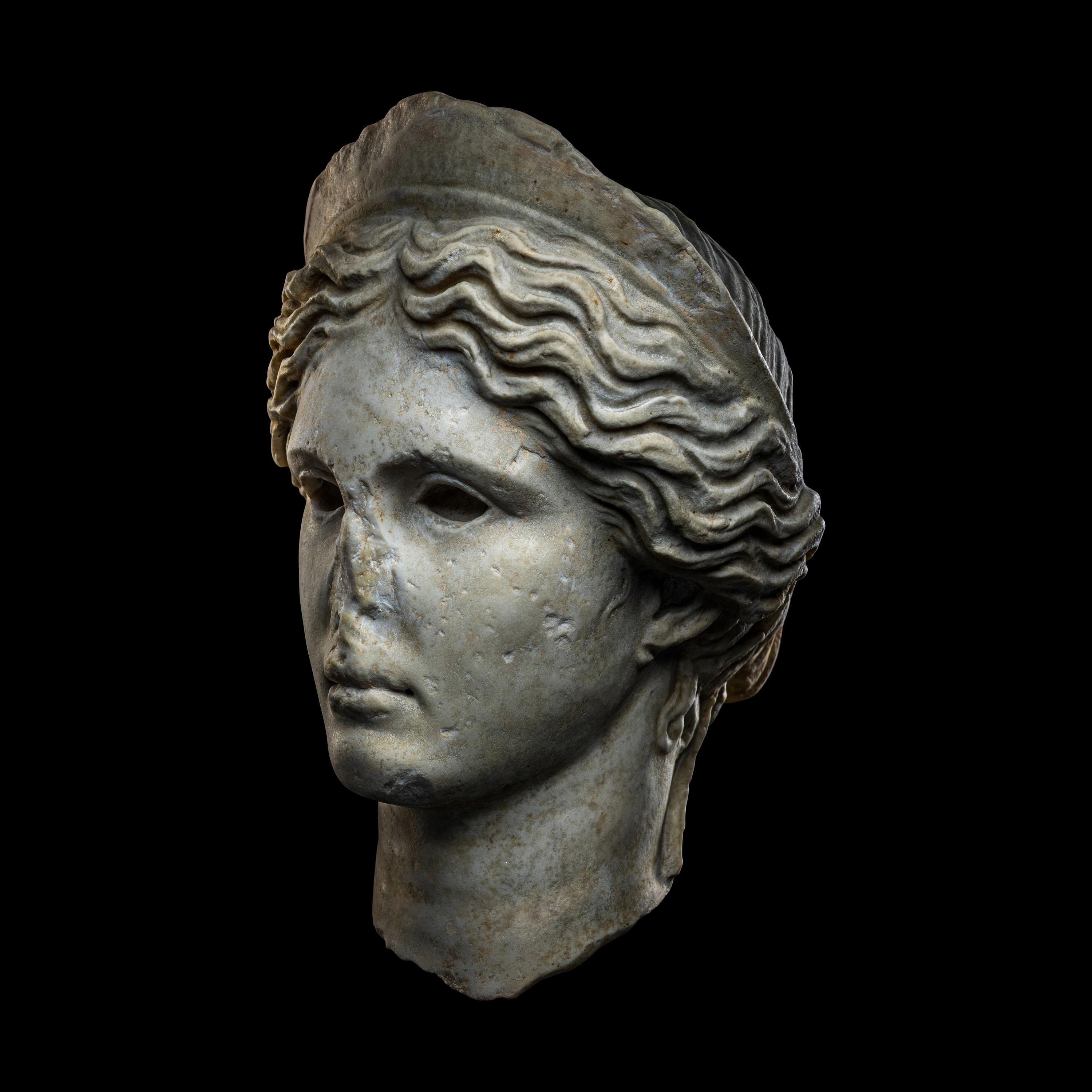
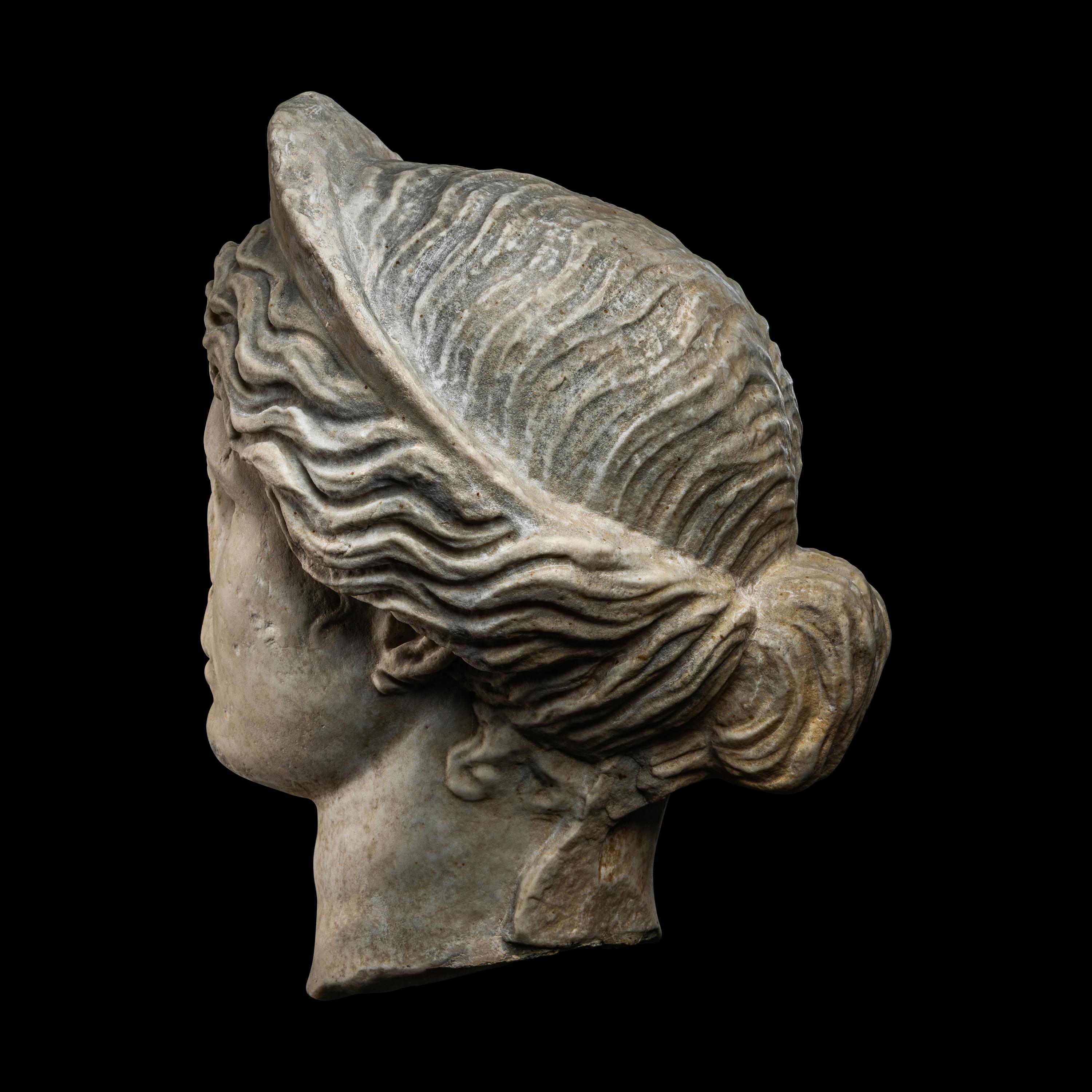
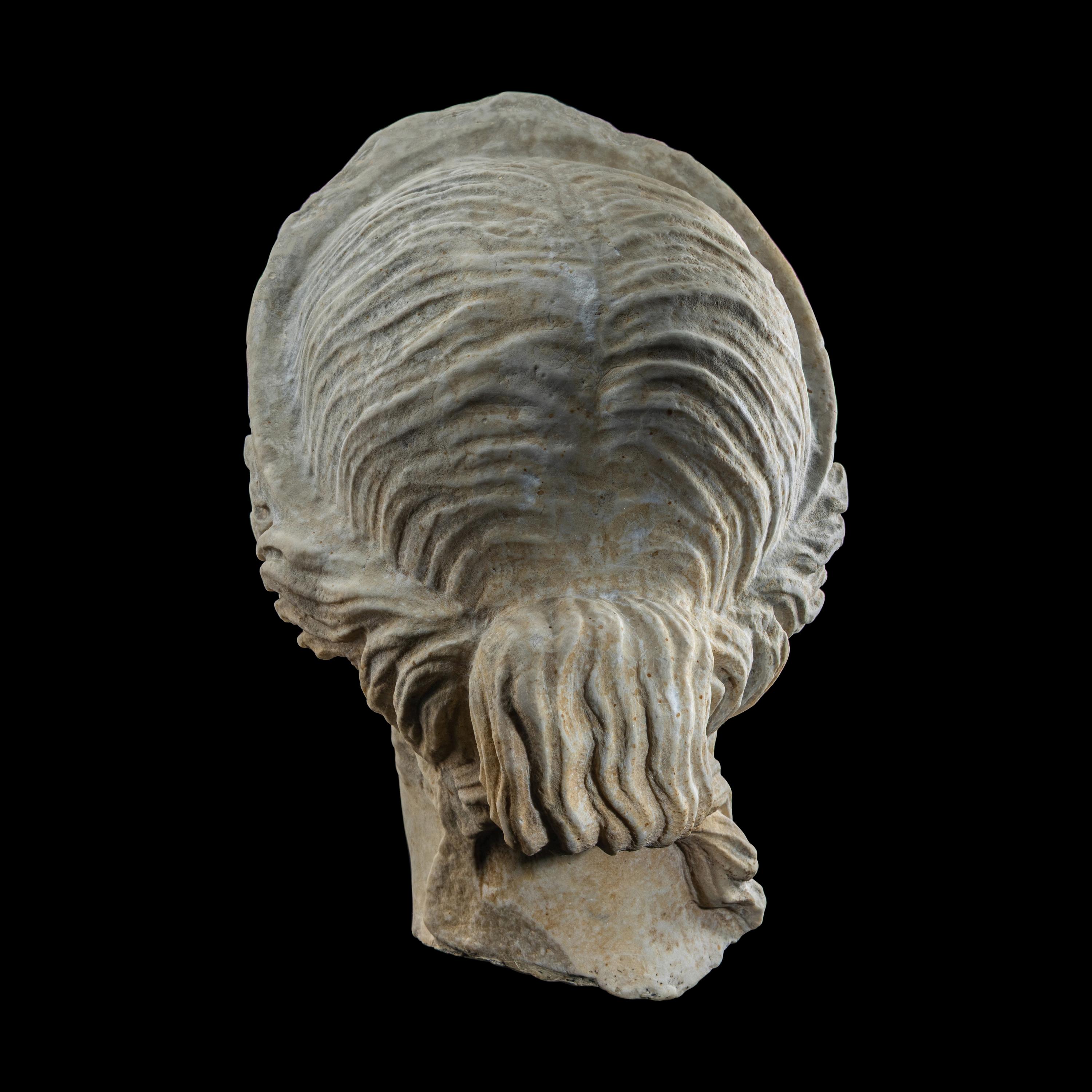
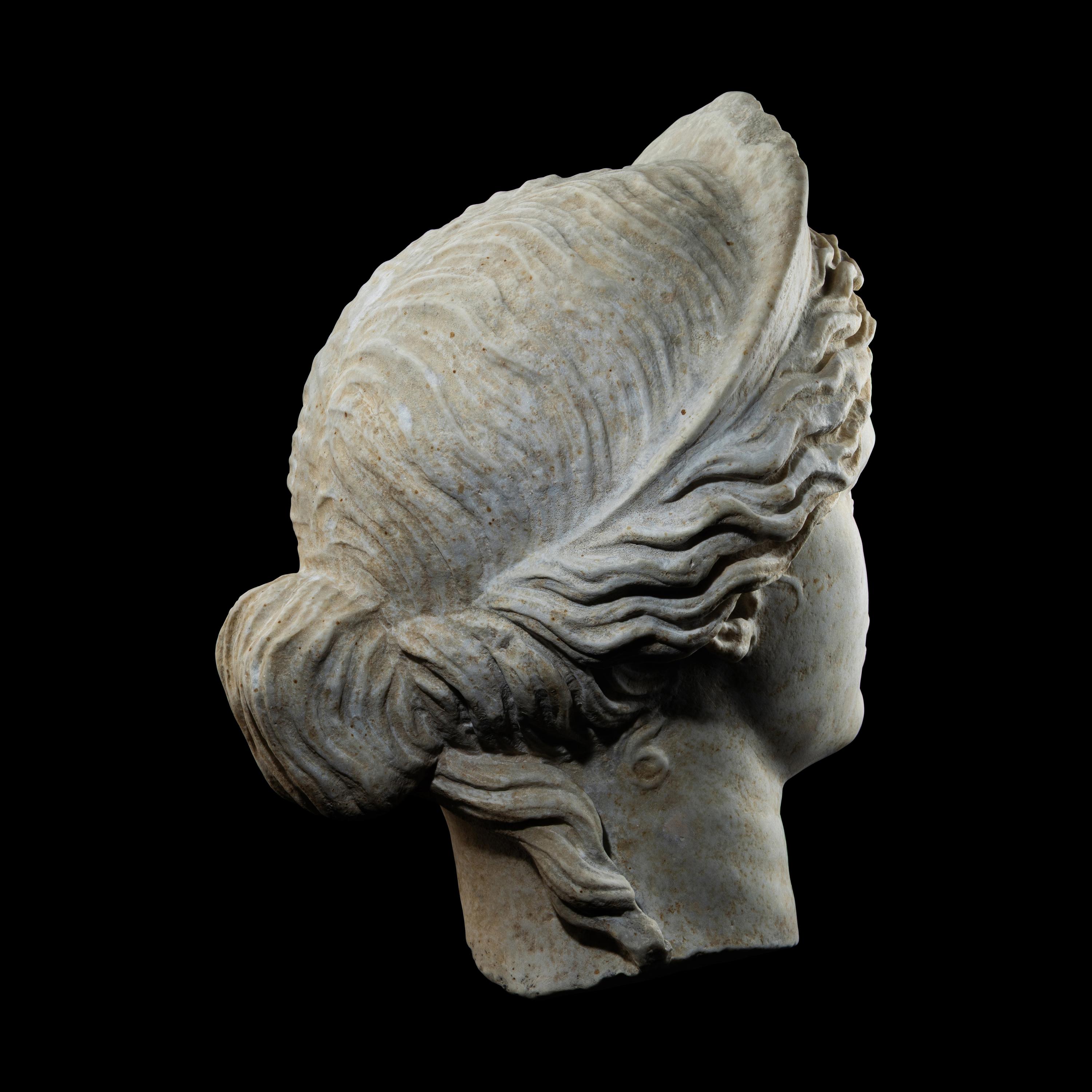
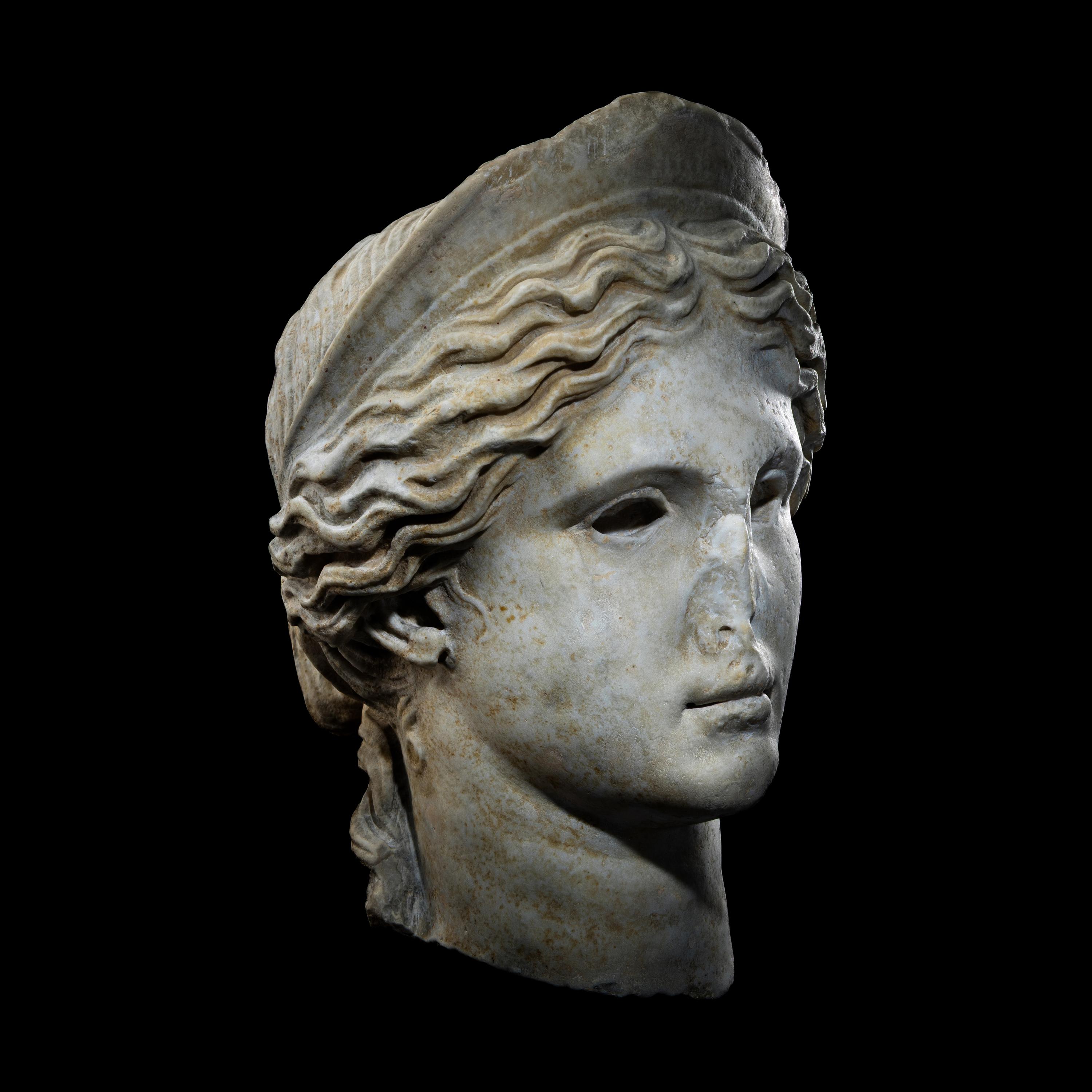
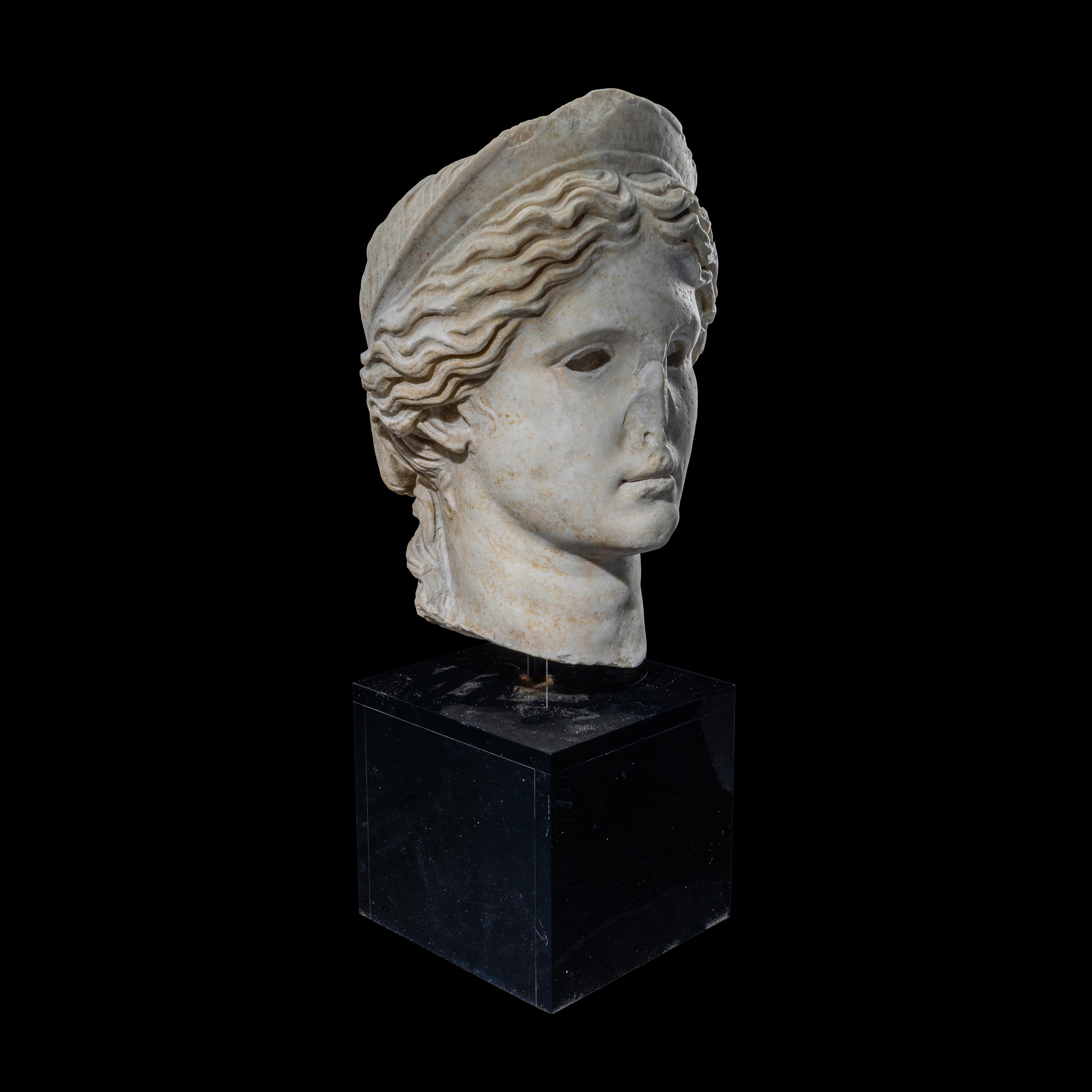
With an undeniably imperious aspect imparted by her serene countenance and lofty crown, the present head belongs to a sculptural type originating in the 5th century B.C. and favored for depictions of both goddesses and imperial women. The balanced features and smooth planes of the face are matched by the crisp manner of carving, with subtly arched brows and high cheeks descending to a rounded chin with a slight indentation. The lips are slightly pouted, with the corners marked by drill holes. Unusually, the eyes were once inlaid with contrasting material; their loss now reveals sockets that still suggest their original almond shape and piercing gaze. The wavy hair is parted centrally, massed at the hairline, and rolled back toward a low chignon, which supports an upstanding crown with a crescent-shaped profile. Several beguiling tendrils escape the coiffure before the ears and at the nape, with thicker locks trailing along the neck on either side of the chignon.
Tentative identification as Juno, queen of the Olympian gods, is based on several well-known parallels. Among these, the head at the Palazzo Altemps, usually identified as the goddess (no. 41 in A. Giuliano, ed., Museo Nazionale Romano: Le Sculture, vol. I, 5), comes closest in terms of both coiffure and crown. Striking similarities to the famous ‘Juno Ludovisi’—so admired by Goethe, who described it as his “first love affair in Rome” and owned a cast of it—and now commonly thought to represent the empress Antonia Minor (Palazzo Altemps, inv. no. 8631), as well as to the colossal Boston Juno, also once part of the Ludovisi collection (Boston, Museum of Fine Arts, inv. no. 2011.75), are also evident. The present head was photographed in 1929 by Cesare Faraglia, an acclaimed photographer of archaeological material whose services were sought after by foreign institutes in Rome and notable private collectors.
Inspected under UV light and 10x loupe. Somewhat smooth polish with old patina and areas of spotting throughout. Losses, gouges, and weathering including to nose and crown. Overall in fine and attractive condition. See additional images. Height with stand 18 3/4 inches (47.63 cm).
The physical condition of lots in our auctions can vary due to age, normal wear and tear, previous damage, and restoration/repair. All lots are sold "AS IS," in the condition they are in at the time of the auction, and we and the seller make no representation or warranty and assume no liability of any kind as to a lot's condition. Any reference to condition in a catalogue description or a condition report shall not amount to a full accounting of condition. Condition reports prepared by Freeman's staff are provided as a convenience and may be requested from the Department prior to bidding.
The absence of a posted condition report on the Freeman's website or in our catalogues should not be interpreted as commentary on an item's condition. Prospective buyers are responsible for inspecting a lot or sending their agent or conservator to inspect the lot on their behalf, and for ensuring that they have requested, received and understood any condition report provided by Freeman's.
Please email [email protected] for any additional information or questions you may have regarding this lot.