To request further details about this lot, please email [email protected]

Jacob Coley
Senior Vice President, Head of Department, Antiquities and Ancient Art
Sale 6344
| Chicago
| Chicago
To request further details about this lot, please email [email protected]
Jacob Coley
Senior Vice President, Head of Department, Antiquities and Ancient Art
Estimate$15,000 – $20,000
Provenance:
Brian Grover, Surrey, United Kingdom.
Private Collection (Professor V.E.), United Kingdom, primarily formed in the late 1970s-1990s; thence by descent to his wife in the 2000s.
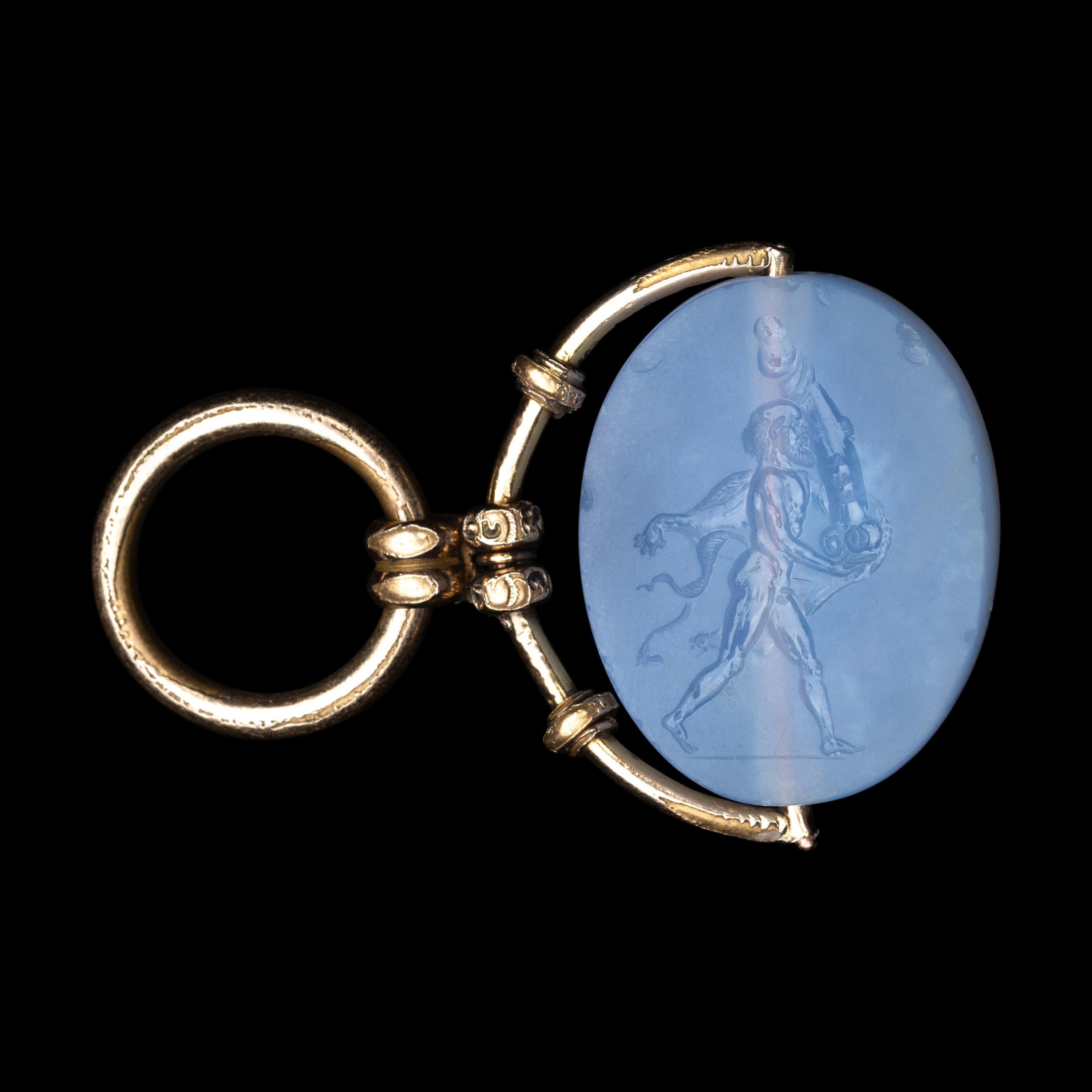
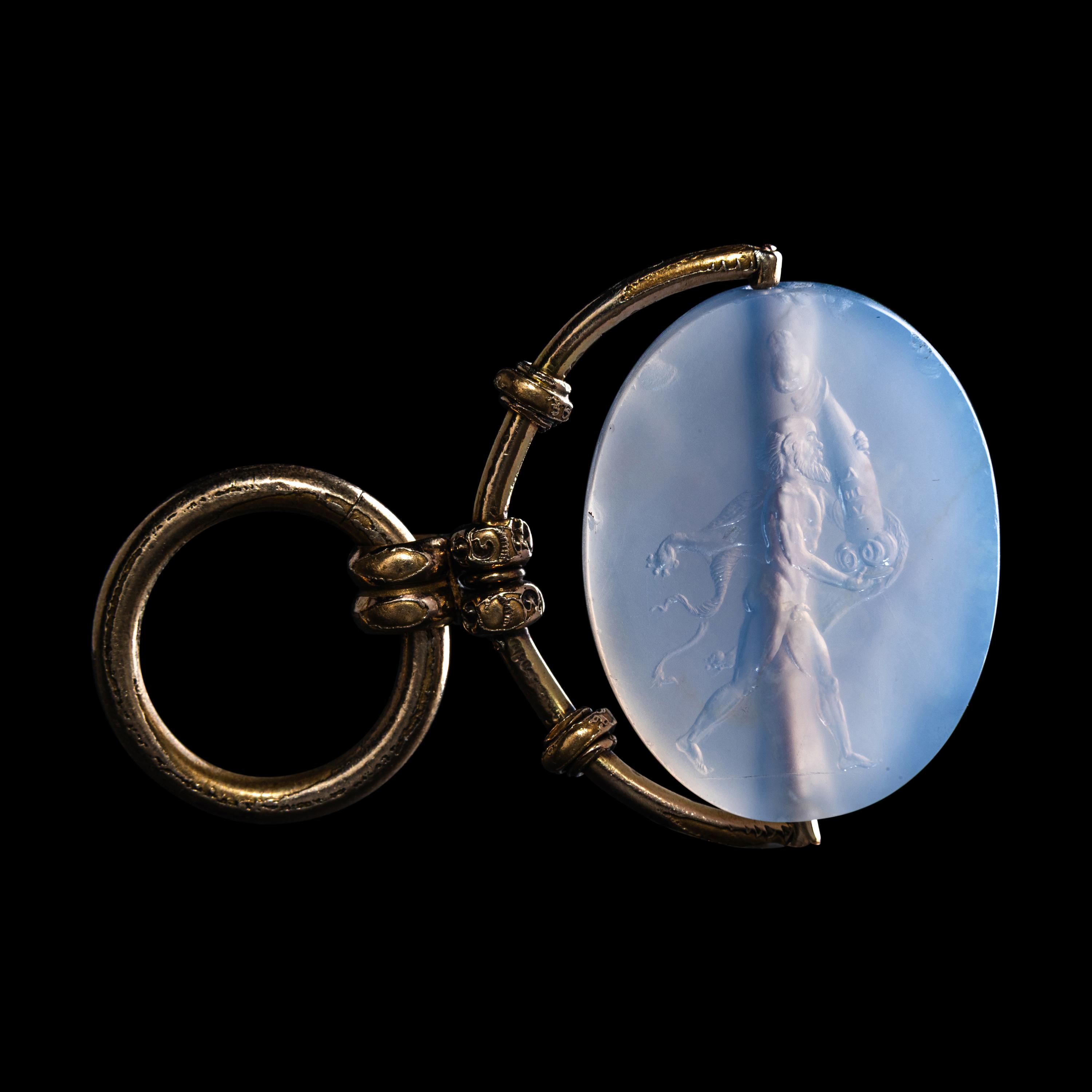
Finely carved in translucent blue chalcedony, this intaglio presents a nude, bearded figure in dynamic striding motion, bearing a herm or phallic idol with three greek letters. The figure’s aged features suggest he may be identified as Papposilenos, the elder satyr and frequent companion of Dionysos. His gesture—hoisting the icon with both arms—invokes imagery of Dionysian revels and phallic processions (phallophoria) known from Athenian festivals and symposium contexts.
A striking parallel appears in a red-figured mug from the National Museum in Copenhagen where a similar satyr strides with a herm in his hands toward an altar (BAPD 211521; LIMC, Seilenos 18). Additionally, a red-figured cup in Rome depicts hetaerae dancing around a model phallus with a Greek inscription on its shaft (BAPD 9017718). Such iconography, though rare, is deeply rooted in Classical visual culture and humor. These motifs were occasionally echoed in small-scale objects, such as engraved gems, particularly in East Greek contexts where Dionysian themes were popular and gem engravers operated with stylistic freedom (LIMC, Hermes 124).
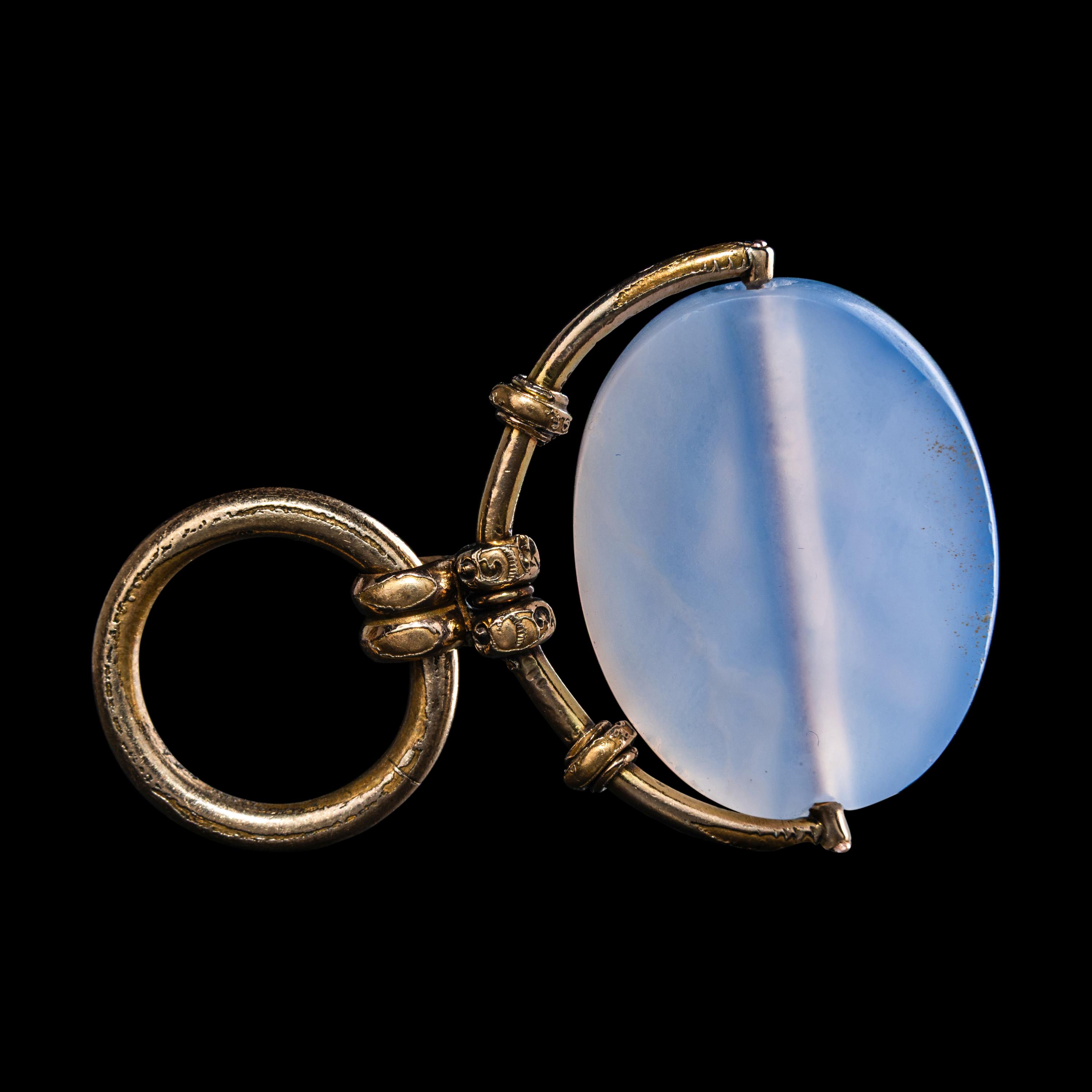
The gem’s subtly planar reverse is atypical for the period, diverging from the domed scaraboid forms more commonly associated with Classical intaglios. However, John Boardman notes that several East Greek examples—often chalcedony or carnelian—were produced with flat or nearly flat backs, especially under Persian influence during the late 5th century (Boardman, Greek Gems and Finger Rings, 'Greeks and Persians', 2001). The off-axis placement of the engraved figure and the clean edge to the reverse may hint at a later recutting or adaptation, potentially to accommodate a new mount or to preserve a damaged gem.
Inspected under UV light and 10x loupe. Minor chips and dents typical of age. Overall in very fine and attractive condition. See additional images.
The physical condition of lots in our auctions can vary due to age, normal wear and tear, previous damage, and restoration/repair. All lots are sold "AS IS," in the condition they are in at the time of the auction, and we and the seller make no representation or warranty and assume no liability of any kind as to a lot's condition. Any reference to condition in a catalogue description or a condition report shall not amount to a full accounting of condition. Condition reports prepared by Freeman's staff are provided as a convenience and may be requested from the Department prior to bidding.
The absence of a posted condition report on the Freeman's website or in our catalogues should not be interpreted as commentary on an item's condition. Prospective buyers are responsible for inspecting a lot or sending their agent or conservator to inspect the lot on their behalf, and for ensuring that they have requested, received and understood any condition report provided by Freeman's.
Please email [email protected] for any additional information or questions you may have regarding this lot.