Sale 6377
| Chicago
| Chicago
Estimate$15,000 – $25,000
Provenance:
Carl Solway Gallery, Cincinnati
Purchased from the above by the present owner in 1988
Lot Essay:
Nam June Paik (1932-2006), widely recognized as the father of video art, was born in Seoul. Paik trained in classical piano from a young age, lending an early appreciation for the arts. In 1950, he and his family fled to Hong Kong and then Japan, escaping the Korean War. Paik studied aesthetics at the University of Tokyo, graduated in 1956, and soon moved to Germany to pursue his passion of avant-garde music. There, he worked with musical composer John Cage, just one of many cross-disciplinary collaborations. He would go on to work with engineers, choreographers, poets, and video artists—including his wife, Shigeko Kubot. In 1964, Paik moved to New York City, expanding his artistic network to three continents.
Paik was associated with Fluxus, an international Neo-Dada movement interested in confusing performer/audience dynamics. As Paik employed different artistic media, he maintained that the role of the viewer should be active, participatory, experimental. Whether in performance, art installation, or television production, he played with his audience: sometimes letting them in on the joke, sometimes turning them into one.
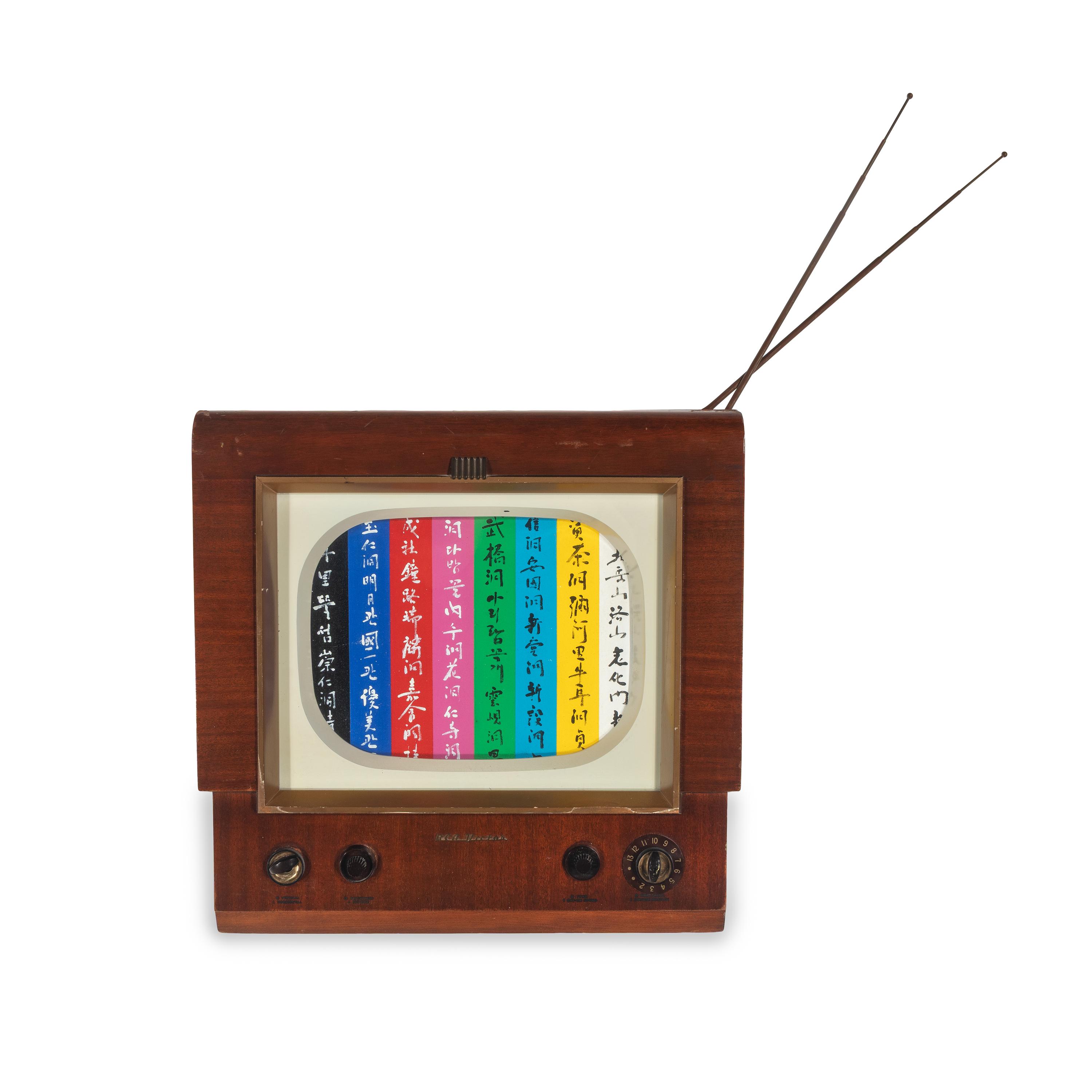
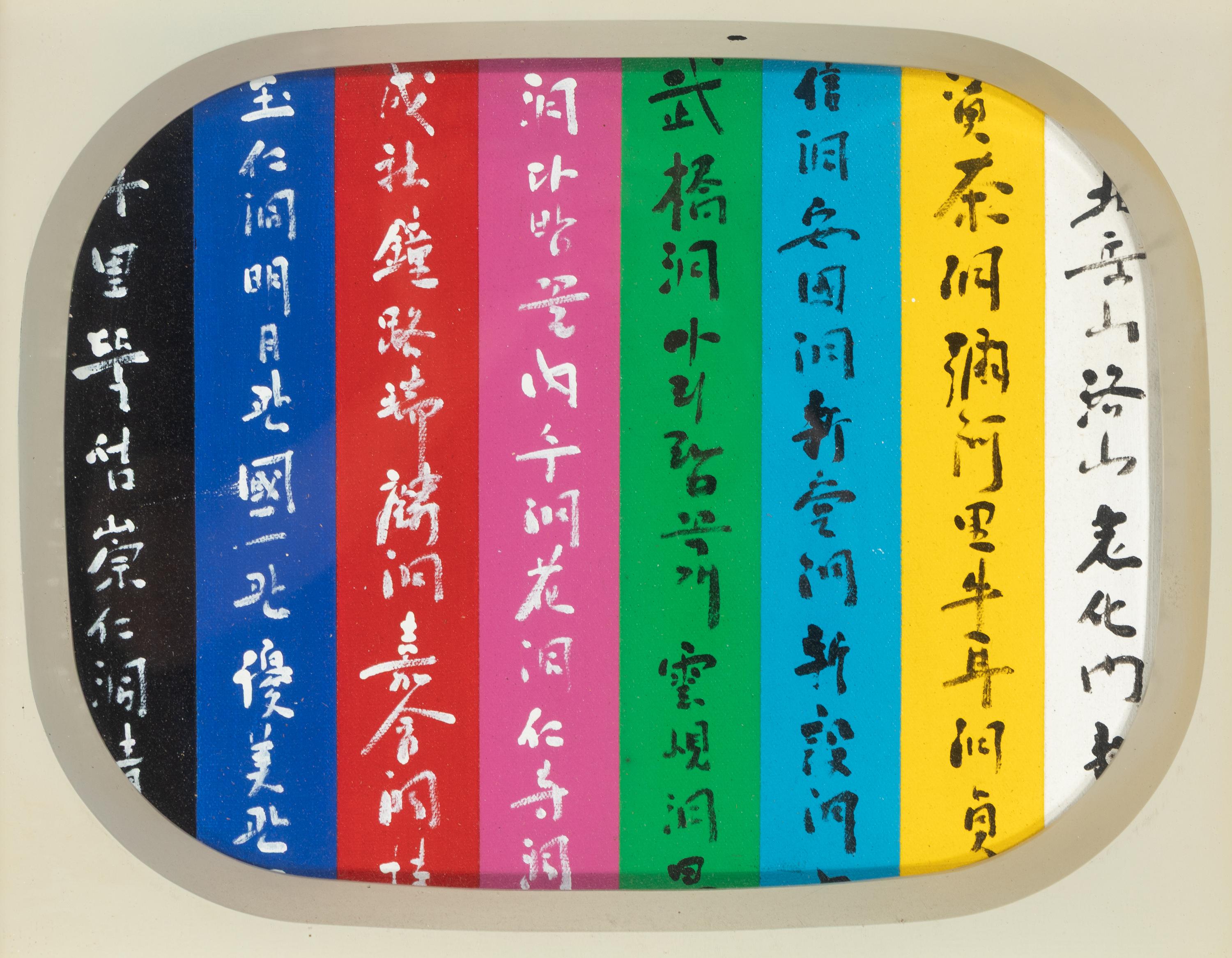
Street of Seoul condenses Paik’s grandest themes into a single painting. A colorful test pattern, hand-painted in oil, serves as a background to the black and white writing atop; he employs the centuries-old medium to represent the modern subject of a calibrating TV screen. While the writing emphasizes the artist’s hand, the background tries to disguise it. The ever-present knot between humans and technology thematically binds Paik’s oeuvre: “Our life is half natural and half technological. Half-and-half is good. You cannot deny that high-tech is progress... [but] we must have strong human element to keep modesty and natural life.”
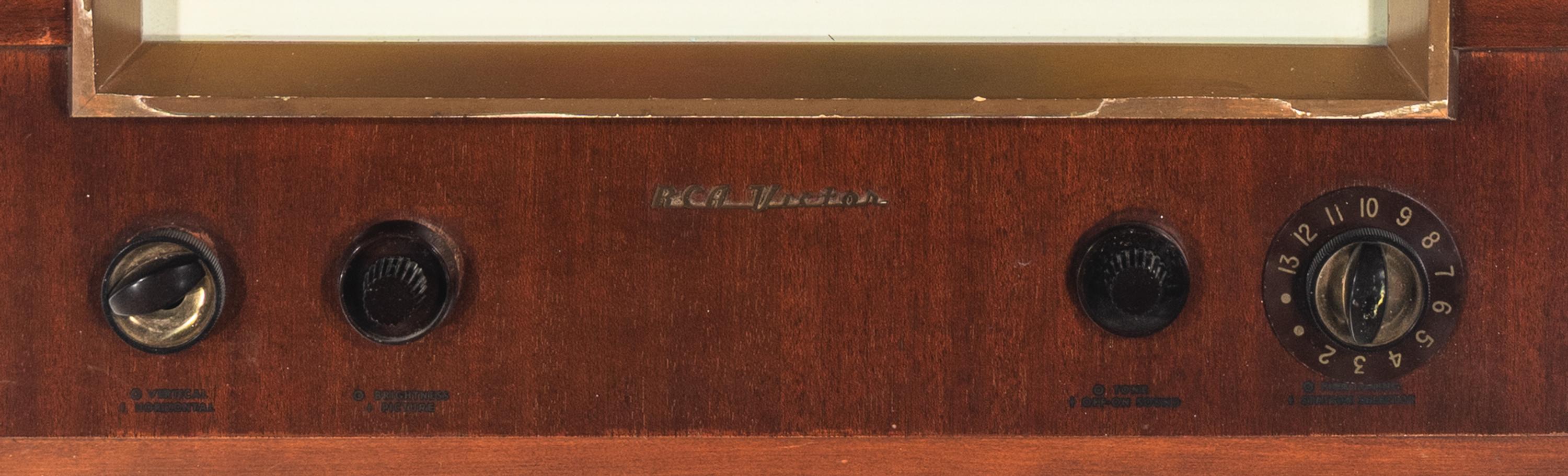
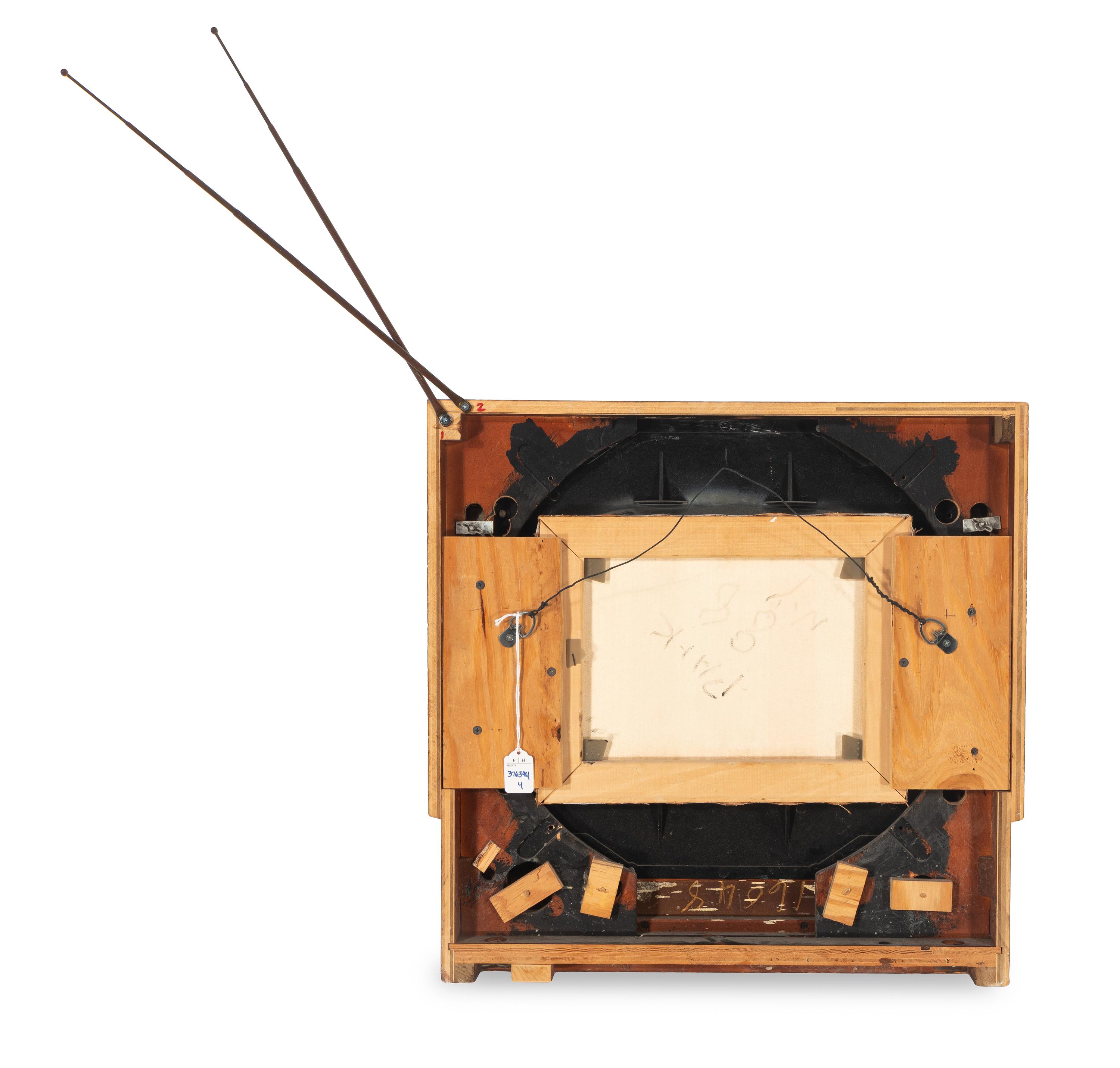
Paik further honors technological themes by framing the painting in a vintage RCA TV cabinet frame: an allusion to the medium for which he is best known. "Television is a dictatorial medium. When the superiors say something to the inferior, they can just listen... I think talking back is what democracy means.” Street of Seoul resists passive reception and demands interpretation, positioning the viewer as an indispensable participant.
While the title Street of Seoul grounds the piece in Paik’s native Korea, the television motif evokes the concept of broadcast networks as global webs of communication. Street of Seoul is not just about Seoul; like all of Paik’s work, it celebrates the increasing interconnectedness of the world at large, as defined and accelerated by technology. Paik understood the power of harnessing technology as a means of reaching people. He viewed it not as a threat but as a supplement to our humanness. Eerily prophetic, he correctly predicted worldwide telecommunications networks, coining the phrase ‘electronic superhighway.’
Paik grew up under the Japanese occupation of Korea, which saw a harsh suppression of the Korean language. Having lived in various countries with disparate official languages, he acquired a particular appreciation for language: “I’ve been away from my country for most of my life now, so every day for me is a communication problem.” In his art, Paik incorporates an amalgamation of different languages that would later be dubbed ‘Paikish.’ Paikish was a mosaic of the many global cultures he lived among. However, it also resonated with him philosophically: perhaps stemming from his avant-garde musical background, Paik believed in the beauty of noise without communicational value. To him, translation, mistranslation, and incomprehension were of equal importance.
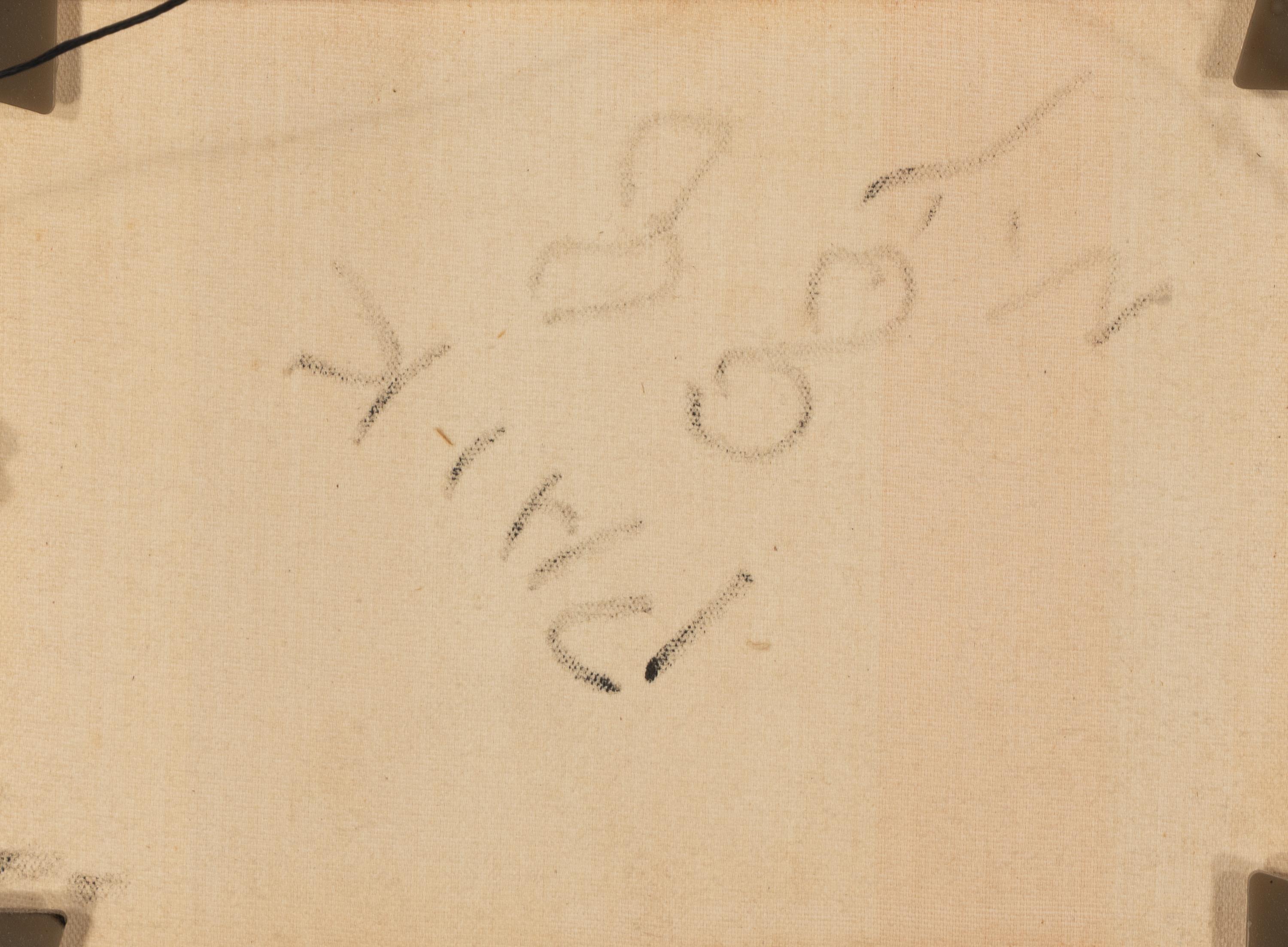
We see his appreciation for fuzzy messages in Street of Seoul: to many, the writing is completely unintelligible. However, the characters sit neatly within the margins of the color bars, carrying an aesthetic function beyond a linguistic one. In this way, he explores visual art as a universal language, conveying meaning without understanding.
Paik dreamt of a video common market showcasing music, dance, and other universal, nonverbal languages. He believed a platform like this was a move toward world peace: that an appreciation for beauty and intrigue beyond legible meaning might foster a more sympathetic world culture. Perhaps that should be our next step. For now, Street of Seoul is an excellent prototype.
Bib:
moma.org/artists/4469-nam-june-paik
americanart.si.edu/artist/nam-june-paik-3670
newyorker.com/culture/culture-desk/how-nam-june-paiks-past-shaped-his-visions-of-the-future
Canvas: 11 x 14 1/2 inches.
The physical condition of lots in our auctions can vary due to age, normal wear and tear, previous damage, and restoration/repair. All lots are sold "AS IS," in the condition they are in at the time of the auction, and we and the seller make no representation or warranty and assume no liability of any kind as to a lot's condition. Any reference to condition in a catalogue description or a condition report shall not amount to a full accounting of condition. Condition reports prepared by Freeman's staff are provided as a convenience and may be requested from the Department prior to bidding.
The absence of a posted condition report on the Freeman's website or in our catalogues should not be interpreted as commentary on an item's condition. Prospective buyers are responsible for inspecting a lot or sending their agent or conservator to inspect the lot on their behalf, and for ensuring that they have requested, received and understood any condition report provided by Freeman's.
Please email [email protected] for any additional information or questions you may have regarding this lot.