Sale 6379
| New York
| New York
Estimate$15,000 – $25,000
Provenance:
The Artist.
The Estate of the Artist.
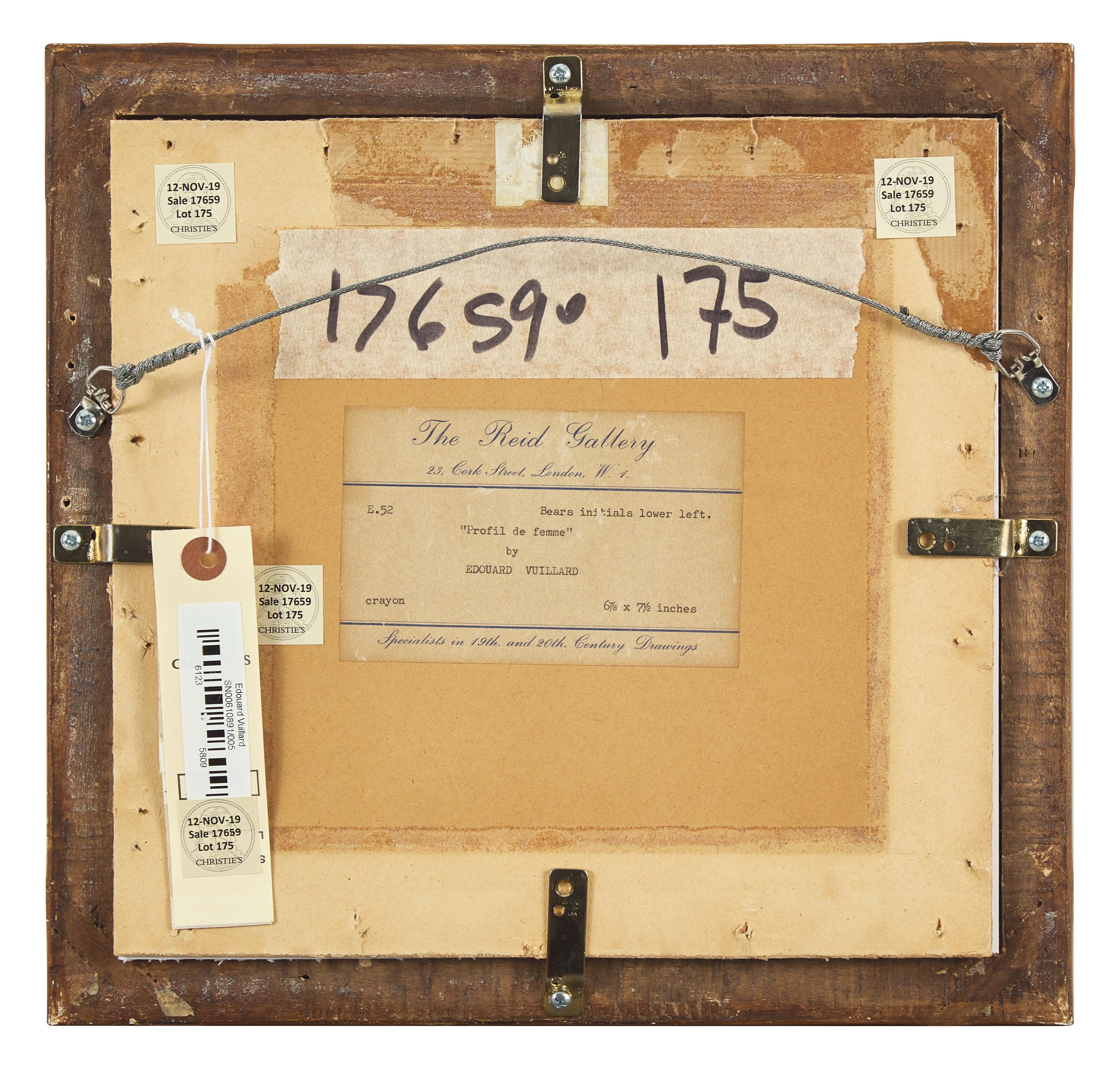
The Reid Gallery, Ltd., London, the United Kingdom.
Acquired directly from the above by the present owner in March 1964.
Literature:
Lugt, 909a.
Antoine Salomon, Guy Cogeval and Mathias Chivot, Vuillard: Le Regard Innombrable, Catalogue Critique des Peintures et Pastels, Skira / Wildenstein Institute, Milan and Paris, 2003, Vol. I, p. 122, II-87 (illustrated).
Lot Essay:
French painter and printmaker Édouard Vuillard was an important member of Les Nabis, a group of Post-Impressionists influential at the end of the 19th-century. Born in 1868 in Cuiseaux, France, his family moved to Paris when he was ten. Vuillard’s father passed away when he was a teenager, leaving him with his mother and sister, Marie. Vuillard’s mother worked at home, running a dressmaking company to support the family. Vuillard lived with her until her death 45 years later. His family life greatly influenced his art, painting mostly women, especially his mother and sister, in domestic environments: a mundus muliebris as literature on Vuillard often describes.
Vuillard trained in Paris at various institutions including the Lycée Julian and the École des Beaux Arts, to which he was eventually admitted after three unsuccessful attempts to gain entrance. He traveled extensively around Europe before exhibiting at his first Salon des Independents in 1901, which signaled the launch of his career and those of Les Nabis painters.
The Nabis drew inspiration from Edgar Degas and Paul Gauguin and leaned toward a flatter, more decorative rendering of space, betraying the laws of linear perspective and tonal modeling. The Nabis de-emphasized the descriptive value of color and form; suddenly, they were vehicles through which emotions and abstract ideas could be conveyed. The group was inspired by Japanese prints which similarly employed color, line, and pattern to create striking, bold compositions. They, too, favored playful aesthetics over naturalism.
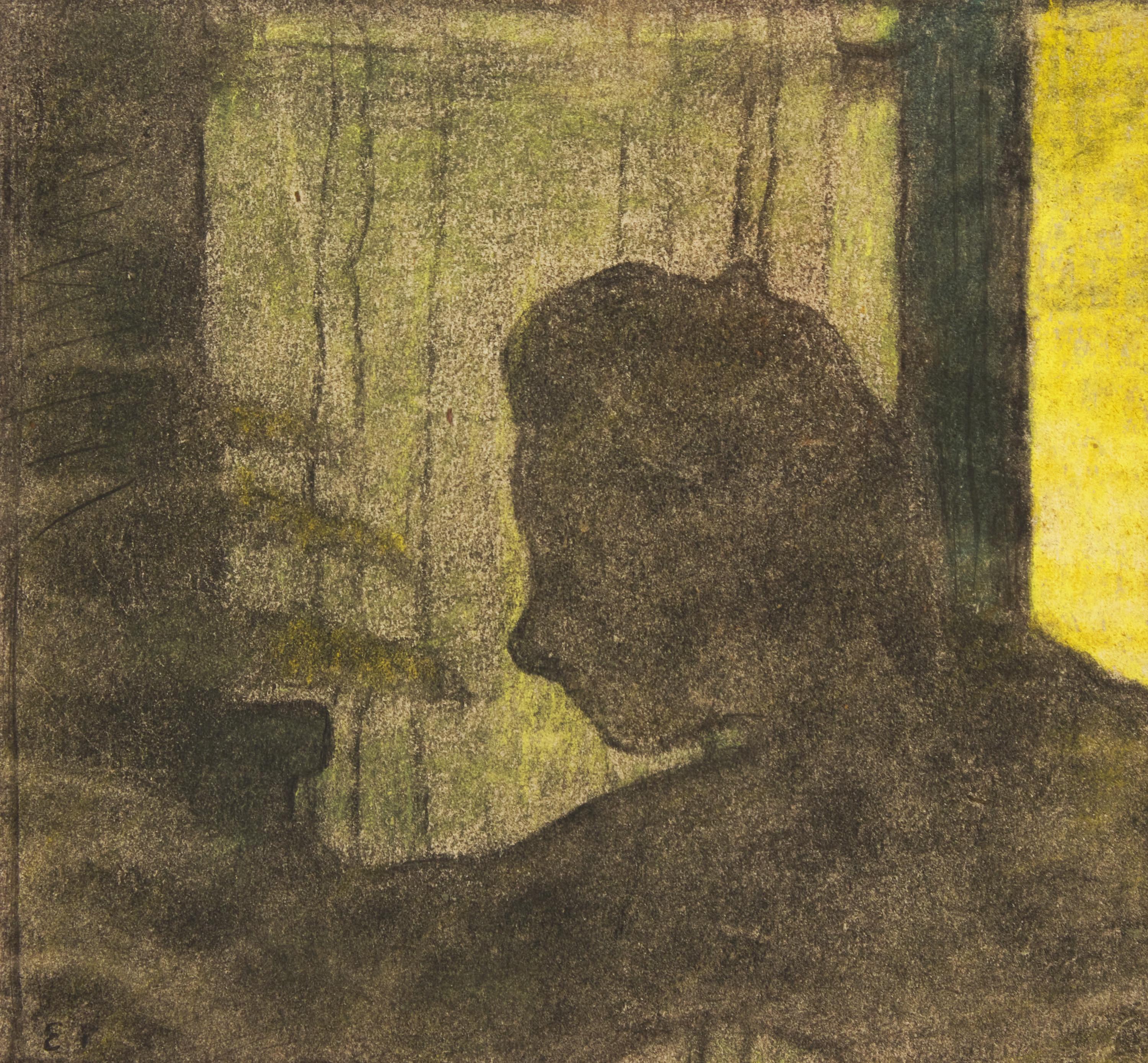
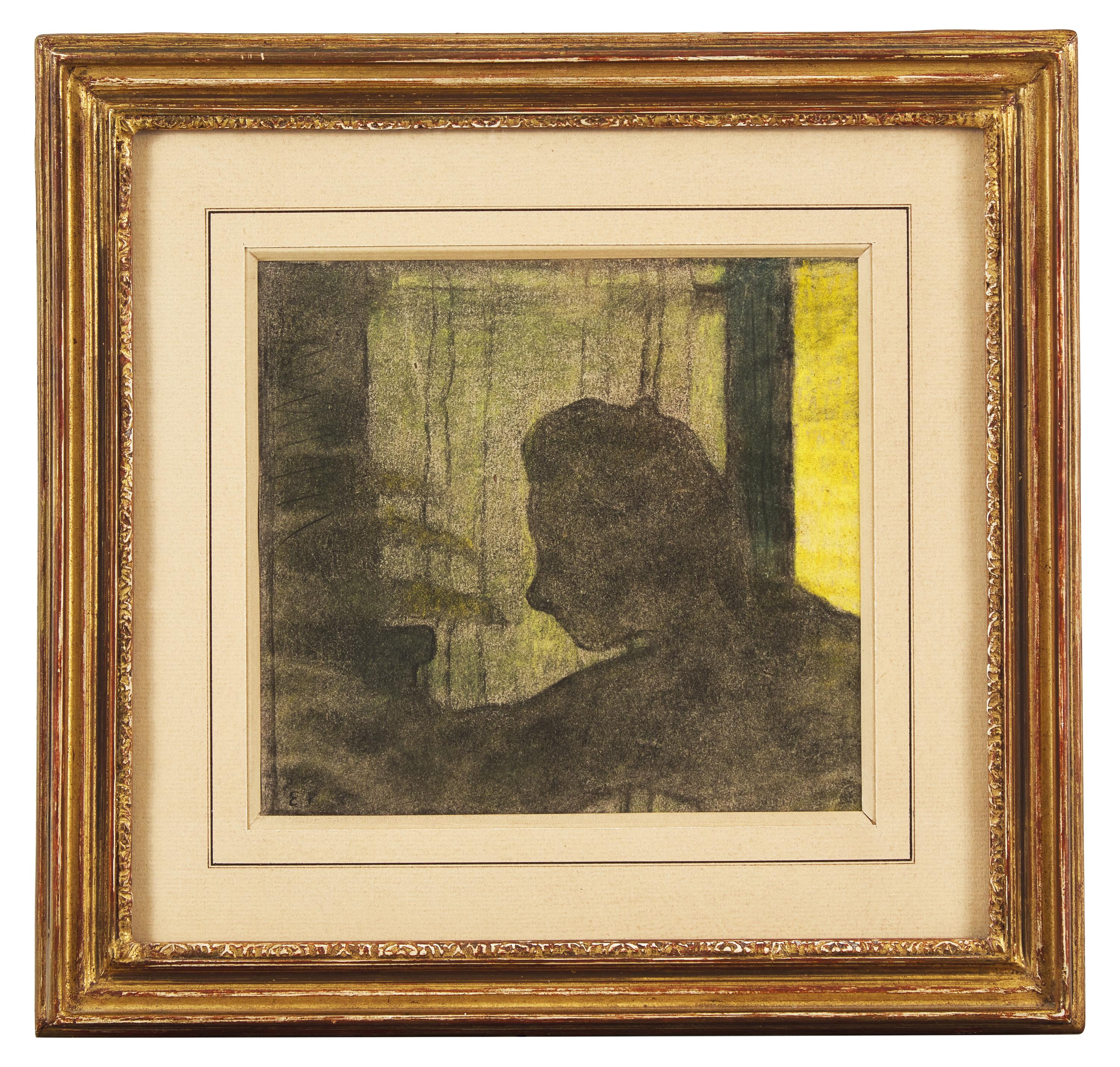
Profil de Marie à Contre-Jour (Profile of Marie Against the Light), however, is no mosaic of embellishment. A more streamlined composition, it depicts the silhouette of Vuillard’s sister, Marie, against an illuminating window. It is almost completely devoid of pattern despite a series of gray vertical lines in the background, perhaps a curtain. Otherwise, yellow light consumes most of the background, casting her profile in a dark shadow.
Marie, who Vuillard affectionately referred to as Mimi, was known to be shy and quiet. If Vuillard’s Nabis instinct was to reflect an emotional or abstract truth through form and color, then perhaps Profil de Marie visually manifests Marie’s introversion. The shadow masks her face, anonymizing her. In contrast to the bright outdoors, she sits alone in a dark room, preferring the comfort and isolation of her home. Vuillard said “I don’t paint portraits. I paint people in their homes.” His paintings do not simply capture the likeness of his subjects but convey a more intimate and comprehensive understanding of their character.
Profil de Marie maintains the decorative, experimental charm of Vuillard’s style. Here, Vuillard does not blend figure and setting in a mass of ornamentation but visually utilizes a continuous shadow. Marie's silhouette bleeds into the gray around her. In Vuillard’s work, the subject becomes a sort of extension of their environment: a mere decoration, possibly a broader comment on the expected domestic role of women in late nineteenth century France.
Early on in his career, Vuillard designed theatrical sets, exercising his lifelong love for drama and literature. He often approached his paintings as if they were sets, carefully planning the composition with a narrative in mind: “what little there is must be thought out completely, forms and colors (the old idea of the intentional).” If Profil de Marie is a theatrical set, then Marie is a shadow puppet, at the will of the puppeteer: the artist himself.
In overall good condition condition, with a very vivid and well preserved yellow hue. The paper is laid down to a thicker cardboard at all four edges, making it impossible to inspect its verso. We notice the edges, especially the bottom outer edge, is slightly irregular. The top one is deckled. With a very minor loss at bottom left corner (likely more cut off than torn). The paper is slightly toned overall. With a small diagonal tear (less than 0 1/2 in.) at the extreme bottom right corner, accompanied y a very slight ripple (due to the paper being laid down). We notice minuscule pinpoint holes in each of the four corners. There is a tiny built up accretion to the left of the figure's forehead. Additional images available upon request.
Framed under plexiglass.
The physical condition of lots in our auctions can vary due to age, normal wear and tear, previous damage, and restoration/repair. All lots are sold "AS IS," in the condition they are in at the time of the auction, and we and the seller make no representation or warranty and assume no liability of any kind as to a lot's condition. Any reference to condition in a catalogue description or a condition report shall not amount to a full accounting of condition. Condition reports prepared by Freeman's staff are provided as a convenience and may be requested from the Department prior to bidding.
The absence of a posted condition report on the Freeman's website or in our catalogues should not be interpreted as commentary on an item's condition. Prospective buyers are responsible for inspecting a lot or sending their agent or conservator to inspect the lot on their behalf, and for ensuring that they have requested, received and understood any condition report provided by Freeman's.
Please email [email protected] for any additional information or questions you may have regarding this lot.