Sale 6379
| New York
| New York
Estimate$40,000 – $60,000
We wish to thank the Comité Giacometti for kindly confirming the authenticity of the present lot, which was examined in Paris in June, 2025. It is now recorded in the Alberto Giacometti Database under no. 4729.
Lot Essay:
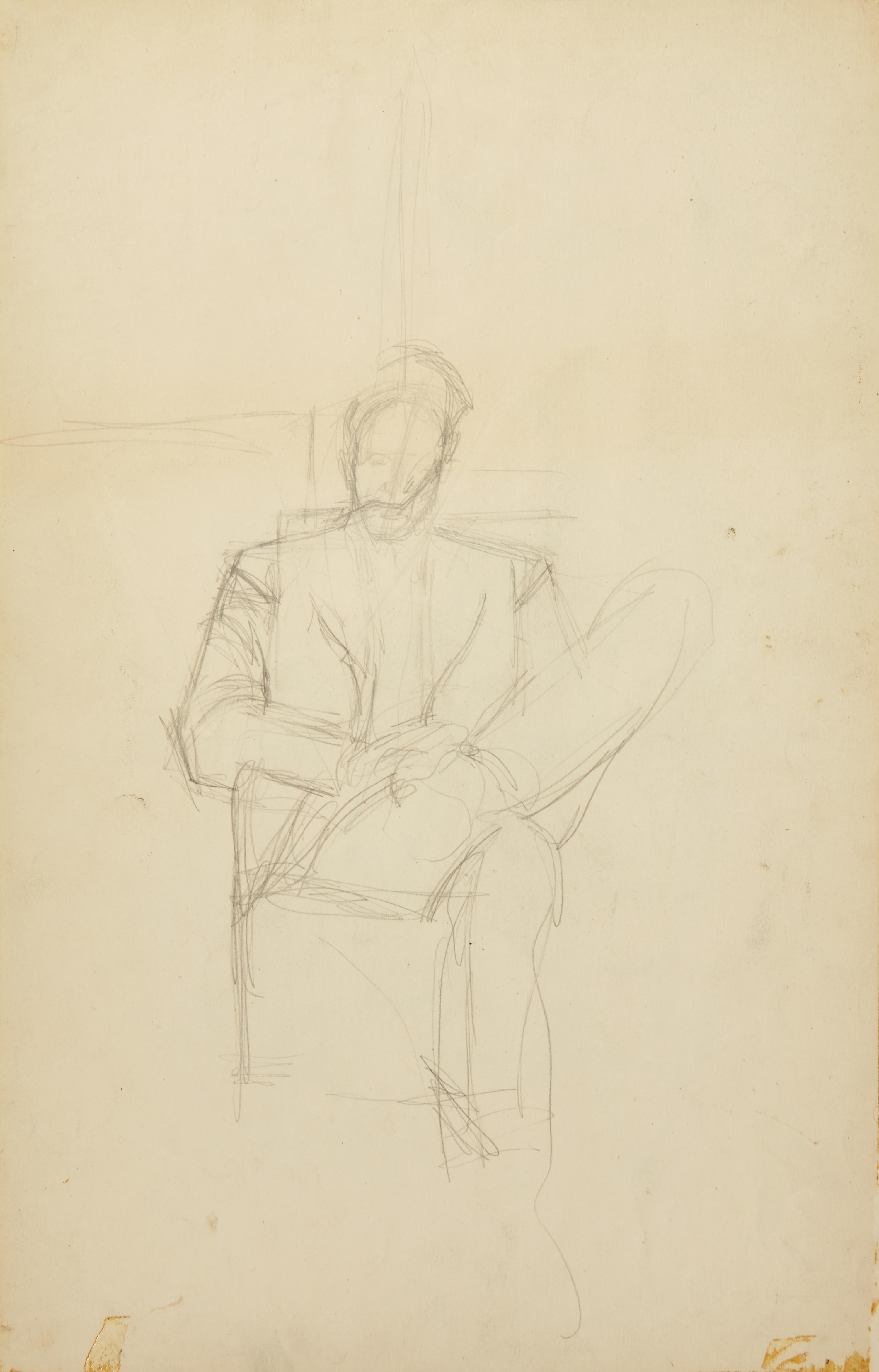
In 1928, Alberto Giacometti was offered a one-year contract by the Parisian gallery owner, Pierre Loeb. Loeb was the preeminent dealer of the Surrealists, and this opportunity cemented the artist’s entrée to that circle, to whom he had previously been introduced to by André Masson. Giacometti was to remain a friend of Loeb, of whom he made several portraits in 1946, including the present work, as well as in 1949, to prepare an etching that was to illustrate a text written by Loeb on figurative art.
1946 was a pivotal year for Giacometti in his artistic development. In an essay accompanying the Solomon R. Guggenheim Museum’s 1974 retrospective on the artist, Reinhold Hohl stated that it was this year that the artist, “…realized that space does not exist merely in front of a figure, but surrounds and separates it from other objects. When we look at something, we see as much of this space (particularly at the sides of the object) as our field of vision permits. The figure seen at a distance appears pronouncedly thin in relation to the absolute standard of our field of vision. As a consequence of its thinness, the figure also appears relatively tall. The change from the tiny representations of the preceding years to the elongated figures of 1946 resulted from new studies—mostly drawings—from nature.” (Alberto Giacometti: A Retrospective Exhibition, New York, 1974, p. 24)
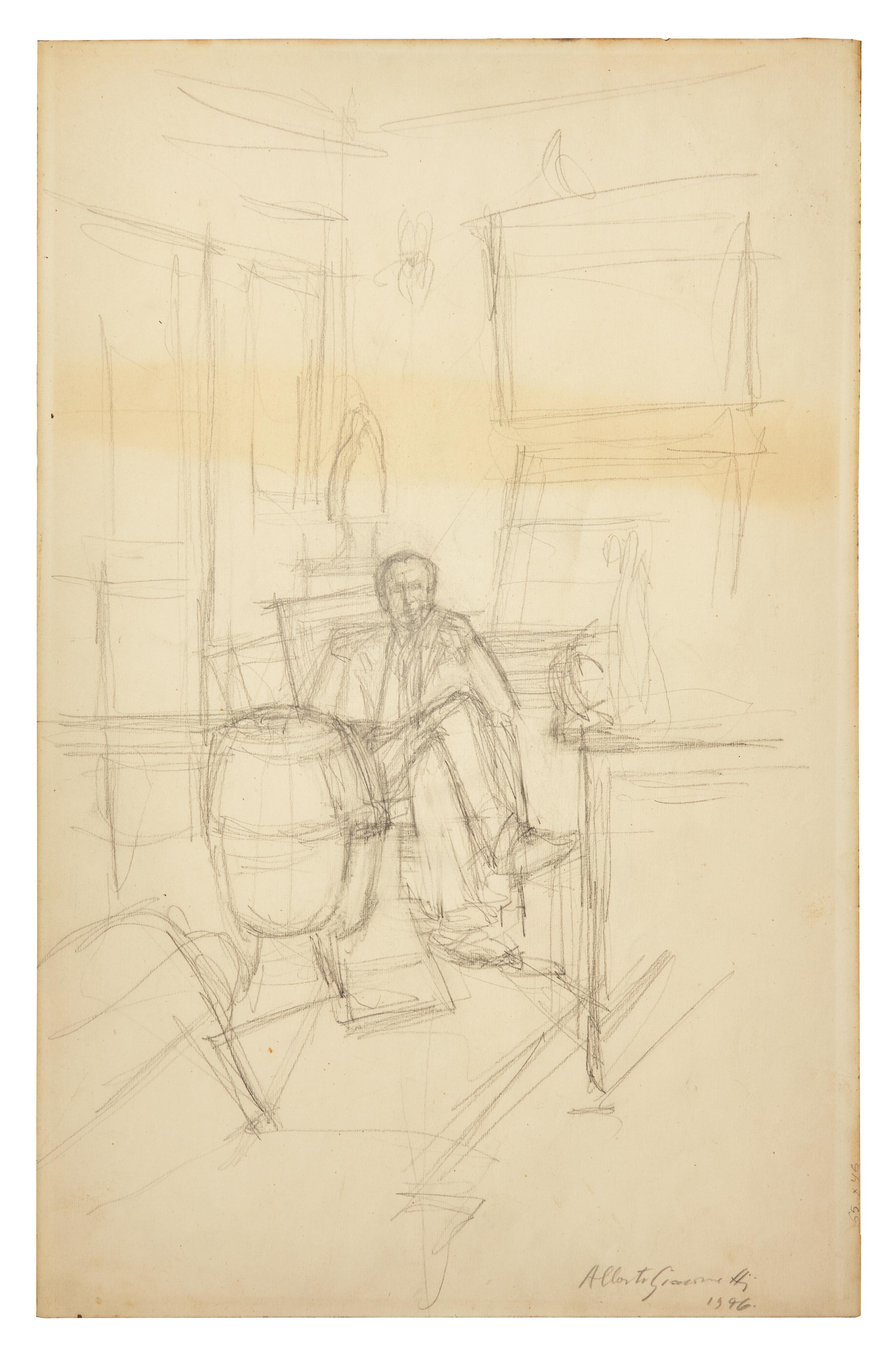
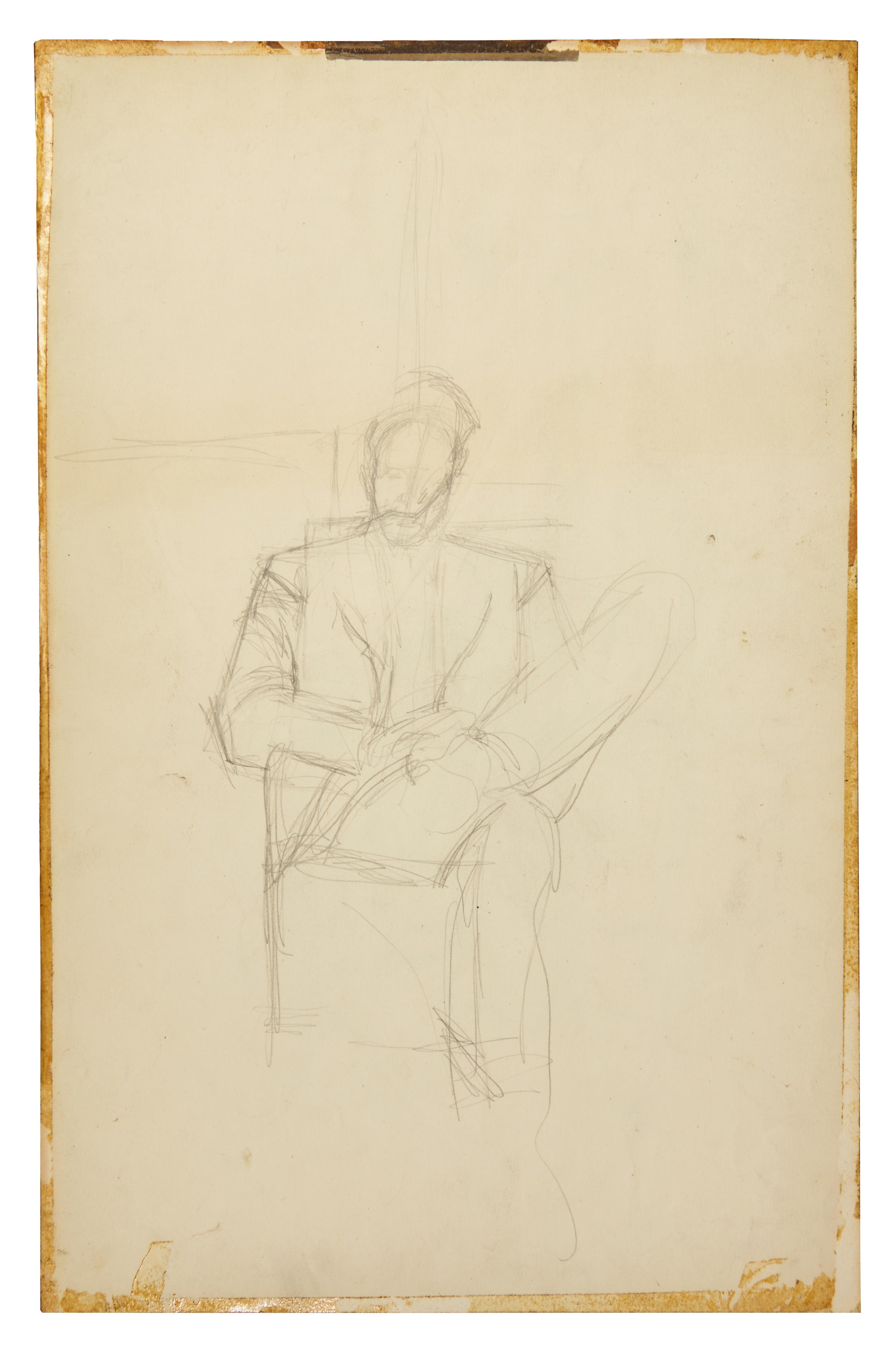
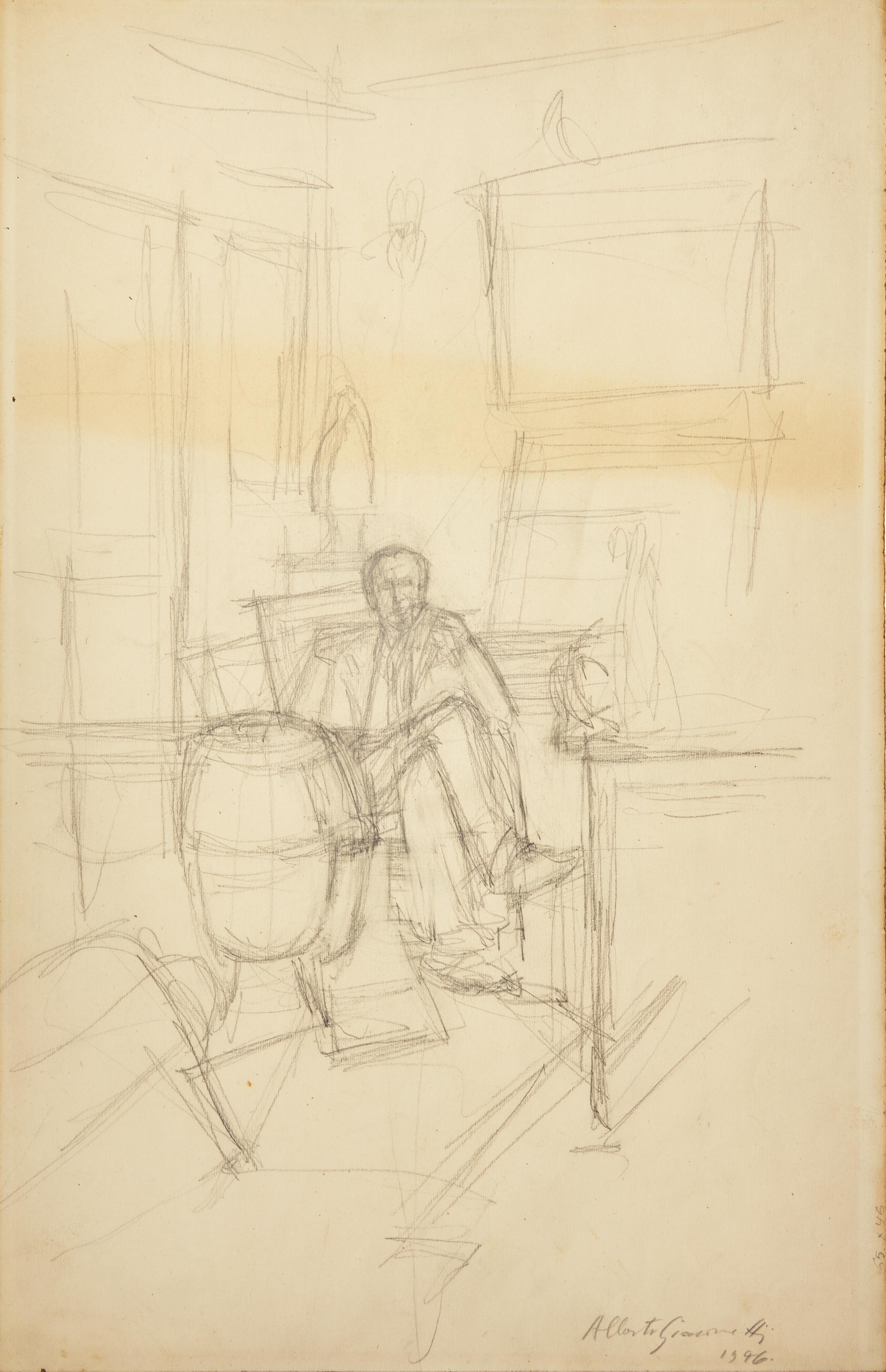
Pierre Loeb Seated in the Office of the Galerie Pierre / Pierre Loeb Seated, 1946, reveals the artist’s experimentation of this time. The recto depicts the dealer in his Paris gallery, sitting in an armchair and smoking a pipe, while the verso presents several sketches of heads. Yet despite the unquestionable likeness, there is a degree of elusiveness to the sitter’s facial features and body, a certain “lack of precision” to his portrayal that highlights its, “forever changing,” fleeting nature (Paul Moorhouse, Giacometti: Pure Presence, London, 2015, p. 150). The real subject matter of the artwork is “…space, this three-dimensional matter which has neither substance nor color, which is a sharply felt presence, but can only be negatively located between and around the objects which obstruct it.” (Alberto Giacometti, 1974, p. 35) The short lines used to compose this space accumulate to form a web between crossing objects, and may stand for the trace of the artist’s eye, “…swiftly and incessantly moving around the composition from one object to another, measuring the distances between them.” (Ibid., p. 35)
As Moorhouse notes with regards to the artist’s portraiture, “To an extreme degree, Giacometti’s art lays bare the complexities and ambiguities of perception, relentlessly exposing the fugitive and elusive nature of visual experience. His portraits are in that sense not simply depictions of individuals. Rather, they are sights that bear evidence of the artist’s struggle to comprehend and express an unfathomable human presence.” (Moorhouse, p. 15). A related drawing from the same year, with Loeb in a similar posture and setting, is held by the Centre Pompidou, Paris. It is drawings such as these that led Giacometti to his post-War sculptural style, which consequently may be characterized as drawing in space.
In overall fair to good condition. The double-sided sheet is loose., encased between two sheets of glass. The sheet is toned, with evidence of old light mat staining along the four outer edges, creating a discolored band of about 0 1/4 in. wide. The outer edges are all even, and straight. Scattered surface soiling at bottom left corner, and evidence of handling (smudges) at upper right quadrant. Light fold in the paper at upper right corner (very minor and unobtrusive). Minor diagonal crease at upper center right, right above the figure, to the right. Across raking light, we notice several creases and pressure points (from handling) on the sheet, but overall the sheet stays flat, and is very stable. With a minor paper tear at center right, along the right outer edge (creating a dent of about 0 1/8 in. into the margin). We notice a 1 in. high yellowed band running across the top tier of the composition, stretching from the left end to the right. Pinpoint foxing mark at center left, just below the boiler. The verso presents well. As toned as the recto, it presents evidence of old brown residue (likely glue from former hinge tape) running all long the four extreme edges of the sheet. A larger, darker, hinge is visible at the center of the top outer edge. With minor traces of surface soiling (medium traces, smudges) at center right, to the right o the figure's lifted knee.
The physical condition of lots in our auctions can vary due to age, normal wear and tear, previous damage, and restoration/repair. All lots are sold "AS IS," in the condition they are in at the time of the auction, and we and the seller make no representation or warranty and assume no liability of any kind as to a lot's condition. Any reference to condition in a catalogue description or a condition report shall not amount to a full accounting of condition. Condition reports prepared by Freeman's staff are provided as a convenience and may be requested from the Department prior to bidding.
The absence of a posted condition report on the Freeman's website or in our catalogues should not be interpreted as commentary on an item's condition. Prospective buyers are responsible for inspecting a lot or sending their agent or conservator to inspect the lot on their behalf, and for ensuring that they have requested, received and understood any condition report provided by Freeman's.
Please email [email protected] for any additional information or questions you may have regarding this lot.