Sale 6380
| Philadelphia
| Philadelphia
Estimate$30,000 – $50,000
We would like to thank Dr. Anna Koopstra, Curator of Early Netherlandish Painting, Musea Brugge, for her kind assistance with the cataloging of this lot.
Provenance:
Sotheby's, New York, 2007, sale of January 25, lot 320.
Acquired directly from the above sale by the present owner.
Literature:
Anna Koopstra & Luuk Hoogsteded, "Observaties over de werkwijze van Lucas Gassel," Lucas Gassel van Helmond: Meester van het landschap, Zwolle, 2020, exh. cat., pp. 50-51, fig. 13, illus.
Lot Essay:
Comparatively little is known of Lucas Gassel’s life. He was probably born circa 1488 in Deurne, a well-to-do municipality east of Antwerp, to the painter Jan Thonisz. van Gassel. It is assumed that Lucas left for Antwerp at the turn of the sixteenth century, which at that time, was an important city for the arts. Gassel later moved to Brussels, where he remained until his death. A successful painter and artist in the sixteenth century, Gassel’s small oeuvre, includes some fifteen signed and dated paintings, all in oil on wooden panels; two drawings that are signed and dated; and three prints that have an LG monogram. He is one of only a handful of artists whose names are known as early practitioners of the landscape genre, together with Joachim Patinir (ca. 1480-1524) and Herri met de Bles (ca. 1510-ca-15510). Gassel’s portrait is known in a print by Jacob Binck, dated 1529, nine years before the artist’s known earliest dated work, which shows that he was by then already well-to-do.
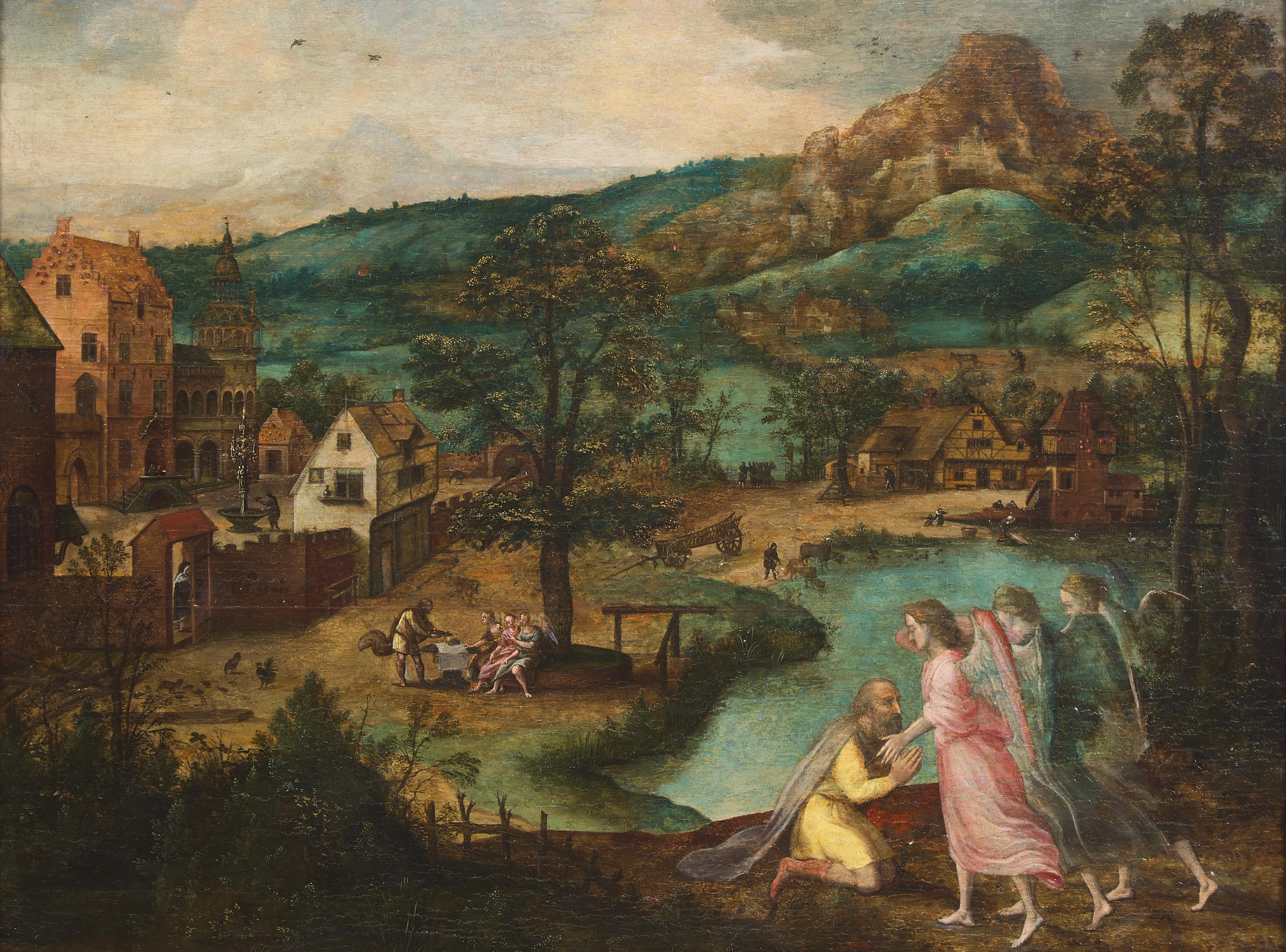
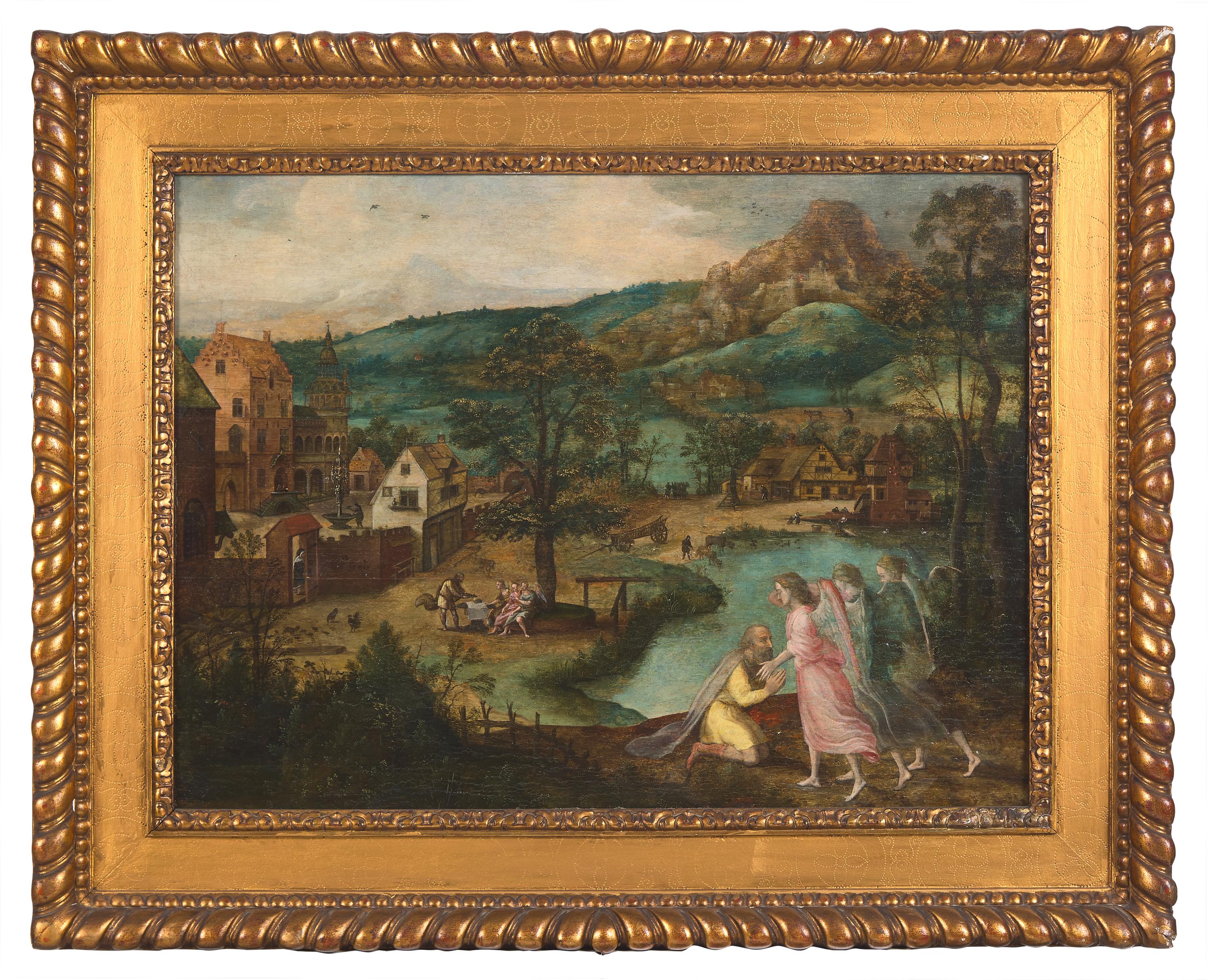
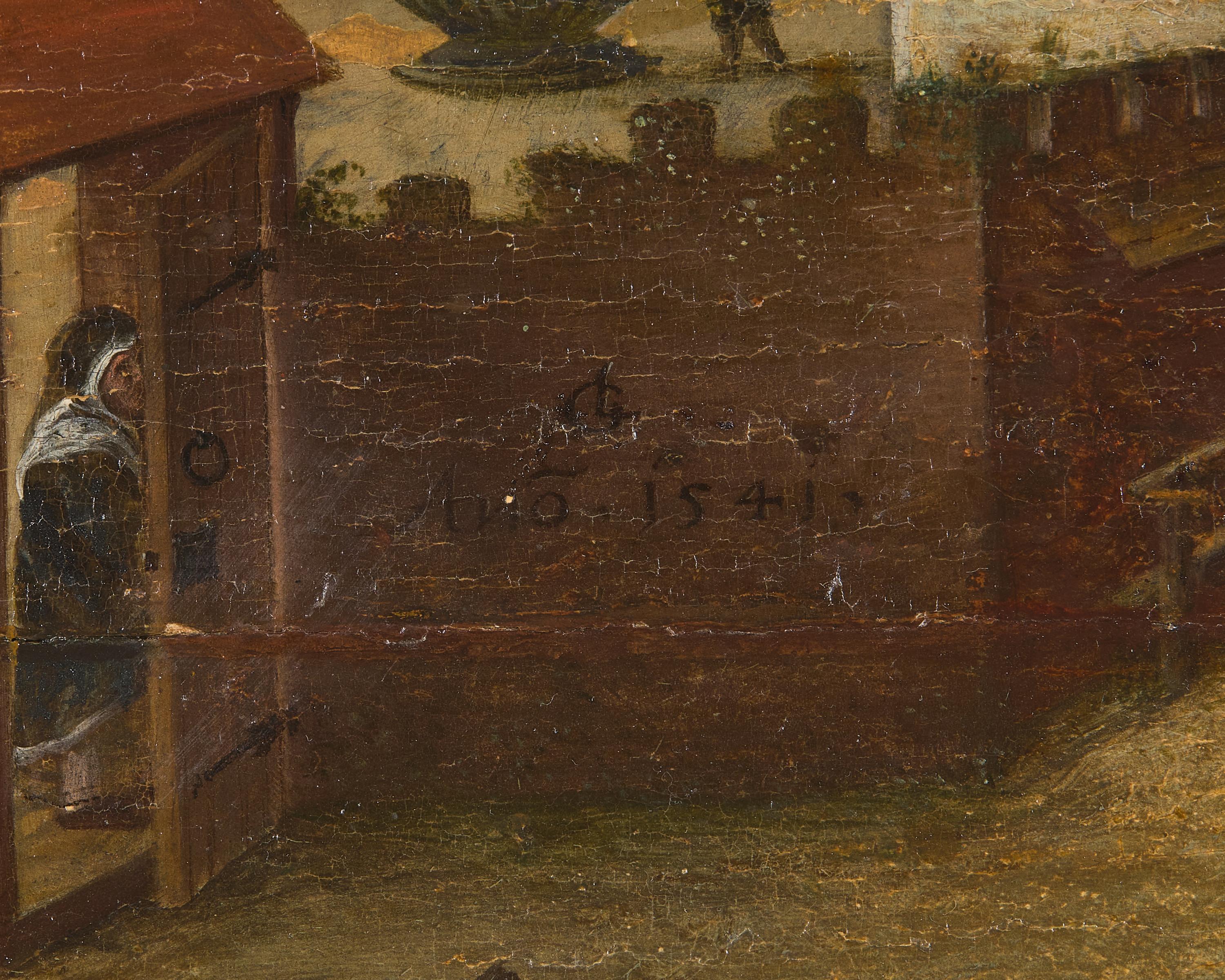
The present panel painting, monogrammed and dated 1541, is an example of a composition of which Gassel did several versions that depict Abraham and the Angels. As is typical for the artist, the overall composition is ‘closed off’ with trees and foliage, which act as repoussoir elements, a common feature of Gassel’s works. The color palette of the painting is characterized by earthy brown and green tones that are stronger in the foreground and become paler and lighter into the distance, with the pale light sky as its culmination. In the center, placed below the foreground to establish perspective, the small figures of Abraham and the three angels, one of which was God, can be seen, with Abraham offering the angels hospitality, who then in turn revealed to Abraham that his elderly wife Sarah was to have a son within a year. Behind this figural group, to the right and left, are typical 16th century Flemish buildings, along with a somewhat fanciful fountain, and scattered figures going about their daily business. A verdant slope climbs up from this middle ground to a rocky escarpment extends into the upper right corner, further establishing depth.
Occupying this escarpment is a castle-like structure, which is likely meant to represent Somom and Gomorrah, as miniature fires and smoke can be seen amongst the fortifications. In the lower right corner, Abraham kneels in front of the angels, pleading with them to spare the inhabitants of Somom and Gomorrah, so that at least the righteous of those towns can survive. According to Dr. Anna Koopstra, these may not be autograph figures. (A. Koopstra, Lucas Gassel van Helmond. Meester van het landschap, Zwolle, 2020, exhib. cat., p. 52) It is possible that Gassel’s workshop may have produced these figures, but this cannot be determined without additional imaging at this time.