Sale 6380
| Philadelphia
| Philadelphia
Estimate$5,000 – $7,000
Lot Essay:
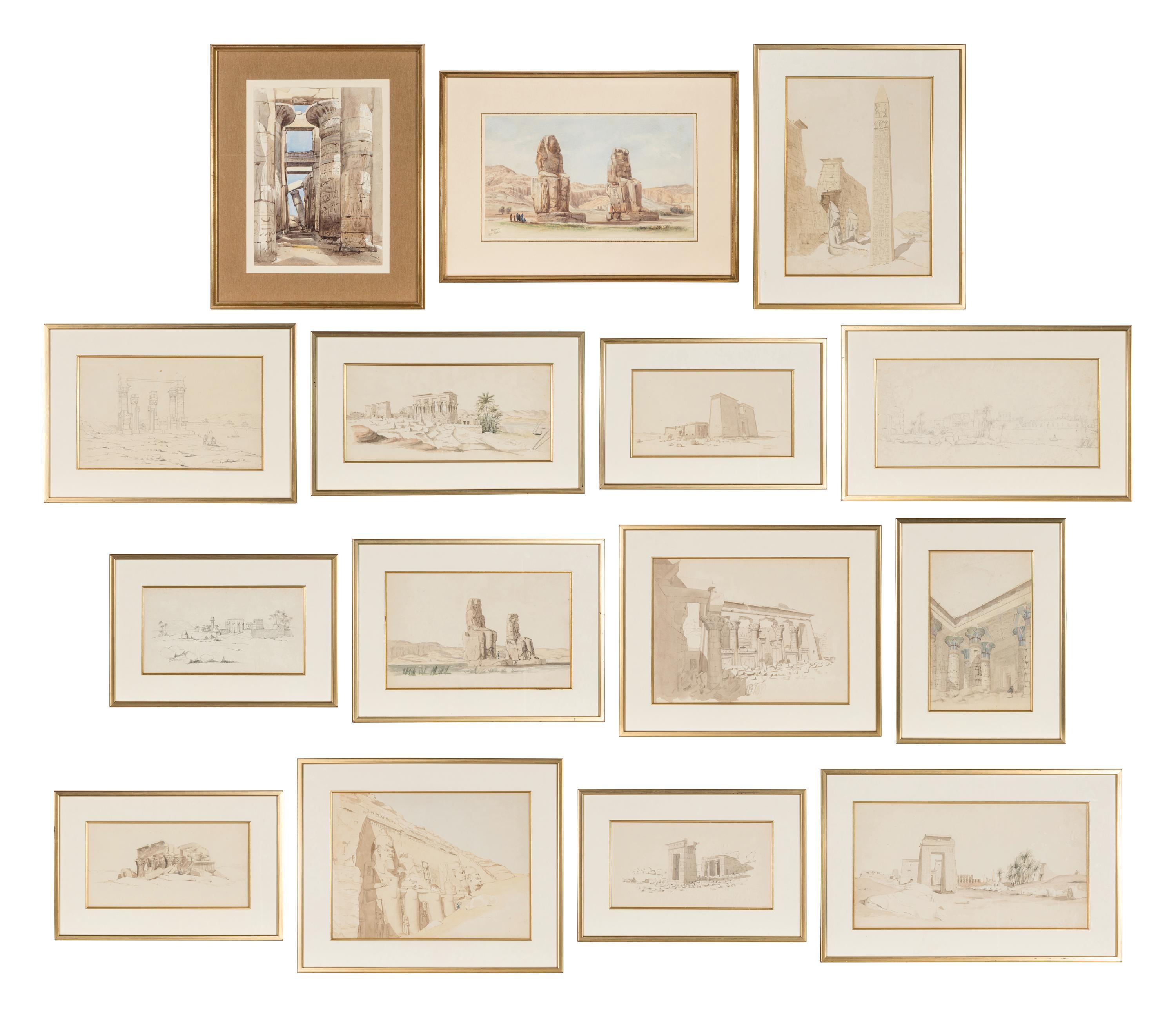
A British engineer, anthropologist, and Egyptologist, John Shae Perring was born in Boston, Lincolnshire in 1813. In 1836, he left for Egypt, where he worked as an engineer on several projects, including those for Muhammad Ali, ruler of Egypt at the time. One of Perring’s main projects was to conduct a survey of the pyramids of Gizeh; he constructed maps and other records of the monuments there. His work was and continues to be an invaluable contribution to research and scholarship on ancient Egypt.
Views of Egypt is a fascinating collection of watercolors, prints, and drawings that Perring made to document his sightings. The collection includes two works of opposite views of the Obelisk at Luxor. One of the depictions exposes a large hole in the foreground where the twin obelisk once stood, before Egypt gifted it to France. Today, it stands in the Place de la Concorde in Paris.
Perring’s Temples of Abu Simbel, Half-Buried and Temple of Kom Ombo, Half-Buried uniquely depict monuments before excavation. The collection also features a representation of the Mammisi of Cleopatra VII and Ptolemy Caesarion in Perring’s Armant (Hermonthis). This monument was later destroyed so that the stone could be used in the construction of a sugar factory. Evidently, Perring’s works immortalize the monuments as they existed in the 1830s. Whether later excavated, moved, or destroyed, his pieces are records of what once was. They are honest historical documents that future Ancient Egyptian scholarship will continue to rely on: rare and reliable evidence of how the landscape of Egyptian ruins has changed.
Lot Note:
Andrew Cunningham Ware (1945-2024) was an avid scholar and amateur Egyptologist whose passion for the ancient world led him to study under the renowned French Egyptologist, Christiane Desroches Noblecourt. Splitting his time between France and South Florida, Ware assembled a diverse collection that reflected his wide-ranging intellectual interests, from ancient Egyptian artifacts to historical documents from the French and Russian Revolutions. His collection, rich with family heirlooms, also features pieces acquired through his travels and academic pursuits. Ware’s family background also adds depth to the collection. He was the great-grandson of Andrew Woodbury Preston, one of the founders of the United Fruit Company. This connection to the world of business subtly informs the collection, where objects of personal significance are intertwined with intellectual curiosity.
1. Gateway of Ptolemy III Euergetes at Precinct of Montu, Karnak Temple Complex
watercolor on paper
sight: 9 3/4 x 18 1/2 in. (24.8 x 47cm)
framed: 15 1/4 x 23 3/4 in. (38.7 x 60.3cm)
2. Hypaethral Temple at Philae Temple Complex and Nile in Background
watercolor on paper
sight: 7 1/2 x 16 in. (19 x 40.6cm)
framed: 12 7/8 x 21 1/2 in. (32.7 x 54.6cm)
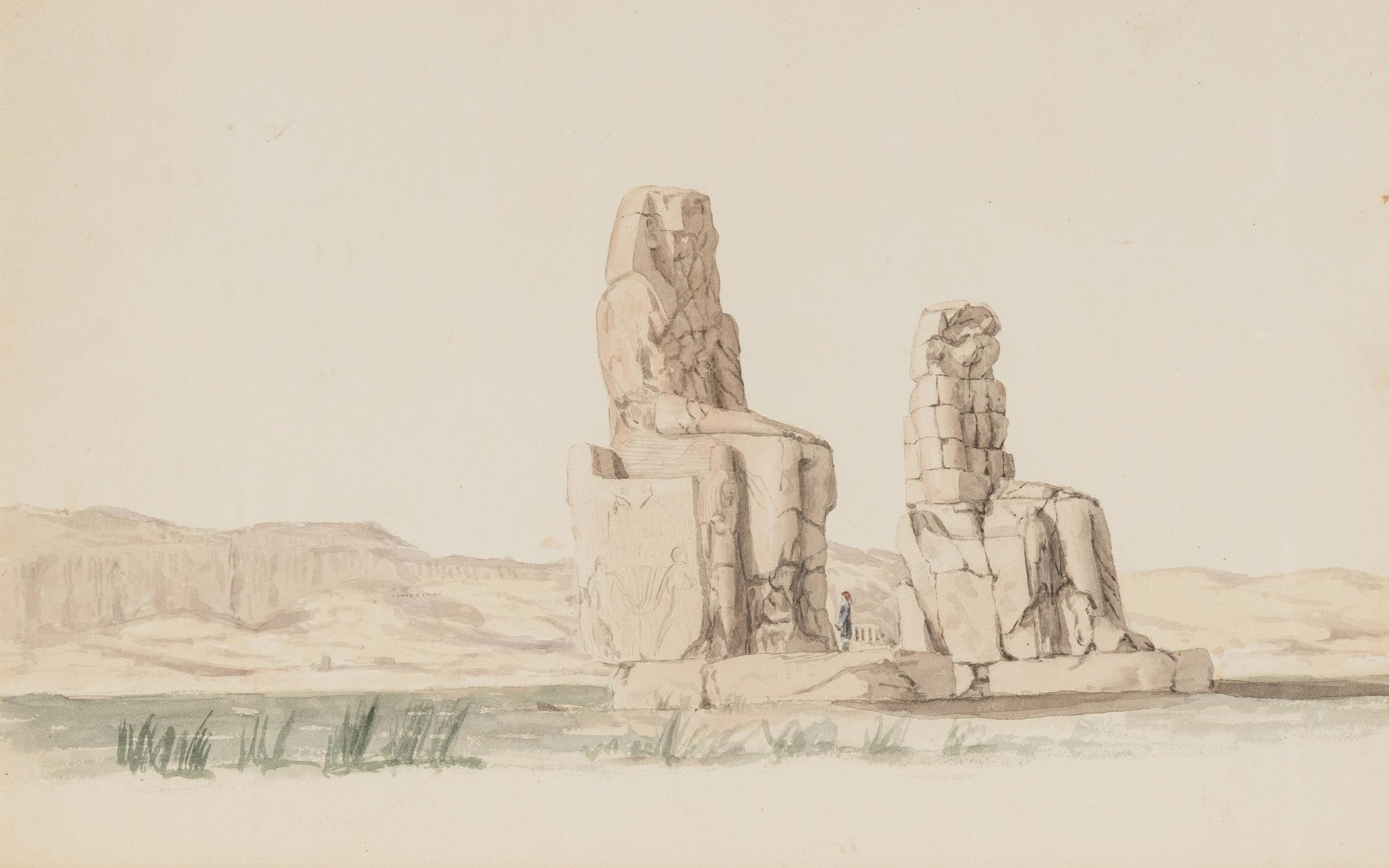
3. Colossi of Memnon at the Mortuary Temple of Amenhotep III
watercolor on paper
sight: 9 x 14 1/2 in. (22.9 x 36.8cm)
framed: 14 1/2 x 20 in. (36.8 x 50.8cm)
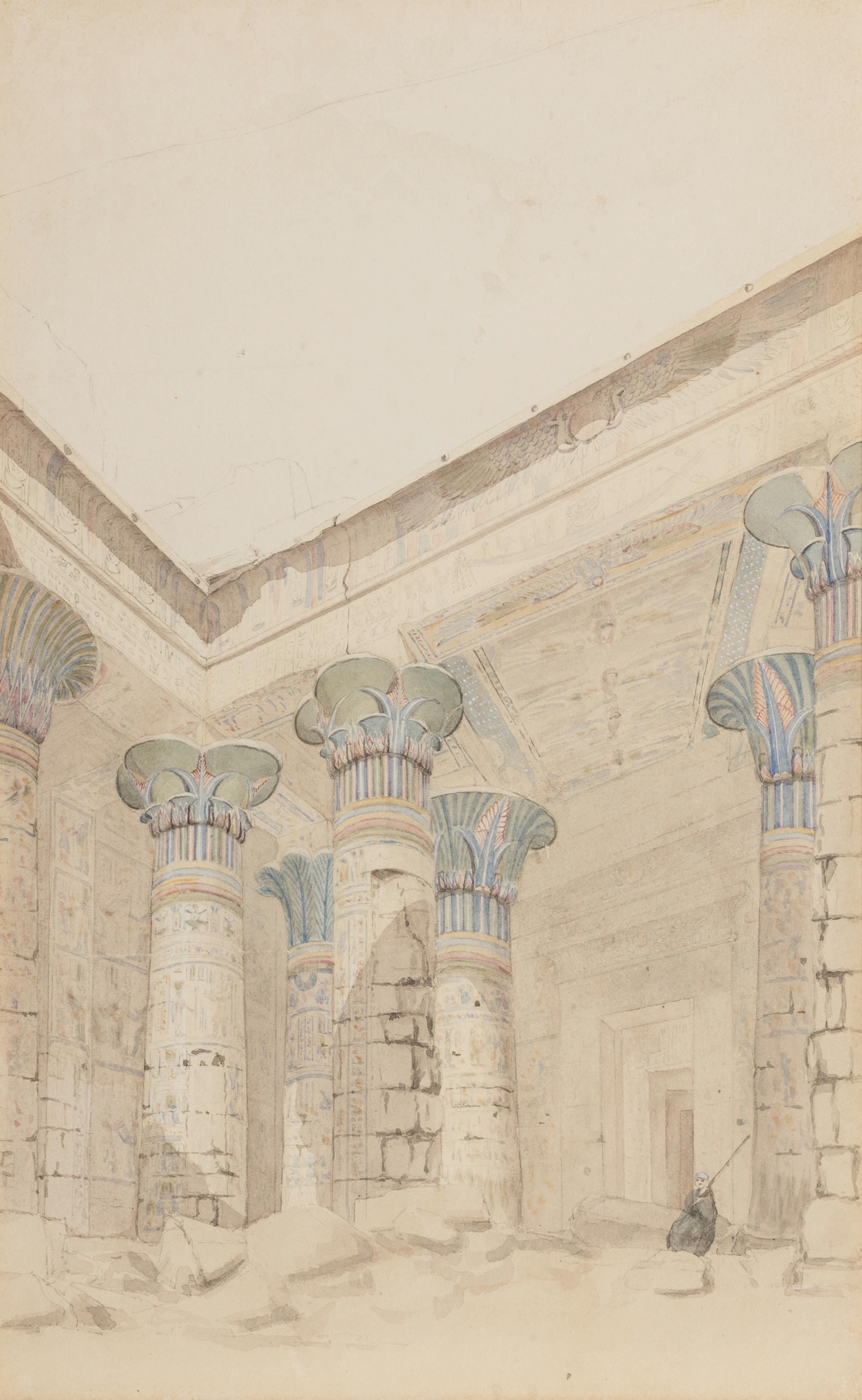
4. Beneath the Grand Portico, Temple of Isis, Philae Temple Complex
watercolor on paper
sight: 12 1/2 x 7 3/4 in.
framed: 18 x 13 1/4 in.
5. Portico of Temple of Horus at Edfu (?)
watercolor on paper
sight: 11 1/4 x 15 1/4 in. (31.8 x 38.7cm)
framed: 16 3/4 x 20 3/4 in. (42.5 x 52.7cm)
6. Temple Ruins with Obelisk at Luxor, 1838-40
watercolor on paper
sight: 15 1/4 x 11 1/4 in. (38.7 x 31.8cm)
framed: 20 3/4 x 16 3/4 in. (52.7 x 42.5cm)
7. Temples of Abu Simbel, Half-Buried 1838-40
watercolor on paper
sight: 11 1/4 x 15 1/4 in. (31.8 x 38.7cm)
framed: 16 3/4 x 20 3/4 in. (42.5 x 52.7cm)
8. Colossi of Memnon, 1871
titled, dated, and inscribed Thebes (lower left)
watercolor on paper
sight: 9 3/8 x 16 3/8 in. (31.8 x 38.7cm)
framed: 16 1/2 x 23 1/2 in. (41.9 x 59.7cm)
9. Salle Hypostyle, Karnak, 1871
inscribed Karnak and dated (lower right)
sight: 13 7/8 x 9 7/8 (35.2 x 25.1cm)
framed: 20 3/4 x 16 3/4 in. (52.7 x 42.5cm)
10. Temple of Dendur, Nubia
watercolor on paper
sight: 6 5/8 x 12 1/2 in. (16.8 x 31.8cm)
framed: 12 x 18 in. (30.5 x 45.7cm)
11. Temple of Kom Ombo, Half-Buried
watercolor on paper
sight: 6 5/8 x 12 1/2 in. (16.8 x 31.8cm)
framed: 12 x 18 in. (30.5 x 45.7cm)
12. Temple of Dakka, Nubia
watercolor on paper
sight: 6 5/8 x 12 1/2 in. (16.8 x 31.8cm)
framed: 12 x 18 in. (30.5 x 45.7cm)
13. Kiosk of Qertassi by the Nile, Nubia
faintly inscribed (lower right)
pencil on paper
sight: 8 1/2 x 14 in. (21.6 x 35.6cm)
framed: 14 x 19 1/2 in. (35.6 x 49.5cm)
14. Armant (Hermonthis), Including the Temple of Montu and the Mammisi of Cleopatra VII and Ptolemy Caesarion
pencil on paper
sight: 6 5/8 x 12 1/2 in. (16.8 x 31.8cm)
framed: 12 x 18 in. (30.5 x 45.7cm)
15. Extensive Temple Grounds by the Nile
pencil on paper
sight: 8 1/2 x 17 1/4 in. (21.6 x 43.8cm)
framed: 13 1/2 x 23 3/4 in. (34.3 x 60.3cm)
The physical condition of lots in our auctions can vary due to age, normal wear and tear, previous damage, and restoration/repair. All lots are sold "AS IS," in the condition they are in at the time of the auction, and we and the seller make no representation or warranty and assume no liability of any kind as to a lot's condition. Any reference to condition in a catalogue description or a condition report shall not amount to a full accounting of condition. Condition reports prepared by Freeman's staff are provided as a convenience and may be requested from the Department prior to bidding.
The absence of a posted condition report on the Freeman's website or in our catalogues should not be interpreted as commentary on an item's condition. Prospective buyers are responsible for inspecting a lot or sending their agent or conservator to inspect the lot on their behalf, and for ensuring that they have requested, received and understood any condition report provided by Freeman's.
Please email [email protected] for any additional information or questions you may have regarding this lot.