To request further details about this lot, please email [email protected]

Adam Veil
VP, Head of Department, American Art and Pennsylvania Impressionists
Sale 6384
| Philadelphia
| Philadelphia
To request further details about this lot, please email [email protected]
Adam Veil
VP, Head of Department, American Art and Pennsylvania Impressionists
Estimate$8,000 – $12,000
Provenance:
The Artist.
By descent to Shayla Spencer, the Artist's granddaughter.
By descent to the present owner.
Literature:
Brian H. Peterson, Pennsylvania Impressionism, Philadelphia, 2002, p. 267, illustrated.
Brian H. Peterson, The Cities, the Towns, the Crowds: The Paintings of Robert Spencer, Philadelphia, 2004, p. 107, pl. 65, illustrated.
Lot Note:
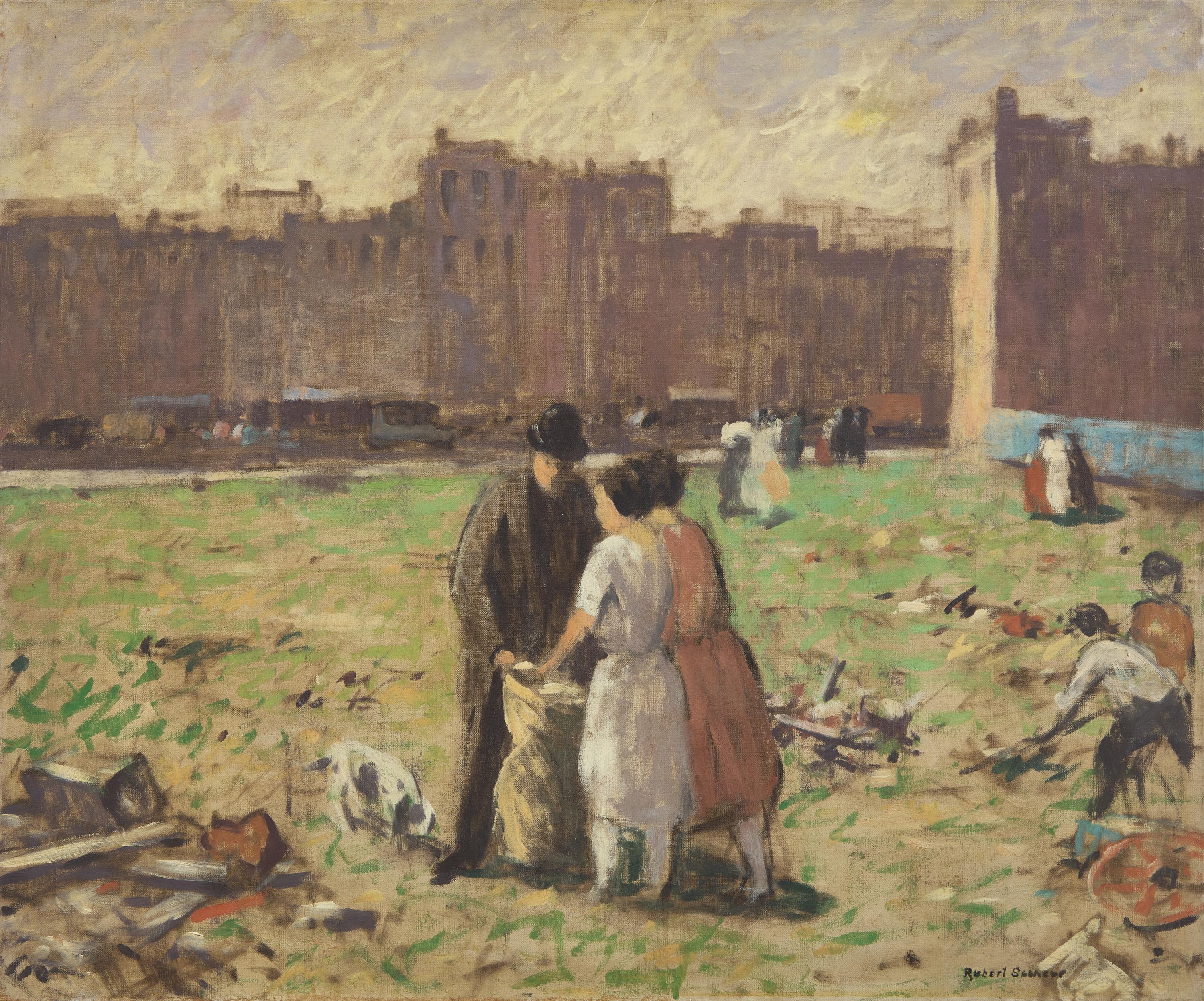
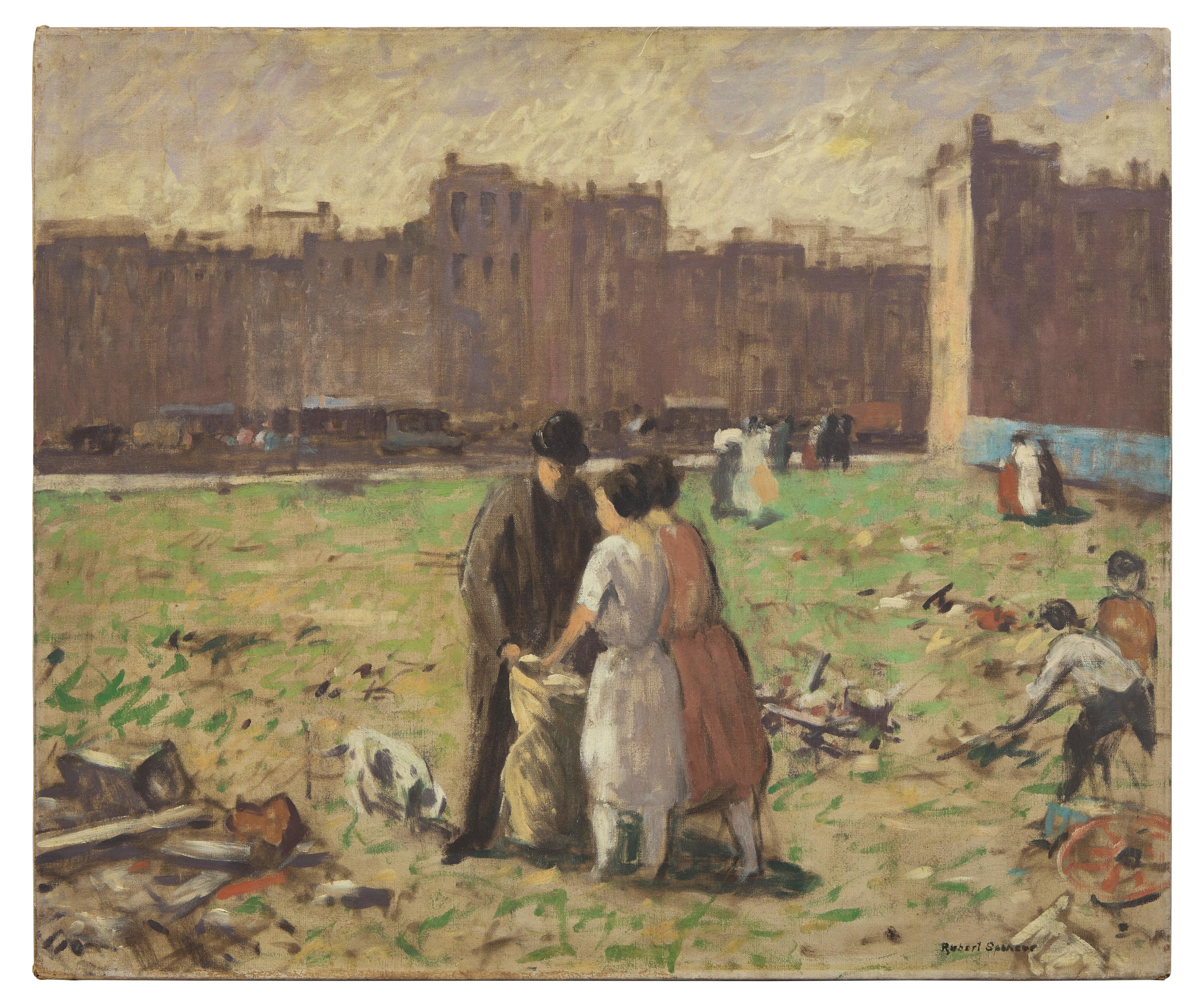
Executed just a year before his passing, the present canvas reflects the final phase of experimentation that marked the artist’s late career. During this period, Spencer began to loosen the disciplined, almost pointillist precision of his earlier work and embraced a freer, more deconstructed touch. Although his subject matter remained largely consistent (he continued to revel in scenes of people working, playing, and simply moving through urban space), by 1926 he had begun to look beyond Bucks County, traveling through Europe and New York, and at times even inventing entire cityscapes from scratch, as appears to be the case here.
In Vacant Lot, the dappled brushwork and heightened lime greens introduce a renewed chromatic richness, recalling the freshness of his early Impressionistic canvases. Yet the atmosphere is quiet, even slightly rigid; the open field and placid light soften the scene, while the severe row of tall tenements anchors it with a stark urban weight. Buildings that were once minutely detailed are now reduced to broad, generalized forms, outlined masses with only the faintest suggestion of detail. This simplification extends to the figures as well. Faceless and understated, those in the foreground are rendered with swift, economical strokes, as though the artist were testing how few marks were needed to suggest presence. At the right, the figures dissolve into dabs and flicks of pigment, their forms barely held together by contour and gesture.
Although Spencer publicly rejected abstraction, these late works resonate with the broader modernist impulse of the 1930s to pare down the visible world to its essential rhythms. The result is an image both experimental and profoundly human. Unlike many of his fellow New Hope School painters, Spencer retained a deep attachment to the human figure, filtering his sympathetic vision of everyday life through an increasingly spontaneous and immediate touch.
Unframed.
The physical condition of lots in our auctions can vary due to age, normal wear and tear, previous damage, and restoration/repair. All lots are sold "AS IS," in the condition they are in at the time of the auction, and we and the seller make no representation or warranty and assume no liability of any kind as to a lot's condition. Any reference to condition in a catalogue description or a condition report shall not amount to a full accounting of condition. Condition reports prepared by Freeman's staff are provided as a convenience and may be requested from the Department prior to bidding.
The absence of a posted condition report on the Freeman's website or in our catalogues should not be interpreted as commentary on an item's condition. Prospective buyers are responsible for inspecting a lot or sending their agent or conservator to inspect the lot on their behalf, and for ensuring that they have requested, received and understood any condition report provided by Freeman's.
Please email [email protected] for any additional information or questions you may have regarding this lot.