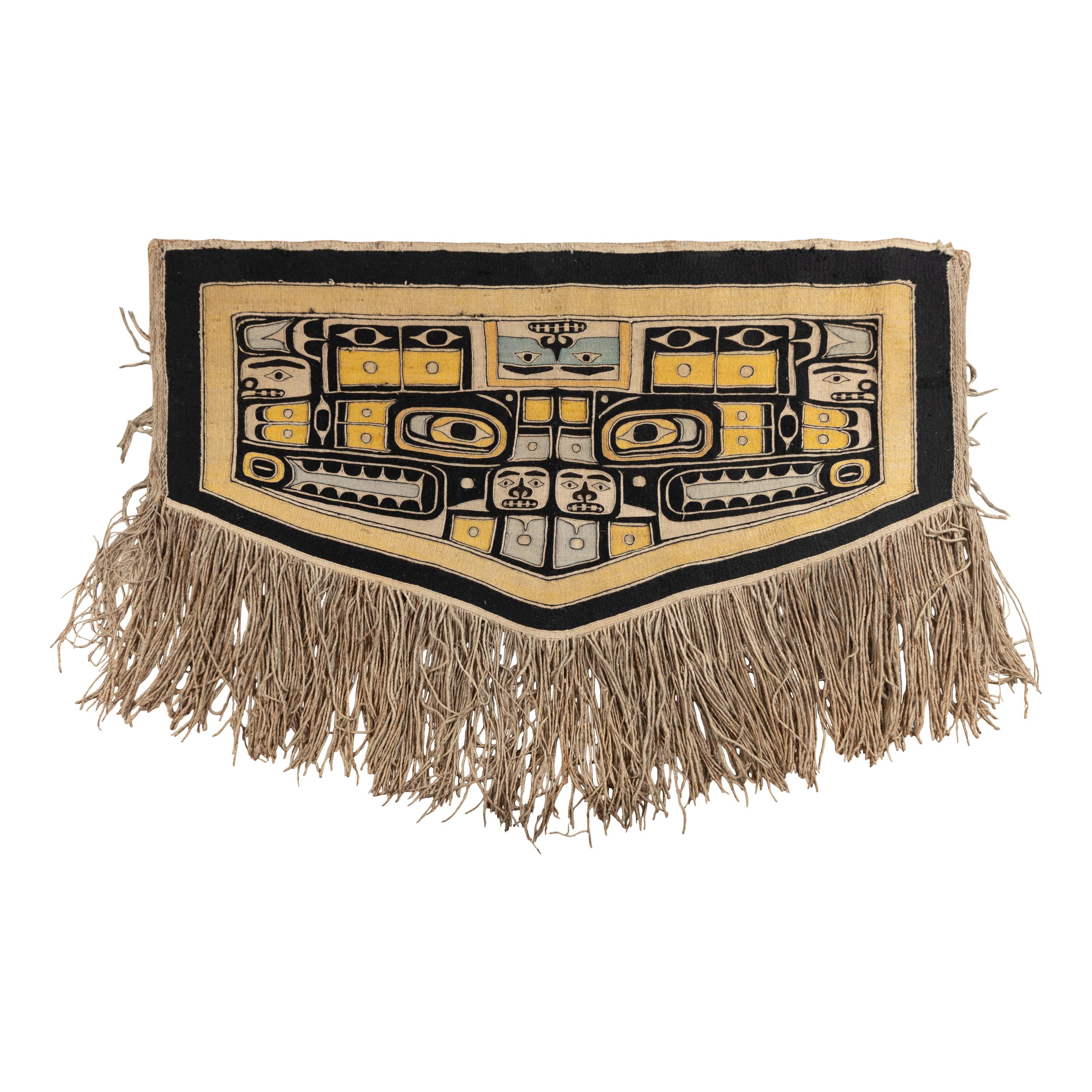
Tlingit Chilkat Blanket
late 19th century
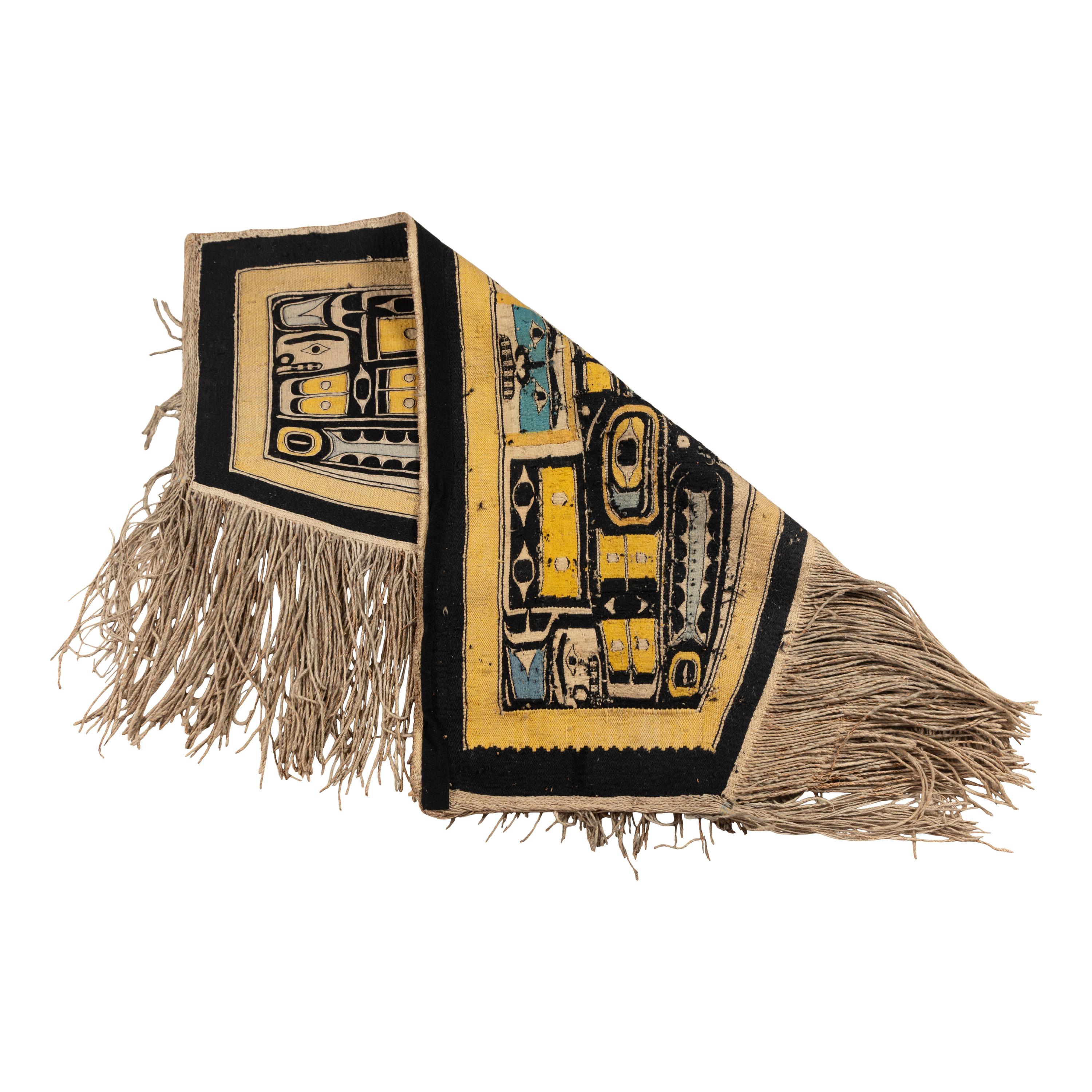
woven of wool and cedar fiber in colors of yellow, blue, black, and natural cream; having a killer whale or Sea Wolf design; blue and yellow "signatures" on both sides of fringe
length 56 inches x width 73 inches
In his 1907 report for the American Museum of Natural History, "The Chilkat Blanket", George T. Emmons documents a blanket bearing a similar design, which he describes as being “treated with unusual freedom” (Emmons 1993: 386). His interpretation, along with those of John R. Swanton and Franz Boas, illustrates the complexity and fluidity of Chilkat design, in which individual elements may be read as different parts of a supernatural being or animal.
"According to Emmons, the design represents a killer-whale. In each lower corner is one-half of the head, with the teeth; right in front of the teeth, the nostril; between the two halves of the head, at the lower border of the blanket, the tail. The inverted face in the middle above represents the body. The large square designs containing the goggle design on each side are interpreted as the water blown out from the blow-hole. One-half of the dorsal fin is indicated by the small round wing-feather design in each upper corner, the human face in profile under it representing one-half of the blow-hole."
John R. Swanton offered a different interpretation: "According to Swanton, the Gonaqadē’t [Sea Wolf] is represented. One-half of the head is shown in each lower corner, the eye design in front of the tongue being interpreted as the chin. The two faces in the middle of the lower border are interpreted as the young ones of the Gonaqadē’t; the flicker-feather designs over them, as the inner part of the body of the old animal. The inverted large face in the middle, at the upper border, is interpreted as its hat; the large square design on each side of this face, containing the goggle design, as the dorsal fin. The two human faces in profile near the upper corners are young ones, the body shown by the round feather design over the face."
"Another interpretation of this design, obtained by Franz Boas, is a killer-whale in the two halves of the head in each lower corner; the food of the killer-whale represented by the eye design in front of the mouth; the tail below, in the middle; the two halves of the dorsal fin just over the tail. The chest is represented by the inverted face in the middle of the upper border; the flippers, by the adjoining square designs and the attached round feather designs. According to this description, the profile faces near the upper corners should be the blow-holes" (see Bulletin American Museum of Natural History, Vol. IX, p. 174).
The Basketry of the Tlingit and The Chilkat Blanket (Emmons, George T. 1993: 386-367, fig. 580)
This lot is located in Chicago.