Images Related to the 1862 Dakota Uprising in Minnesota, Including Views of Sioux Held at Fort Snelling and Rev. H.B. Whipple
cartes de visite
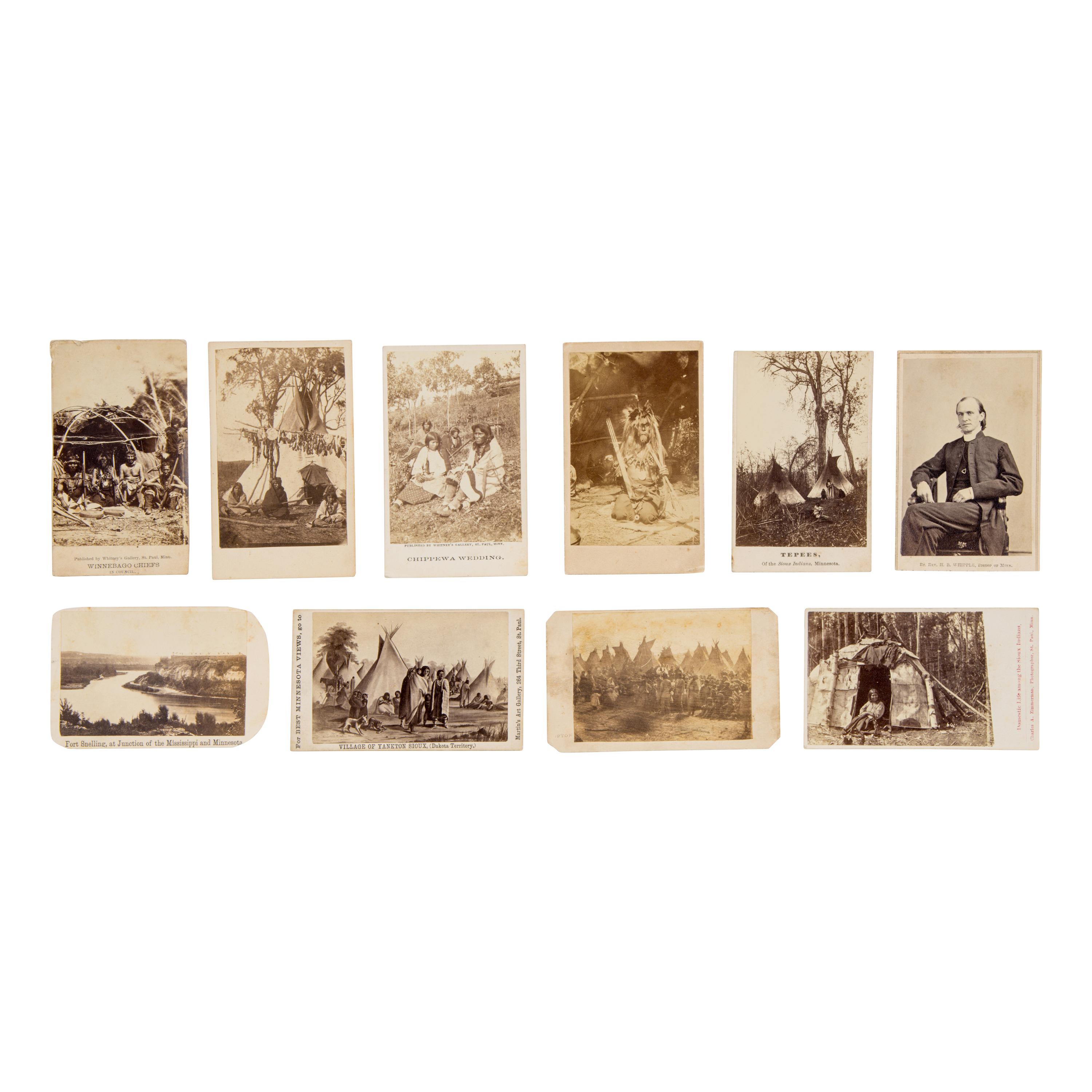
lot of 10 CDVs on cardstock mounts. Scenes and subjects, some identified on rectos, include:
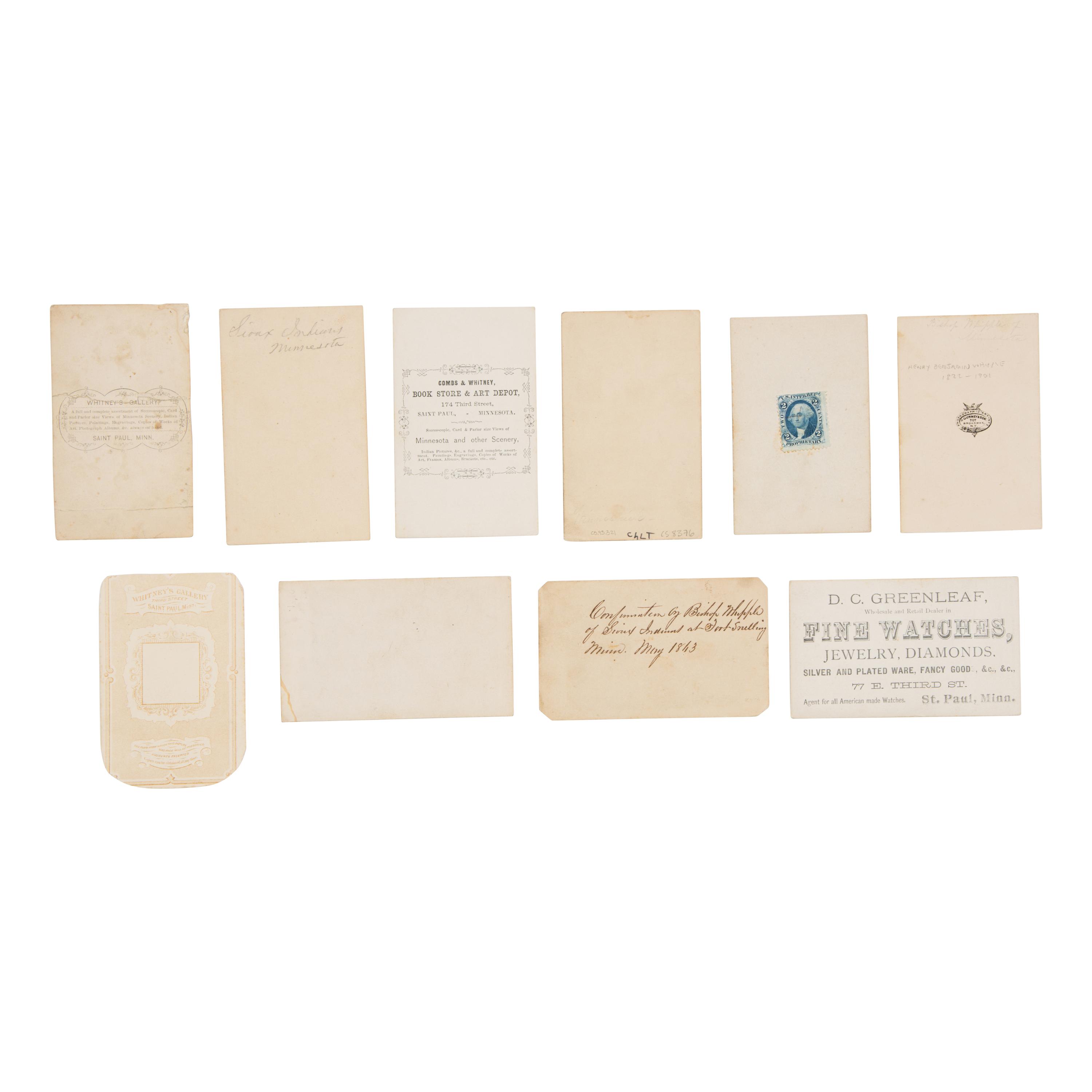
"Confirmation by Bishop Whipple of Sioux Indians at Fort Snelling Minn. May 1863" (as inscribed in period hand on verso). Mount recto with "Upton" blindstamp at lower left (soiling to print and mount). Bishop Henry Whipple (1822-1901), a well-known figure in Minnesota history, was elected the state's first Episcopal bishop in 1859. For more than 40 years he built churches and congregations throughout Minnesota. He was a vocal advocate for Indian rights, continually urging decency and honesty in US government policies and treatment of the Dakota. Called "Straight Tongue" by his Indian friends, he can be seen in the center of this photo in clerical garb, ministering to the Dakota. -- "Rt. Rev. H.B. Whipple, Bishop of Minn." Seated portrait of Bishop Whipple, with imprint of Gurney & Son, New York.
The remaining 8 CDVs are credited to St. Paul, Minnesota, studios including Whitney's Gallery, Martin's Gallery, and Charles Zimmerman. Many were likely taken at the prison camp at Fort Snelling. Subjects include: "Winnebago Chiefs," including Winneshiek and other Ho-Chunk leaders (significant horizontal crease near center of print and mount). -- "Domestic Life among the Sioux Indians," with a woman seated before a tent. -- Ho-Chunk leader Winneshiek II, likely at Fort Snelling in 1863. -- A Sioux camp in Minnesota (as per verso penciled notation), featuring three Native subjects seated in front of a tent. -- "Chippewa Wedding." -- "Tepees, of the Sioux Indians, Minnesota." -- "Fort Snelling, at Junction of the Mississippi and Minnesota." -- "Village of Yankton Sioux (Dakota Territory)."
The new state of Minnesota was home to thousands of Native Americans in 1862, many of whom were disenchanted with the government's promise for annuities. In August of that year, a number of the Dakota were starving; on the 18th, Indians at the Lower Agency attacked the white settlers there. Over the next few weeks hundreds of whites were killed, until the uprising was finally put down by Federal troops under the command of Henry Sibley.
Fort Snelling was used to confine Dakota survivors of the US-Dakota War of 1862 before they were forced to relocate to the Crow Creek Reservation in Dakota Territory, where many died of starvation and disease during the following three years. In 1866, the survivors were moved downriver to Santee, Nebraska, where their descendants remain.
The Larry Ness Collection of Native American Photography
This lot is located in Chicago.