To request further details about this lot, please email [email protected]

Adam Veil
VP, Head of Department, American Art and Pennsylvania Impressionists
Sale 6582
| Philadelphia
| Philadelphia
To request further details about this lot, please email [email protected]
Adam Veil
VP, Head of Department, American Art and Pennsylvania Impressionists
Estimate$500,000 – $700,000
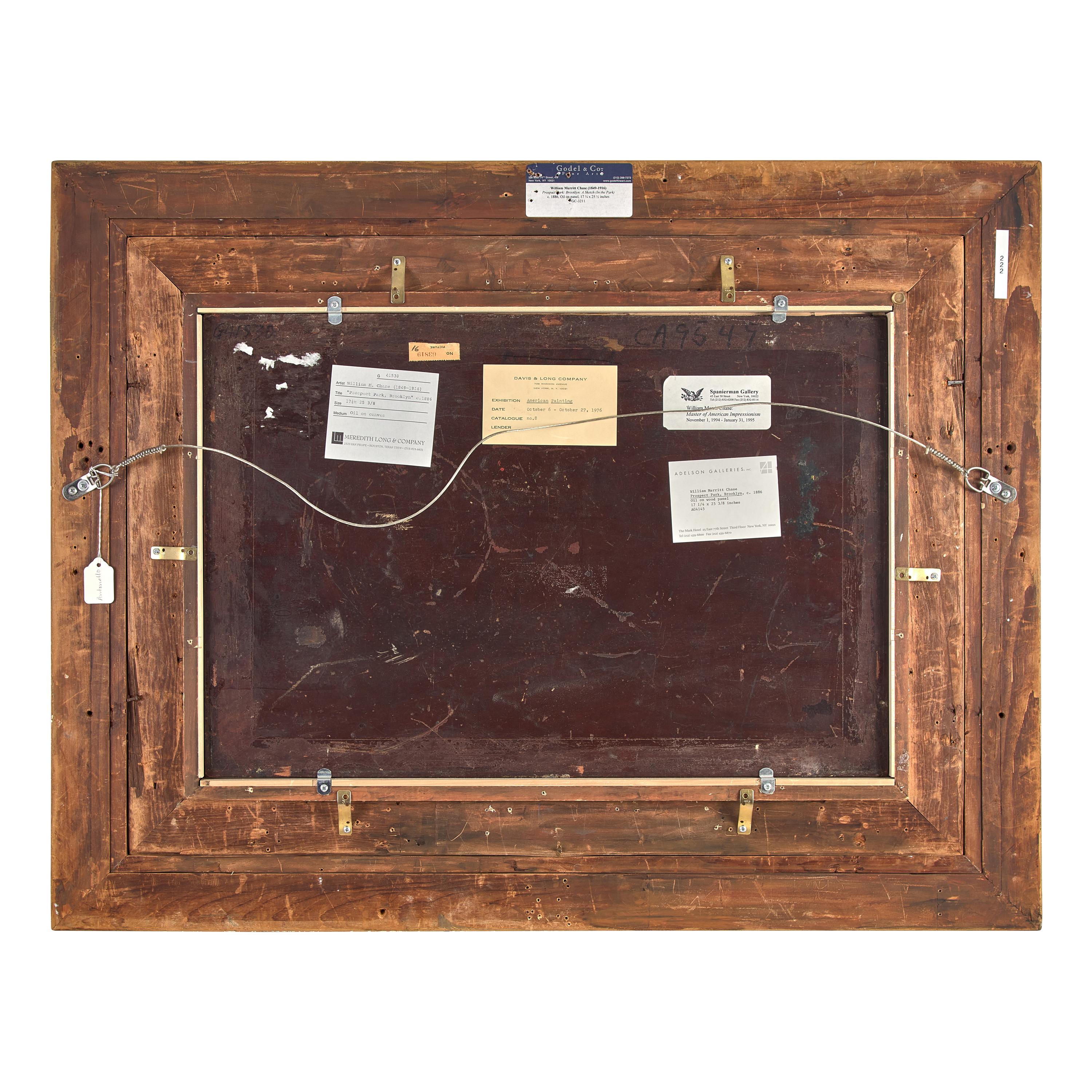
Provenance:
Estate of the Artist.
American Art Galleries, New York, The Paintings and Other Artistic Property Left by the Late William Merritt Chase, N.A., May 14 - 17, 1917, Lot 84 (as Prospect Park, Brooklyn: A Sketch).
(Possibly) Young's Art Galleries, Chicago, acquired from the above sale.
Weston Galleries.
Mrs. Albert Sterner, New York, acquired from the above.
M. Knoedler & Co., New York, acquired from the above c. 1960.
Mr. and Mrs. Raymond Horowitz, acquired from the above, c. 1966.
Davis and Long Co., New York, c. 1977.
Private Collection.
Adelson Galleries, New York.
Acquired from the above by the present owner, c. 2006.
Exhibited:
Boston, Boston Art Gallery, Exhibition of Pictures, Studies and Sketches by Mr. Wm. M. Chase Under the Auspices of the American Art Association, November 13 - December 4, 1886, (possibly) no. 80 (as Landscape-Sketch).
New York, Moore's Art Galleries, Paintings by Mr. William M. Chase, (possibly) no. 29 (as Landscape-Sketch).
Chicago, Young's Art Galleries, Exhibition and Sale of Paintings by American and European Artists, November 1921, no. 28.
New York, The Gallery of Modern Art, William Merritt Chase, April - May 1965 (exhibition organized by the Art Gallery, University of California, Santa Barbara as The First West Coast Retrospective of Paintings by William Merritt Chase. The present lot was added to the exhibition in New York, and thus not included in the exhibition catalogue).
New York, Spanierman Gallery, Master of American Impressionism, November 1, 1994 - January 31, 1995.
New York, Metropolitan Museum of Art, William Merritt Chase: Modern American Landscapes, May 26 - August 13, 2003, pl. 16, illustrated (and traveling to the Art Institute of Chicago, September 7 - November 26, 2000; Museum of Fine Arts, Houston, December 13, 2000 - March 11, 2001).
Literature:
American Art Association, Catalogue of The Completed Pictures, Studies and Sketches Left by the Late William Merritt Chase, N.A., New York, 1917, no. 84.
Art News, February 1977 (advertisement for David and Long Co., New York).
Letter from D. Frederick Baker, on behalf of Ronald G. Pisano's Catalogue Raisonné of William Merritt Chase, October 28, 2003.
Ronald G. Pisano and Carolyn K. Lane, William Merritt Chase: Landscapes in Oil (Complete Catalogue of Known and Documented Works by William Merritt Chase 19849-1916), vol. 3, New Haven and London, 2009, pp. 30-32, no. L55, illustrated.
Lot Note:
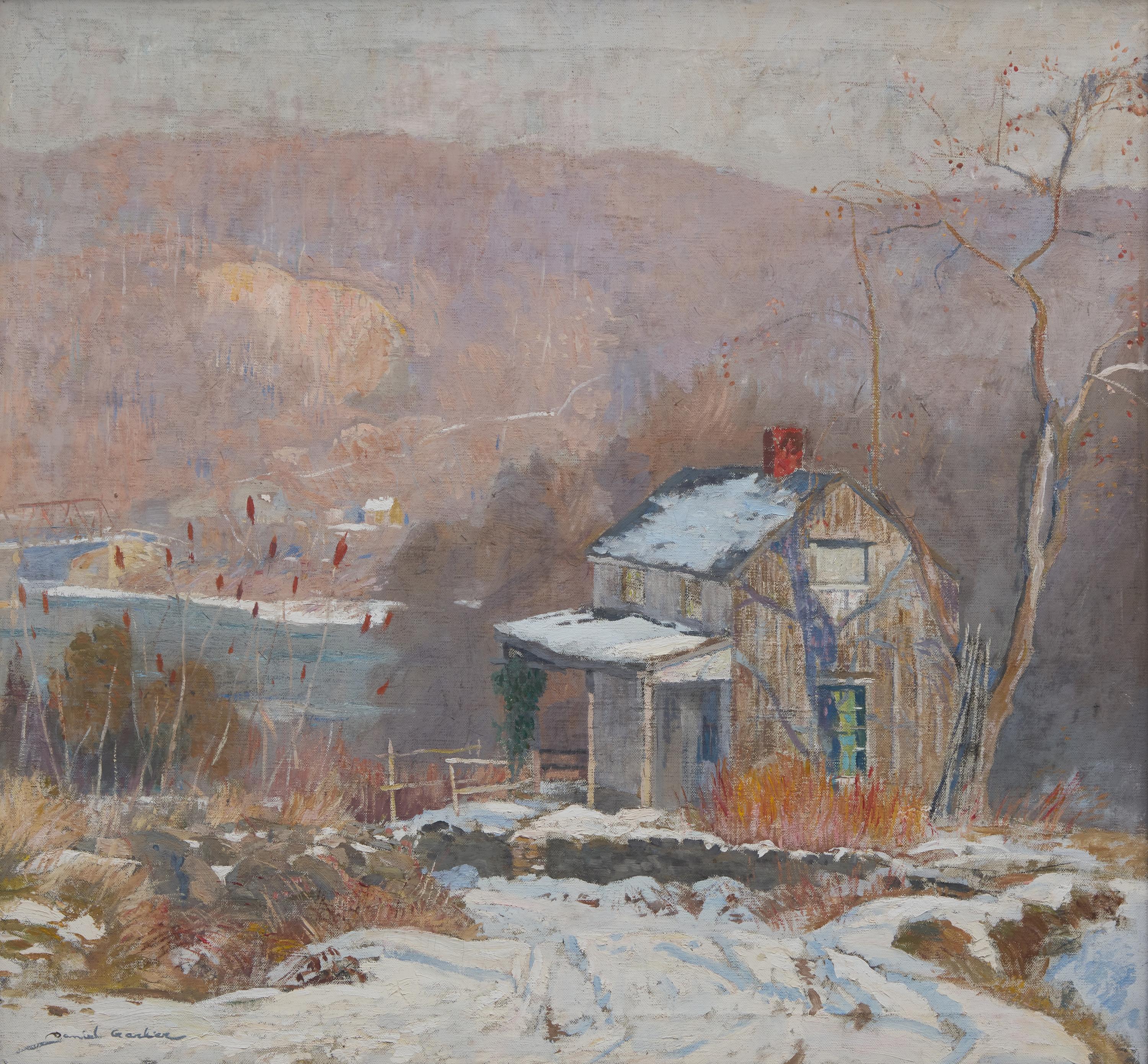
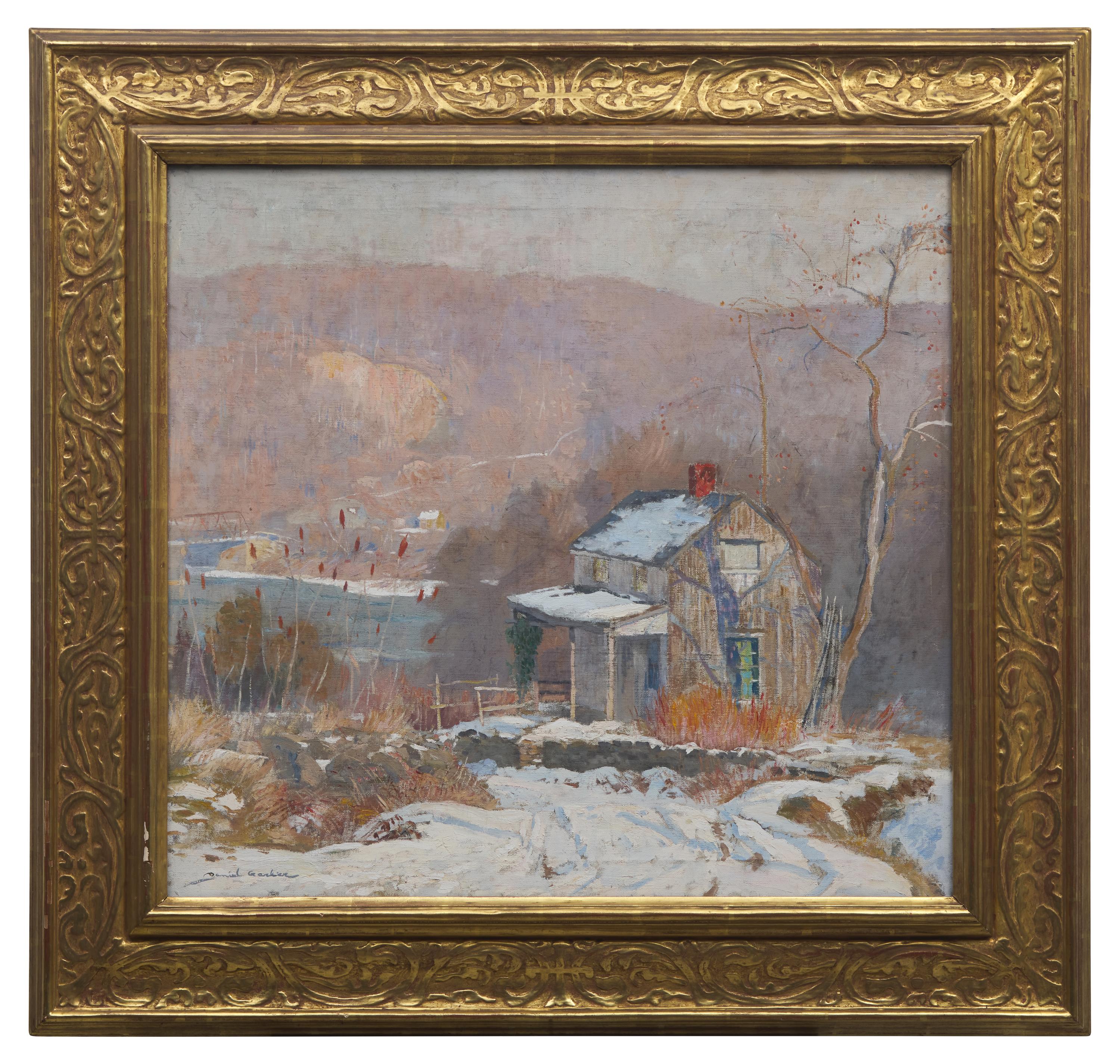
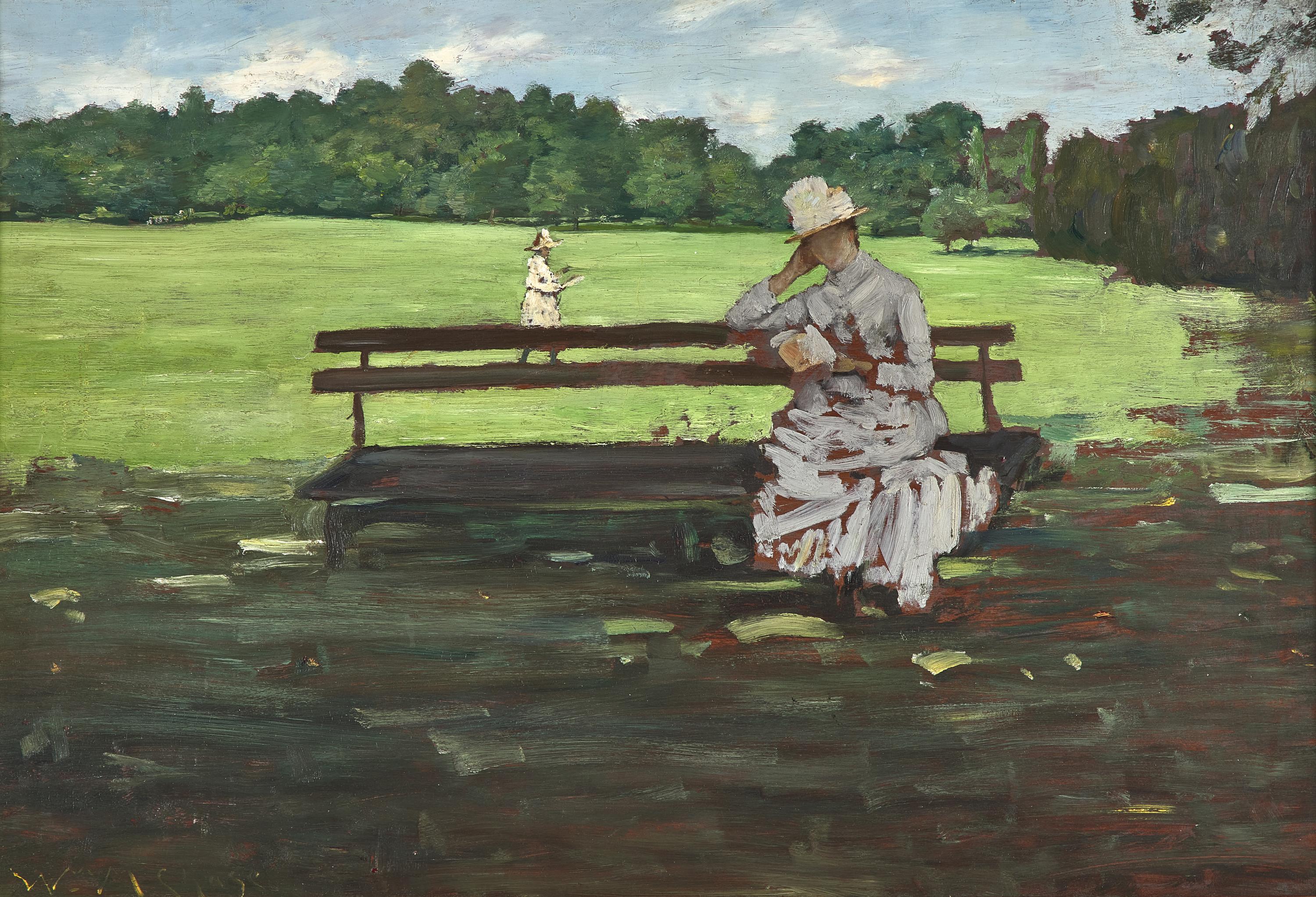
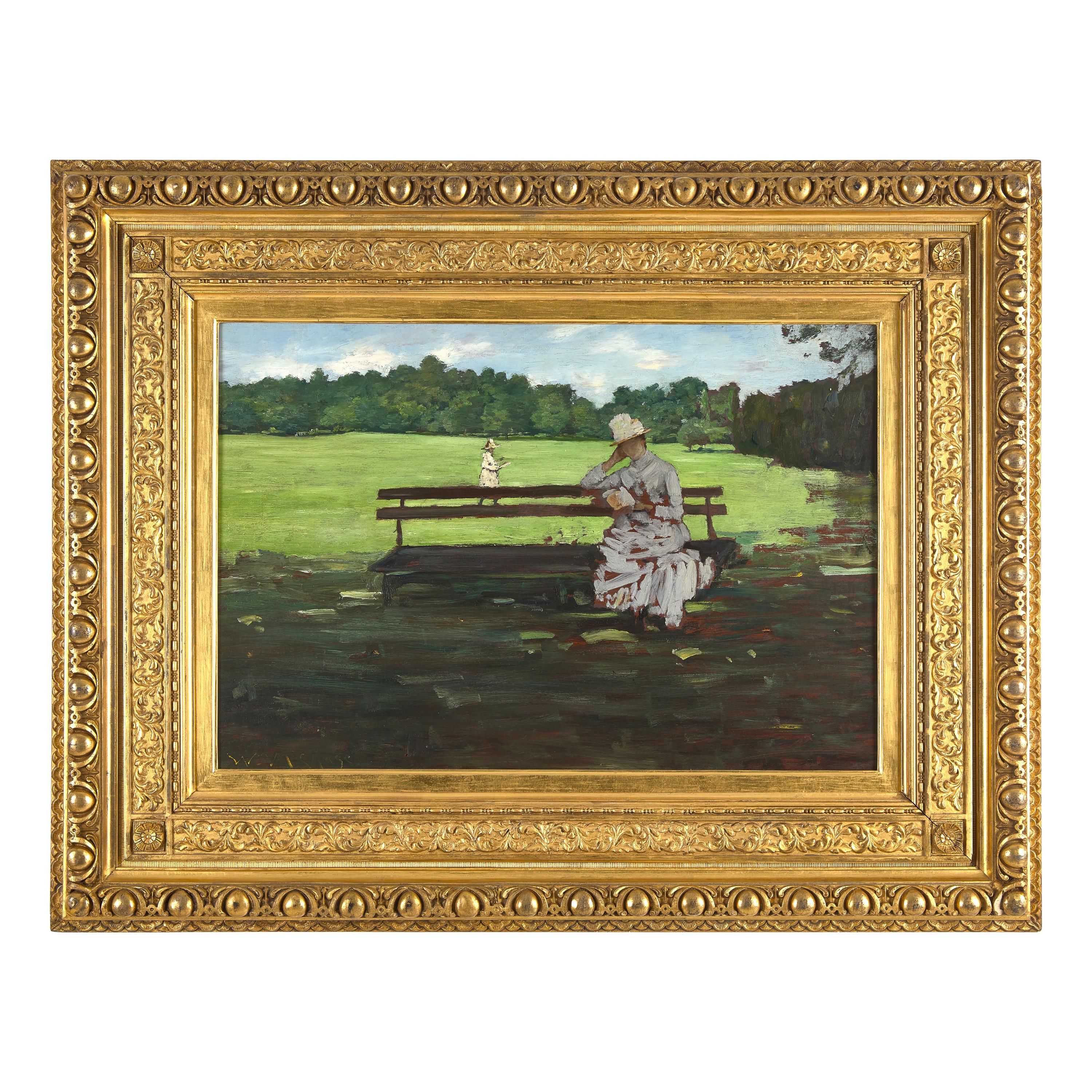
Prospect Park, Brooklyn: A Sketch (In the Park), c. 1886 is the archetypal Chase painting of this period in the artist’s career. It captures light and shadow, as well as the fleeting moment, and one can almost imagine Chase seated at his portable easel painting the panel "on the spot." The unpainted parts of the panel also signaled a new approach to creating art – that it was more important for an artist to paint a sense of place than recreate every detail of a scene. At the end of the 19th century, this was considered daring and “modern” but for Chase it reflected the spontaneous nature and joy of painting that employed methods he had first been exposed as a student at the Munich Royal Academy in the 1870s. While the work Prospect Park Brooklyn was most likely titled for the 1917 estate sale, it reflects Chase’s belief that the painting is complete, as he often exhibited painted sketches, believing them to have finished integrity.
Prior to 1886, the artist had spent part of every summer in Europe since 1881. However, in 1886 he remained in New York as he prepared for his first major retrospective exhibition, to be held at the Boston Art Club in November and December of that year. That same year, his parents moved to Brooklyn and Chase, after his marriage to Alice Gerson, also moved for a short time to Brooklyn, at the time America's third largest city.
The Boston exhibition included several paintings of Prospect Park, and Chase would go on to create a unique body of park scenes painted in Brooklyn parks, and Central Park between 1886 and 1890. As a result, he became known as “the artistic interpreter of Prospect Park and Central Park.” Contemporary accounts described these paintings as “veritable little jewels,” “marvelous little masterpieces,” and “brilliant...strong...and joyous paintings.” The foremost Chase scholar, Ronald G. Pisano, wrote that the artist was described as, "a kind of human camera, through whose lens a new definition of beauty emerged in subjects most people, including his fellow artists, had found dull and uninteresting.” The American artist Kenyon Cox believed these park paintings to be “proof...that it is not subjects that are lacking in this country, but eyes to see them with. Let no artist,” he continued, “complain of lack of material when such things as these are to be seen at his very door, and the public cease complaining of the un-American quality of American art.”
In an 1891 article titled "Suburban Sketching Grounds" (Art Amateur), Chase described his working methods when painting city parks: “When I start to paint out of doors I put myself in as light marching order as possible; that is I have everything made as portable and with as little weight as it can be. I have a light color box...wooden panels [and] a neatly made frame with grooves into which I can slip two panels and carry them firmly without their touching each other when the paint is wet...I carry a comfortable stool that can be closed up in a small space and I never use an umbrella. I want all the light I can get...I set up my easel and paint the picture on the spot. I think that is the only way to rightly interpret nature.”
In the spring of 1890, the park's superintendent banned Chase and other professional artists from painting in Prospect Park. Chase vehemently fought for the right to paint in the park, but it wasn't until the end of June 1890 that he and his fellow artists prevailed. At this point, Chase had already spent a month painting in Central Park, and as a result, he didn't return to paint in Prospect Park. Charles De Kay wrote of these park paintings in Harper's Weekly, May 1891, that “...the artist sees the beauty of the Park, watches the play of sunlight on lake, tree-top, and meadow, and picks out for its unexpected charm some corner neglected by the public.” At the time this article was written, however, Chase was teaching at his Shinnecock Summer School of Art, in Southampton, a venture he would continue until his last class on Long Island in 1902. His depictions of the dunes and beaches near his summer home in Shinnecock Hills would, along with his park scenes, reflect the carefree lives of his family and America's growing leisure class, described at the time as the “picnic generation.” In the early 20th century, Chase resumed his yearly trips to Europe, and while he never returned to paint the lawns, lakes, and byways of Prospect Park, these paintings retain the charm and beauty of a place very close to the heart of the artist.
The present painting was most likely painted during the summer of 1886 when Chase visited his parents, David and Sarah Swaim Chase, who had recently moved to Brooklyn. It is one of a number of paintings and pastels of Prospect Park completed between 1886 and 1890. Scholar Barbara Dayer Gallati has identified the location as a slight rise overlooking Prospect Park's Long Meadow.*
________
*William Merritt Chase: Modern American Landscapes, New York, 2000, p. 71.
Framed: 29 x 37 x 3 in.
The physical condition of lots in our auctions can vary due to age, normal wear and tear, previous damage, and restoration/repair. All lots are sold "AS IS," in the condition they are in at the time of the auction, and we and the seller make no representation or warranty and assume no liability of any kind as to a lot's condition. Any reference to condition in a catalogue description or a condition report shall not amount to a full accounting of condition. Condition reports prepared by Freeman's staff are provided as a convenience and may be requested from the Department prior to bidding.
The absence of a posted condition report on the Freeman's website or in our catalogues should not be interpreted as commentary on an item's condition. Prospective buyers are responsible for inspecting a lot or sending their agent or conservator to inspect the lot on their behalf, and for ensuring that they have requested, received and understood any condition report provided by Freeman's.
Please email [email protected] for any additional information or questions you may have regarding this lot.