Sale 6329
| New York
| New York
Estimate$60,000 – $80,000
We are grateful for the research conducted by Susan Weininger, Professor Emerita, Roosevelt University.
Provenance:
Karl Priebe, Milwaukee, Wisconsin
Sold: Milwaukee Auction Galleries, Milwaukee, Wisconsin, Priebe Estate Sale, September 9-21, 1980
Acquired at the above sale by the present owners
Lot Essay:
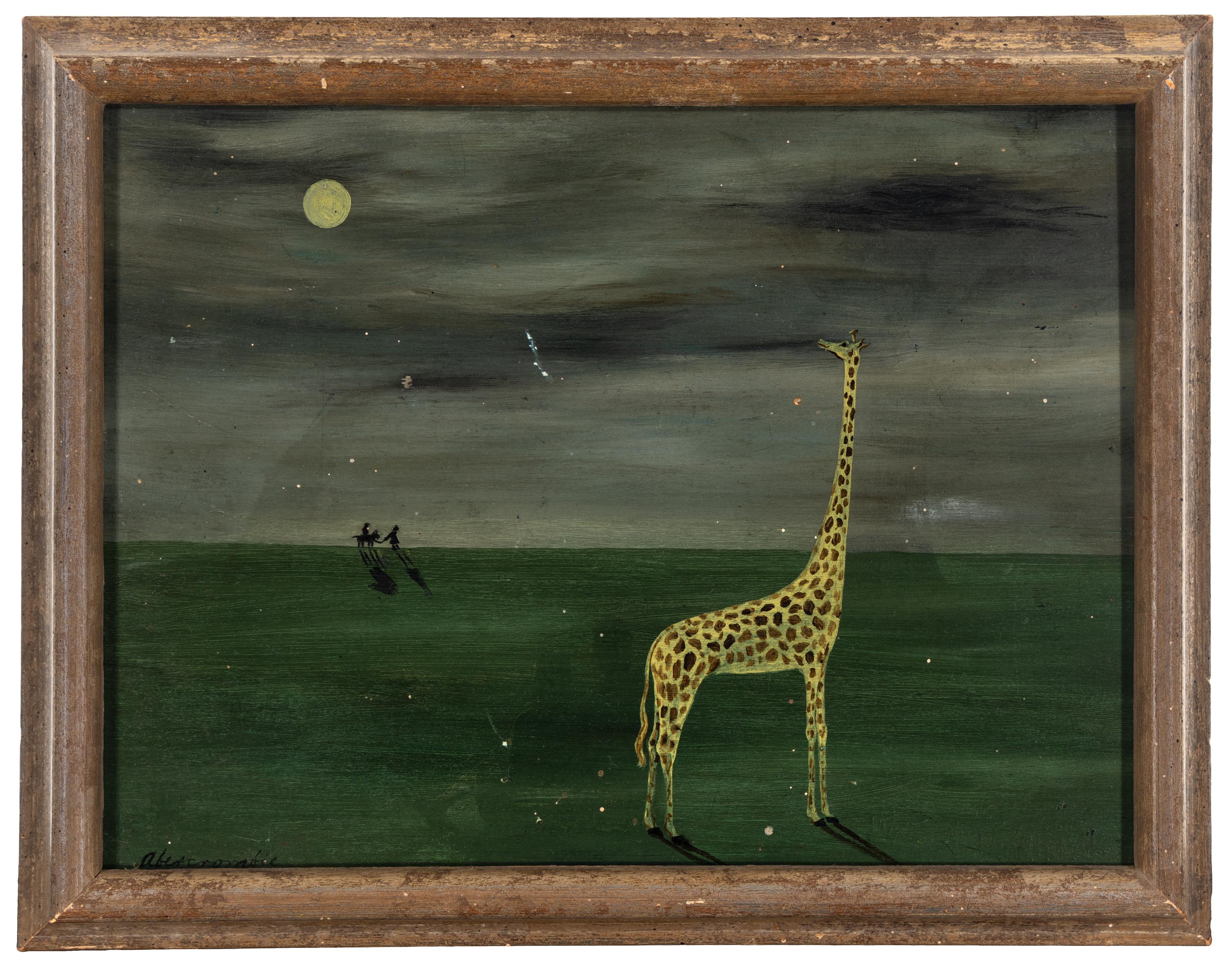
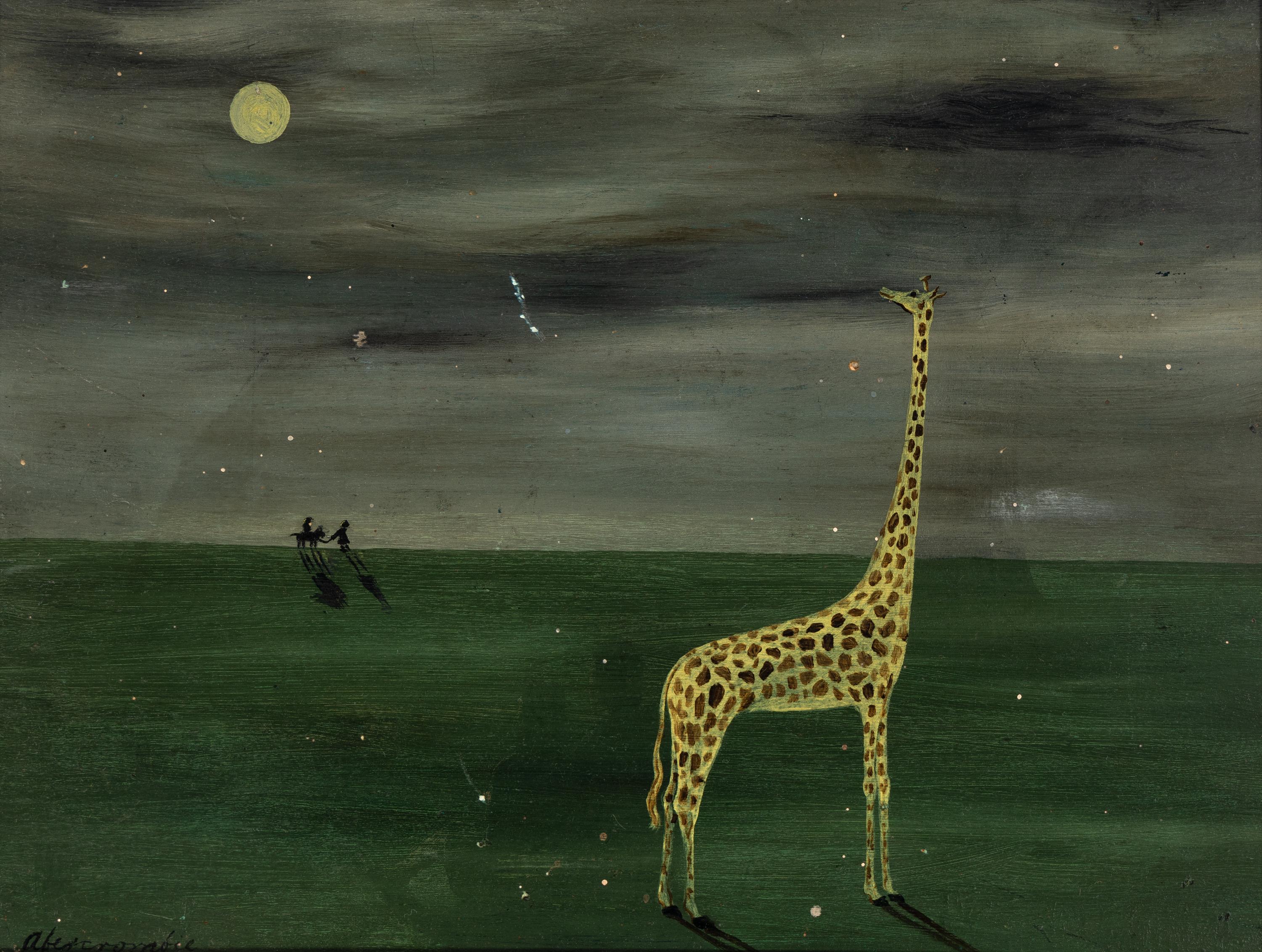
Gertrude Abercrombie did many paintings of giraffes, with the earliest dating to around 1938, near the beginning of her career and the latest dating to 1958, about a decade before her last paintings. During this 20-year period she executed at least 16 paintings in which a giraffe, or on at least one occasion, two giraffes, are the major subject (Two Giraffes [Giraffe Lovers], 1951, Private Collection). Sometimes a giraffe appears in the background of a scene, such as the one in Search for Rest, 1951 (Dijkstra Collection), which resembles the one in the present painting. Landscape with Giraffe may be the largest in which the giraffe is the major subject; most are about half its size, and several are very tiny (1 ½” x 2” or smaller), which the artist created to be made into brooches. The popularity of this subject is attested to by the fact that almost all of them were sold at various venues, including Associated American Artists in Chicago, Katharine Kuh Gallery, the Renaissance Society of the University of Chicago, and at the South Side (Hyde Park) Art Fair where Abercrombie was a very popular fixture each summer and where she made many sales.
The composition of Landscape with Giraffe is similar to the artist’s other 1950s compositions that include giraffes, which consist of a single giraffe in an austere landscape with a moon in the sky. The earliest Giraffe, from about 1938, is situated in a brilliantly colored, lush landscape characteristic of that period in Abercrombie’s development. Landscape with Giraffe has more similarities to the arid, desolate landscapes that come to dominate her work by the early 1940s. While the painting is not dated, stylistically it appears to be from sometime in the early to mid 1950s. Although the painting is spare in elements, as in other giraffes works from this time, it is unique. Here, the giraffe, in the right foreground of the work, faces right but turns its head to look at the moon in the upper left sky. In the distant background there are the silhouettes of a tiny figure leading a horse and rider. These figures and the giraffe all cast shadows in the light of the moon.
Abercrombie once famously said, “It is always myself that I paint,” and even in her still life paintings and empty rooms she is present. The repertoire of personal objects that recur in her paintings come to stand in for the artist herself. It may be that the tall, long-necked artist may have found in this animal another alter ego. She adopted the owl and the cat, familiars of the witch, for compositions in which she wanted to emphasize those roles; she might have chosen to identify also with the giraffe, a less familiar creature but something of a unique outlier as she was herself. There are numerous self-portraits in which her neck is elongated, for example, Self Portrait of My Sister, 1941 (Art Institute of Chicago). Likewise, in the many images of Abercrombie in a room or a landscape, her neck appears unnaturally long.
Additionally, although there is no evidence of the artist’s awareness of this, Abercrombie’s interest in giraffes coincided with the widely publicized arrival of two African giraffes in New York enroute to the San Diego Zoo. They arrived in San Diego in late 1938, around the same time Abercrombie began to paint these animals. This was an event of some moment, as giraffes were a rarity in the United States at this time; reportedly there were only five of the animals in the country in 1925. Even though the artist did not generally reference current events in her work, the huge outpour of publicity around the giraffes’ arrival may have stimulated her to inhabit this animal as another alter ego. The moon, which Abercrombie always considered her personal property, is accessible to the long-necked animal, who can reach it by virtue of its height, something Abercrombie would have loved to do herself. This image of a giraffe stretching towards the moon attests to her ownership in a simple, yet resonant way. It is typical of the artist’s transformation of recognizable things of this world into evocative, meaningful, and mysterious art.
Framed: 10 3/4 x 13 5/8 x 2 inches.
The physical condition of lots in our auctions can vary due to age, normal wear and tear, previous damage, and restoration/repair. All lots are sold "AS IS," in the condition they are in at the time of the auction, and we and the seller make no representation or warranty and assume no liability of any kind as to a lot's condition. Any reference to condition in a catalogue description or a condition report shall not amount to a full accounting of condition. Condition reports prepared by Freeman's staff are provided as a convenience and may be requested from the Department prior to bidding.
The absence of a posted condition report on the Freeman's website or in our catalogues should not be interpreted as commentary on an item's condition. Prospective buyers are responsible for inspecting a lot or sending their agent or conservator to inspect the lot on their behalf, and for ensuring that they have requested, received and understood any condition report provided by Freeman's.
Please email [email protected] for any additional information or questions you may have regarding this lot.