Sale 6342
| Philadelphia
| Philadelphia
Estimate$120,000 – $180,000
Provenance:
Collection M. Marien Pré, Anse.
Collection of Madame Nora Kars (wife to painter Georges Kars).
Galerie Paul Pétridès, Paris.
Sharry Grosman Fine Arts, New York, New York.
Private Collection, New York, New York.
Exhibited:
Paris, Musée Galliéra, Marie-Anne Camax-Zoegger, Louise Hervieux, Suzanne Valadon, 1961, no. 52.
Paris, Musée National d'Art Moderne, Suzanne Valadon, March 17-April 30, 1967, no. 8.
National Museum of Women in the Arts, Washington, D.C. (on long-term-loan from 1991 to 1996).
Literature:
Robert Rey, Suzanne Valadon, Vingt-Huit Reproductions de Peintures et Dessins etc., Paris, 1922, p. 27.
Paul Pétridès, L'œuvre Complet de Suzanne Valadon, Paris, 1971, no. P14 (illustrated).
Lot Essay:
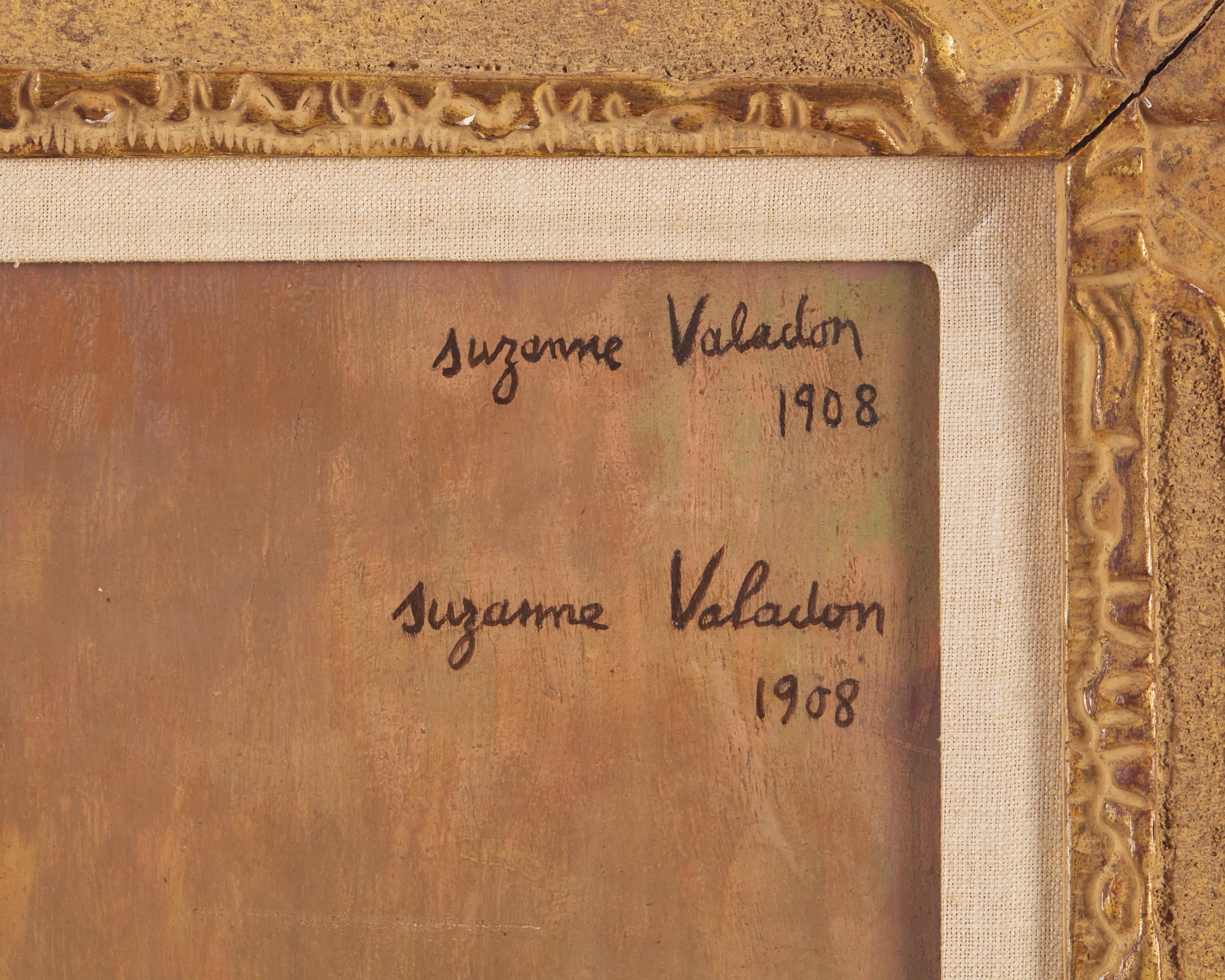
Before becoming known as an artist in her own right, Suzanne Valadon posed as a model for famous artists including Pierre Puvis de Chavannes, Pierre-Auguste Renoir, and Henri de Toulouse-Lautrec, appearing in some of their best-known compositions such as Le Bois Sacré Cher aux Arts et aux Muses (The Art Institute of Chicago), Danse à la Ville (Musée d'Orsay, Paris) or Gueule de Bois (Harvard Art Museums/Fogg Museum, Cambridge, MA), respectively. Valadon drew at a young age and taught herself to paint by closely observing several artists in Montmartre, the Parisian débauché neighborhood where she lived. One of the only women allowed in their circle, she progressively honed her own technique, supported and encouraged by Edgar Degas who, upon reviewing her early drawings, concluded she was one of theirs. Throughout her impressive career, spanning three decades and counting over three hundred paintings, Valadon carved a reputation for her unique take on the female body, particularly the nude.
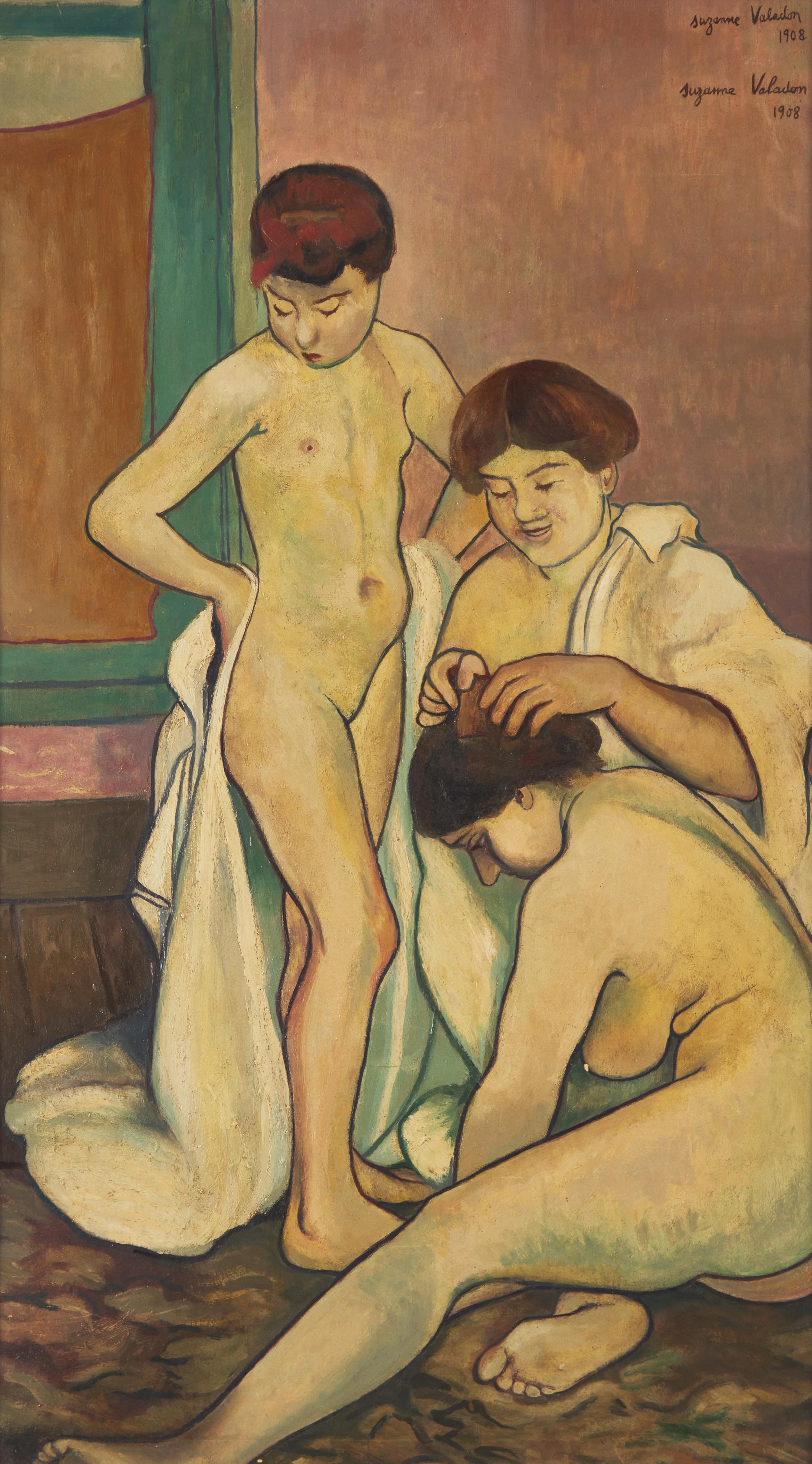
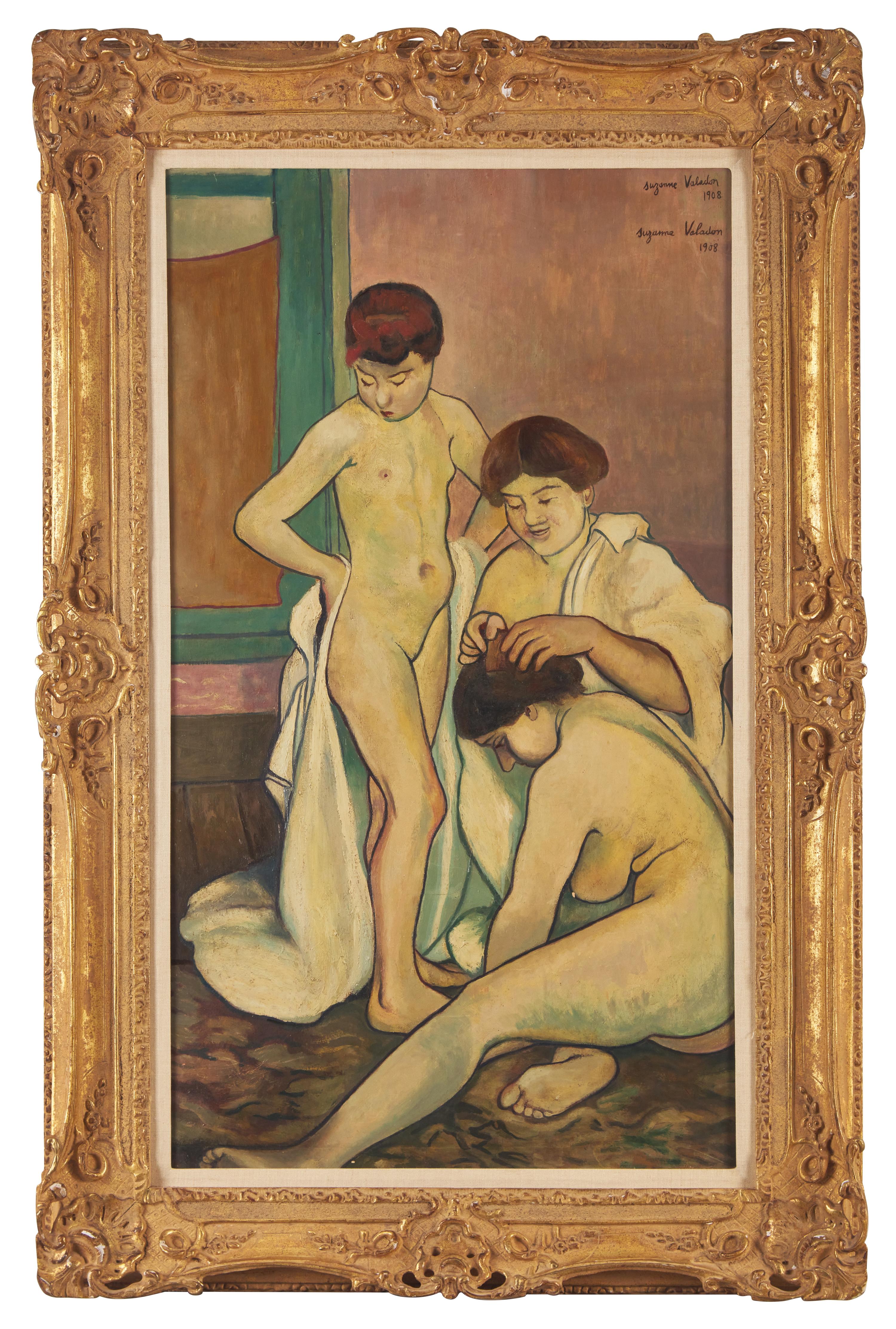
1908 was a pivotal year for the artist, not only personally (following a rocky marriage, she is about to embark on a relationship with André Utter) but also professionally, as exemplified by Nus à la Toilette, where she reinterprets the classic theme of bathers with a fresh, newfound sensitivity. This large canvas, never before seen at auction, is part of a groundbreaking series of nude paintings she created through 1909, which challenge the portrayal of the female nude.
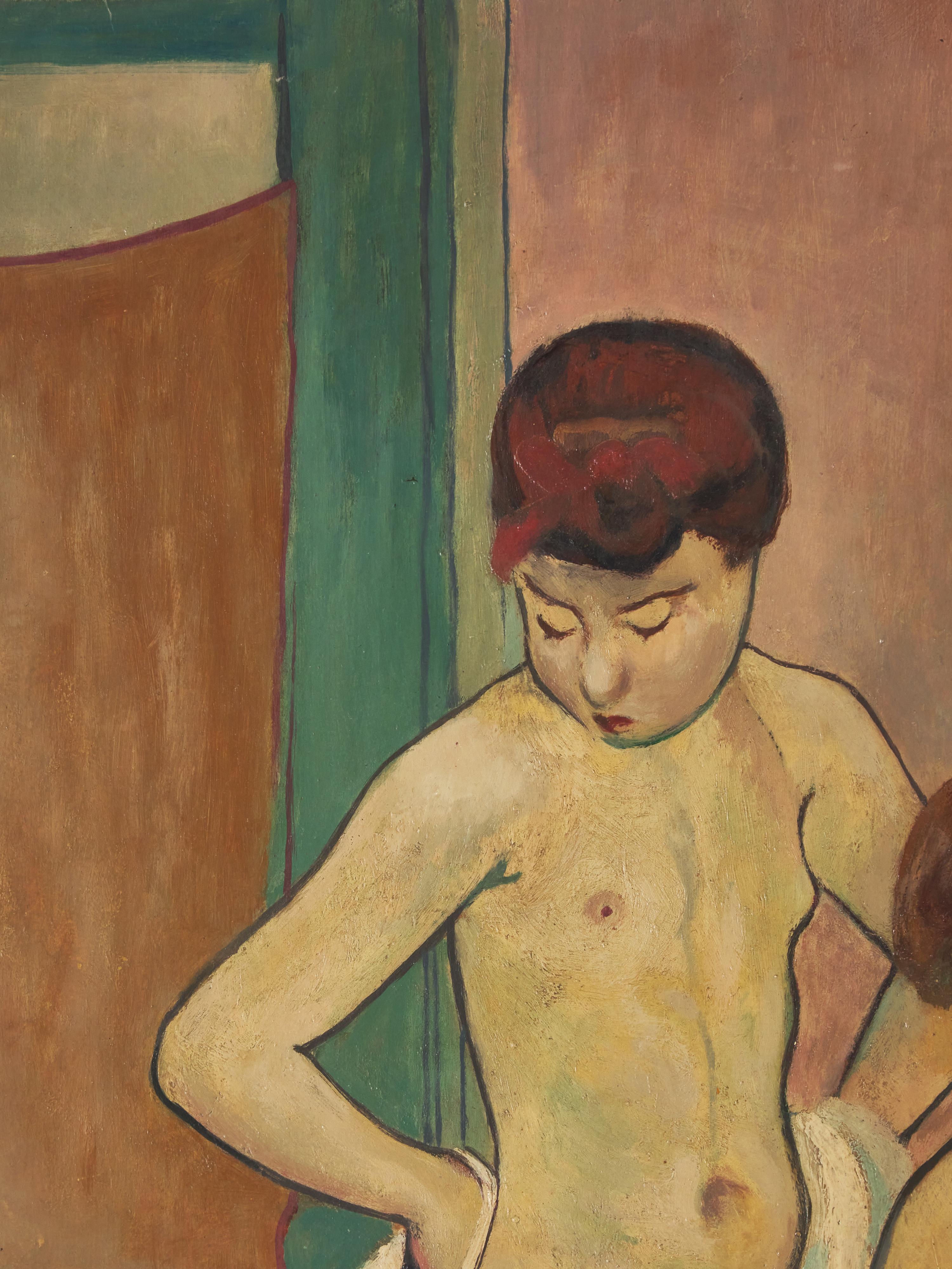
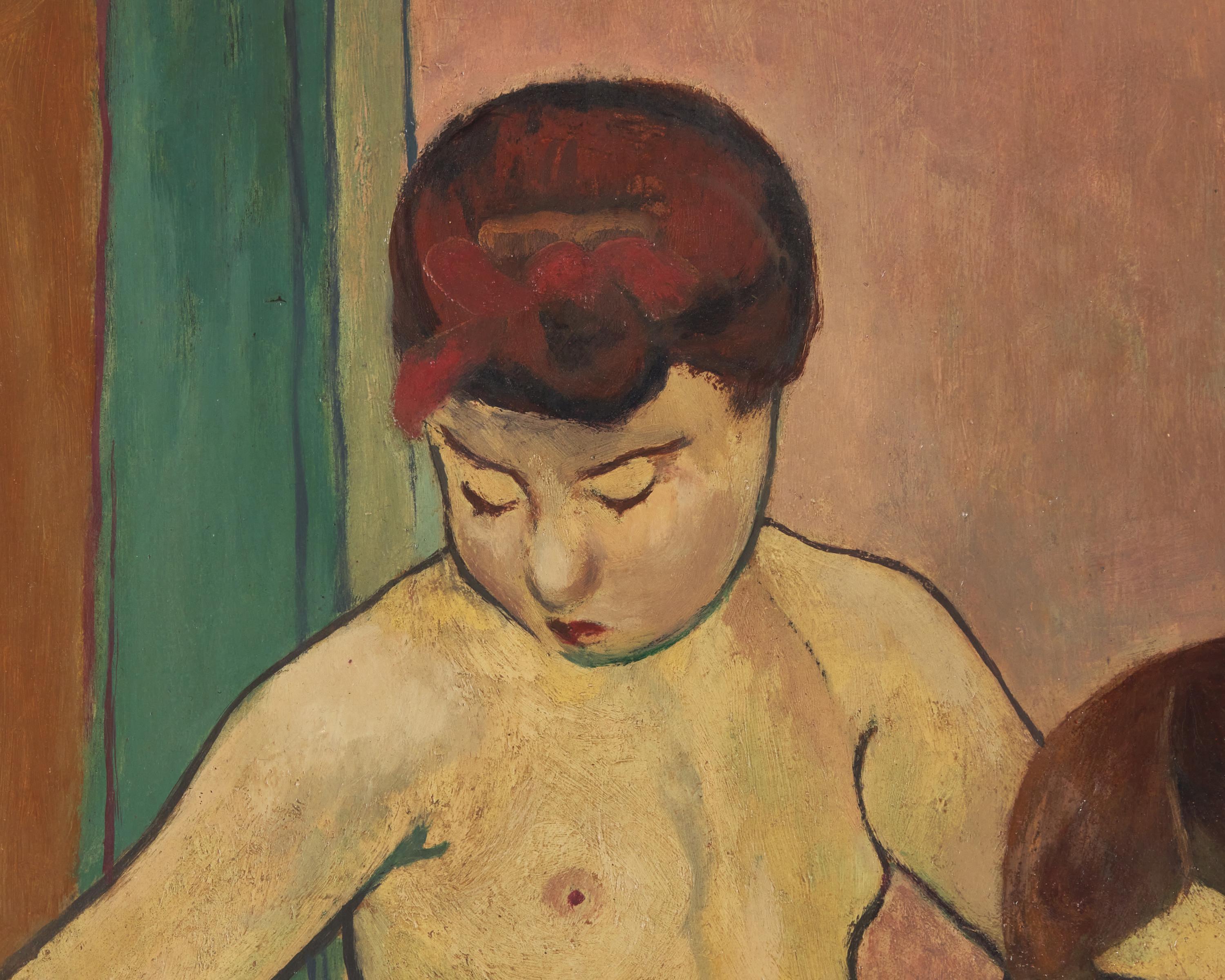
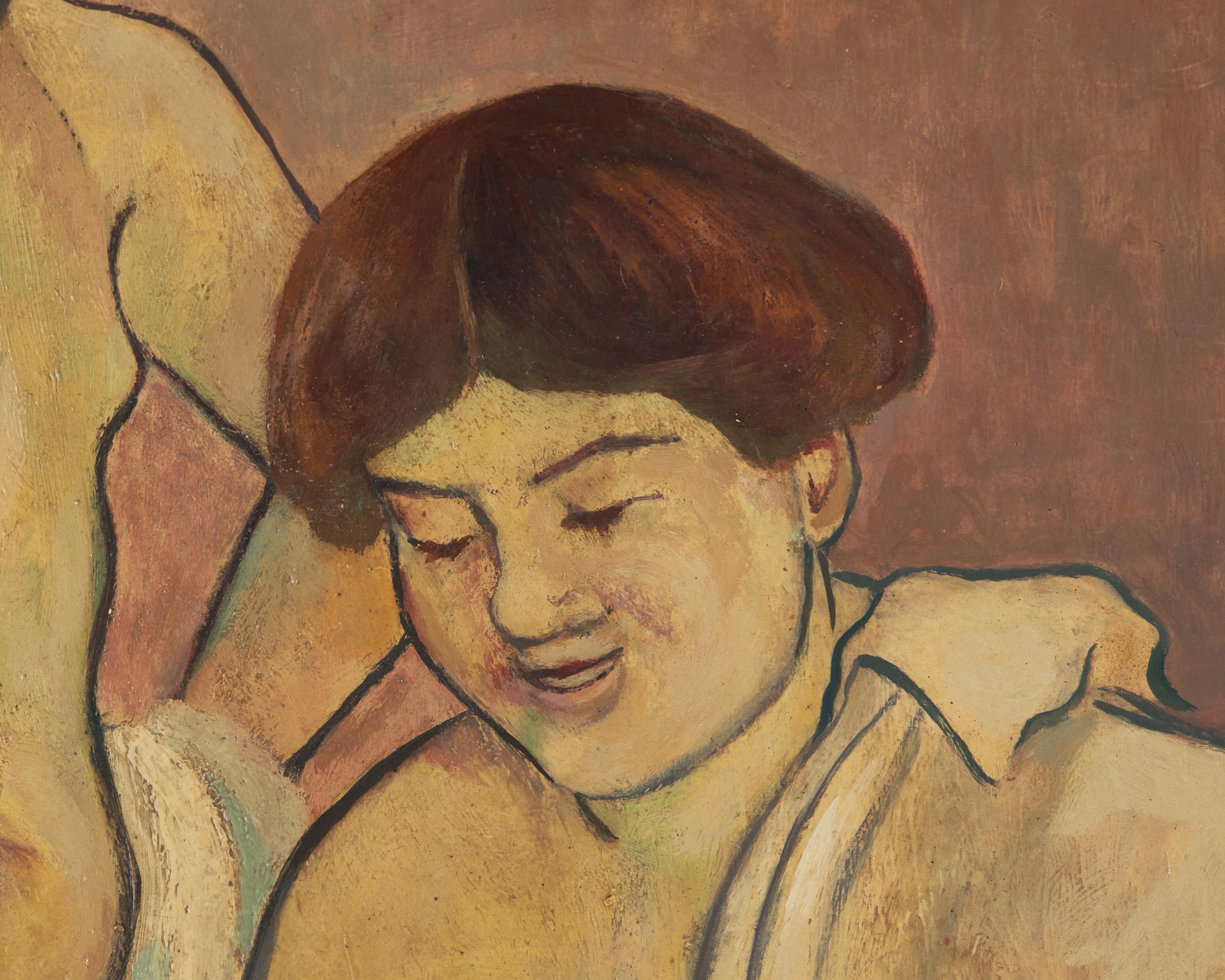
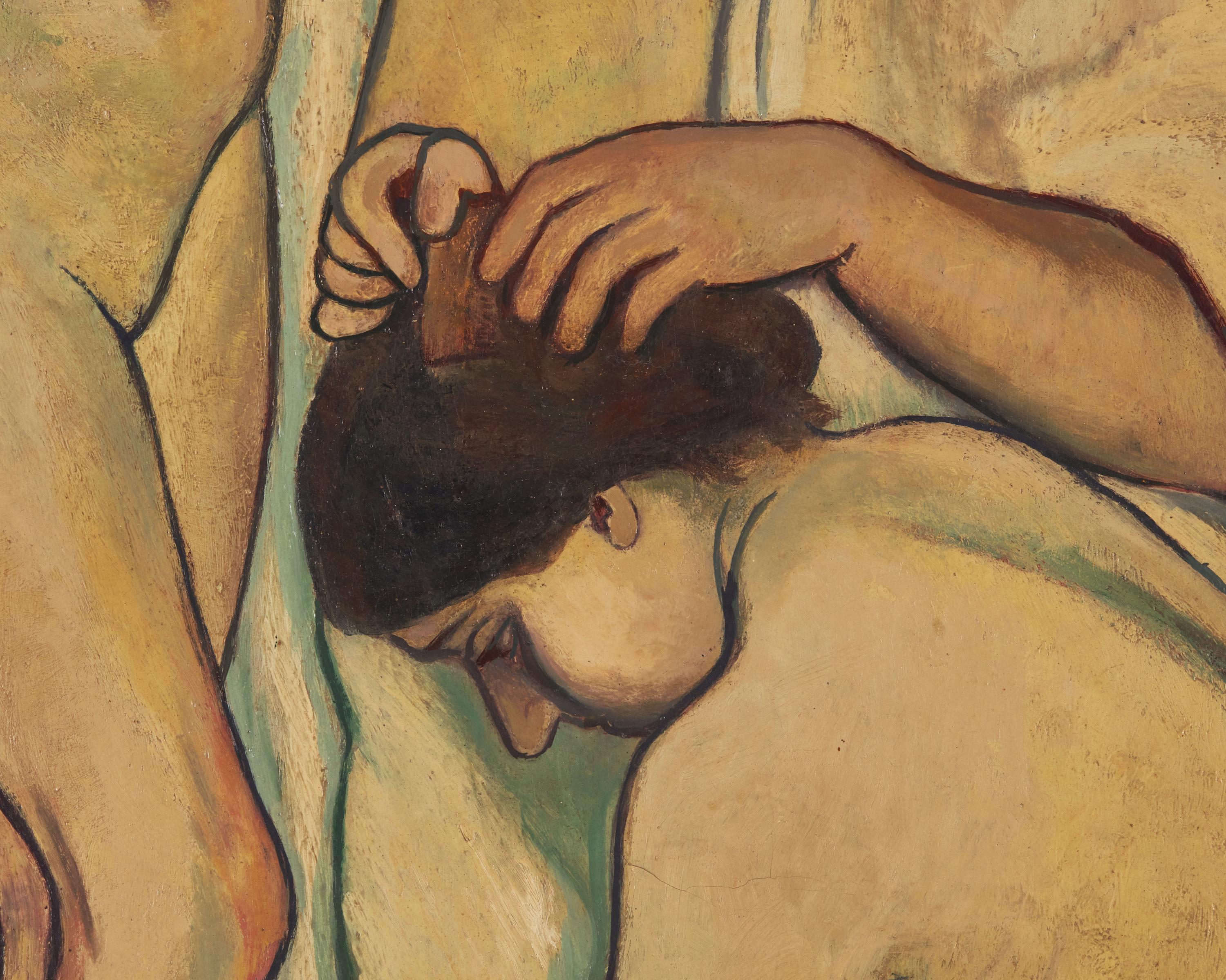
The composition of Nus à la Toilette features three women engaged in an intimate, everyday moment of grooming. The central figure, younger than her counterparts, stands confidently, her arm resting on her hip as she gazes downward, embodying a natural self-assurance. To her right, a seated woman leans forward on the rug, her posture relaxed yet engaged. Behind her is another figure. Partially draped in a white cloth and grinning, she arranges her companion’s hair. The three women are rendered with bold, dark outlines that reinforce their physical presence, a technique that distances Valadon’s work from the softness of traditional Impressionist nudes. The background, with its muted pastel tones and simplified geometric elements, enhances the focus on the figures while subtly suggesting depth and space.
At first glance, Nus à la Toilette reflects Valadon’s artistic influences, particularly the subject matter of Degas and the bold composition and striking color contrasts associated with Paul Gauguin. However, the painting marks a decisive evolution in her work, moving beyond her early black-and-white charcoal drawings and prints to establish her as a painter in her own right. While references to her elders are evident, Valadon asserts a distinct personality and style, characterized by her signature use of bold black contouring—what Bernard Dorival describes as "dark circles" (cernes)—which create dynamic, decorative arabesques that seem to dance across the canvas. Within these outlines, she applies pure, vibrant hues with a daring confidence. Following Renoir’s advice, she uses unmixed pigments to infuse the scene with vitality, offsetting the composition’s solid and austere structure. Shadows are rendered in deep blues, while the flesh tones shimmer with a mosaic of warm, luminous color points, reinforcing the painting’s modernity.
In Nus à la Toilette, Valadon redefines the depiction of the female form, stripping it of artifice and convention. She introduces a new archetype—one that is truer to life, devoid of coquetry, and unapologetically real. Her women are robust, with wide hips, full breasts, thick thighs, and natural bellies—unidealized bodies that the poet Guillaume Apollinaire described as désabusés (jaded). Yet, far from appearing weary or objectified, they exude a quiet confidence and a sense of freedom. Unlike traditional nudes, which often exist for the viewer’s gaze, Valadon’s bathers are simply living, moving through their private rituals without concern for being seen. The composition captures a moment of unguarded camaraderie, as seen in the seated figure’s subtle smile—a testament to the warmth and trust among them. Freed from eroticism or idealization, the scene radiates simplicity, intimacy, and sorority, offering a powerful alternative to the traditional male-dominated vision of the nude.
Here, Valadon defines her own artistic voice, balancing naturalism with stylization but also reappropriating the female form through a distinctly personal lens. Having once been subject to the male gaze as a model, Valadon here reclaims agency as a painter, offering her own vision of the female body that is deeply personal, unvarnished, and honest, and in many ways molded onto her own experience (she worked different jobs before modeling that had a dire impact on her body). This approach, which is not simply truth-telling but also a "sophisticated critique of the tradition of the eternal nude," would set her apart from her peers and challenge conventions. Nus à la Toilette embodies a new, discreet form of modernity, which would reach its culmination the following year in Ni Blanc Ni Noir (also known as Deux Nus or Après le Bain), a particularly Rubenesque and striking double nude portrait now in the Musée d’Art Moderne de Paris. Through such works, Valadon redefined the representation of women in art, proving that her female perspective could not only challenge artistic tradition but also create a new vision of femininity.
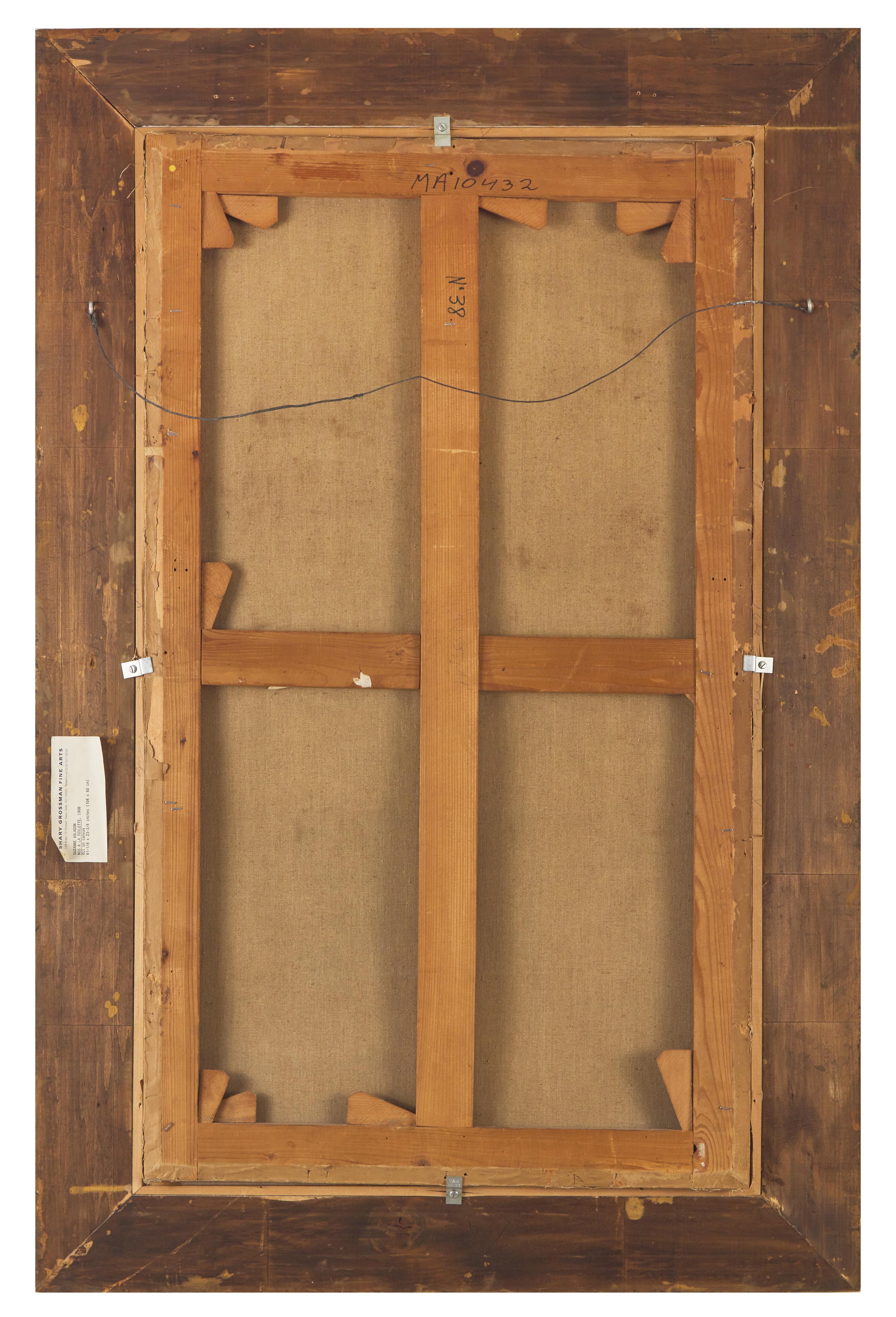
The relined canvas in overall good condition, with slight undulations in some parts of the canvas, all stabilized. Judging from the yellowed varnish at places, the work would likely benefit from a light cleaning. We notice a couple of pinpoint losses at bottom center left, to the left of the seated figure's feet, as well as at center right, at the top of the same figure's hanging breast (nipple). With a small horizontal ripple on the canvas at bottom center, in the folds of the drapery - likely a combined result of the lining and the thick impasto seen there. Examination under UV light reveals a thick layer of old greenish varnish throughout the canvas, which makes our examination more difficult. While we notice several areas of fluorescence on the motifs of the rug across the bottom as well as on all three nudes, those areas are due to the pigments used by the artist: blues, greens, creams, whites and pinks; they all correspond to the painted areas as seen with the naked eye. In our opinion, only two areas of restoration stand out: a small blister in the seated figure's hair (likely an old repair) as well as on the hair of the lady behind her (a small spot on the left part, and another on the right part: likely old scratches due to their feathery aspect, which don't match the pigments). Additional images available upon request.
The physical condition of lots in our auctions can vary due to age, normal wear and tear, previous damage, and restoration/repair. All lots are sold "AS IS," in the condition they are in at the time of the auction, and we and the seller make no representation or warranty and assume no liability of any kind as to a lot's condition. Any reference to condition in a catalogue description or a condition report shall not amount to a full accounting of condition. Condition reports prepared by Freeman's staff are provided as a convenience and may be requested from the Department prior to bidding.
The absence of a posted condition report on the Freeman's website or in our catalogues should not be interpreted as commentary on an item's condition. Prospective buyers are responsible for inspecting a lot or sending their agent or conservator to inspect the lot on their behalf, and for ensuring that they have requested, received and understood any condition report provided by Freeman's.
Please email [email protected] for any additional information or questions you may have regarding this lot.