To request further details about this lot, please email [email protected]
Please email [email protected] for any additional information or questions you may have
Sale 2561
| Philadelphia
| Philadelphia
To request further details about this lot, please email [email protected]
Please email [email protected] for any additional information or questions you may have
Estimate$2,000 – $3,000
Although now partly forgotten, Alice Halicka was widely considered one of the brightest minds of her generation. Born in Cracow, Poland, Halicka was drawn to art at a young age. Anxious to break free from the uptight, secluded Bourgeois milieu in which she grew up, she demanded to go to Munich to study painting as a teenager, which her father agreed to. Although she appreciated her time in Germany, where she enjoyed the many cultural attractions the city had to offer, Halicka only had one dream: to go to Paris. She first visited the City of Light in May 1912 and settled for good there the following year. Enrolled at the Academic Ranson where Maurice Denis and Paul Sérusier taught, she stayed close to other Polish emigrates in the city such as Kisling and Zig Brunner, who introduced her to Louis Marcoussis, who would become her husband in 1913.
Despite a happy marriage, Marcoussis has been credited as the reason why Halicka's career was eclipsed. Justifying a dangerous, corrupted world, Marcoussis kept her wife at bay, which frustrated her, as she recalled in her Autobiography: “I often regretted that I coped with life as a spectator, not as an actress, and that I never had young comrades; hence ensued the feeling of isolation and loneliness, which left an imprint on my entire life."
Almost as a reaction to her husband's take with this movement, and despite the couple's close connection with Juan Gris, Halicka never truly embraced the aesthetics, and philosophy of Cubism. It seemed to pay off in 1914 when poet Guillaume Apolinaire said, while reviewing her work on view at the Salon des Indépendants: “Halicka has the gift of manliness and realism, which enables her to judiciously construct a painting without deforming the composition."
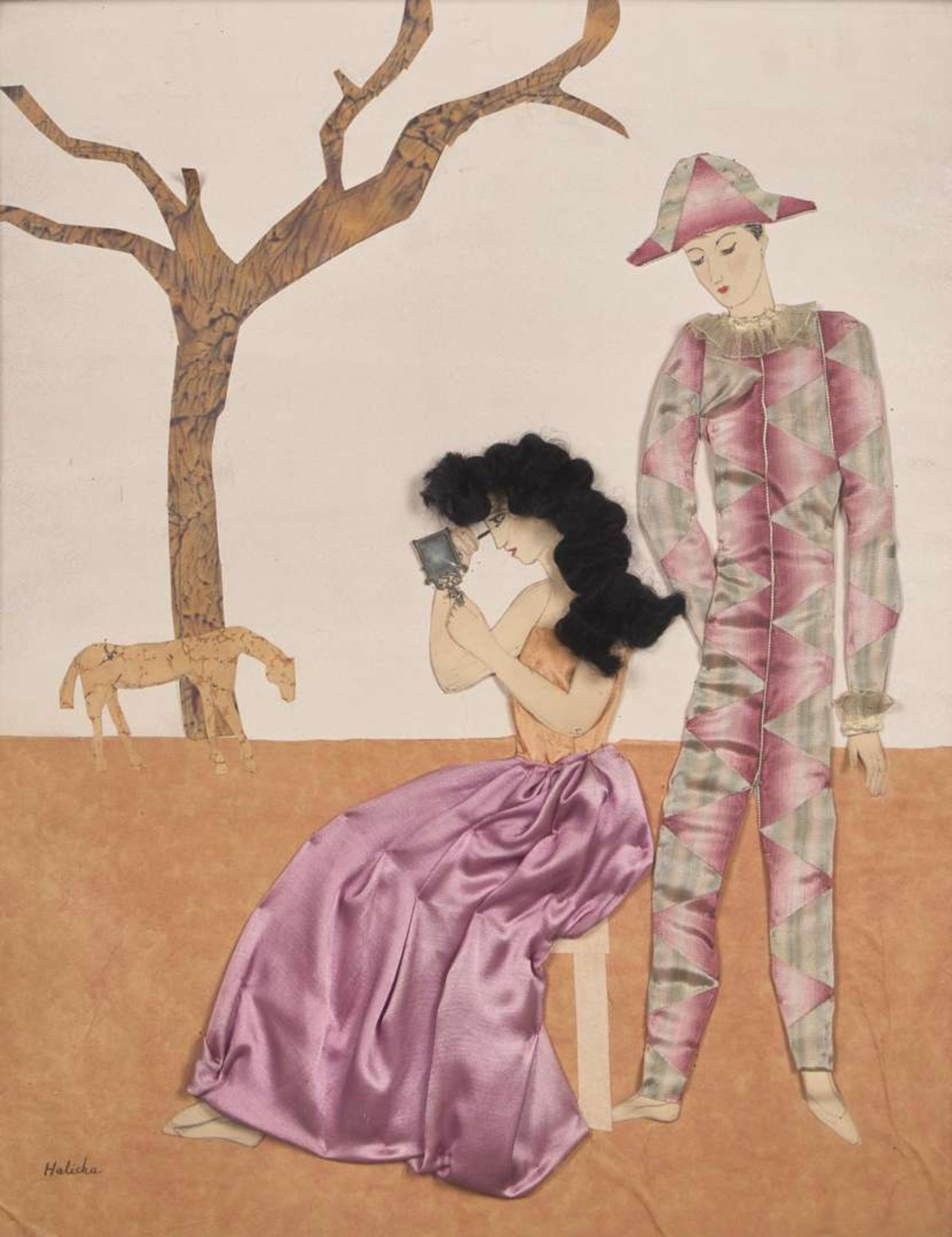
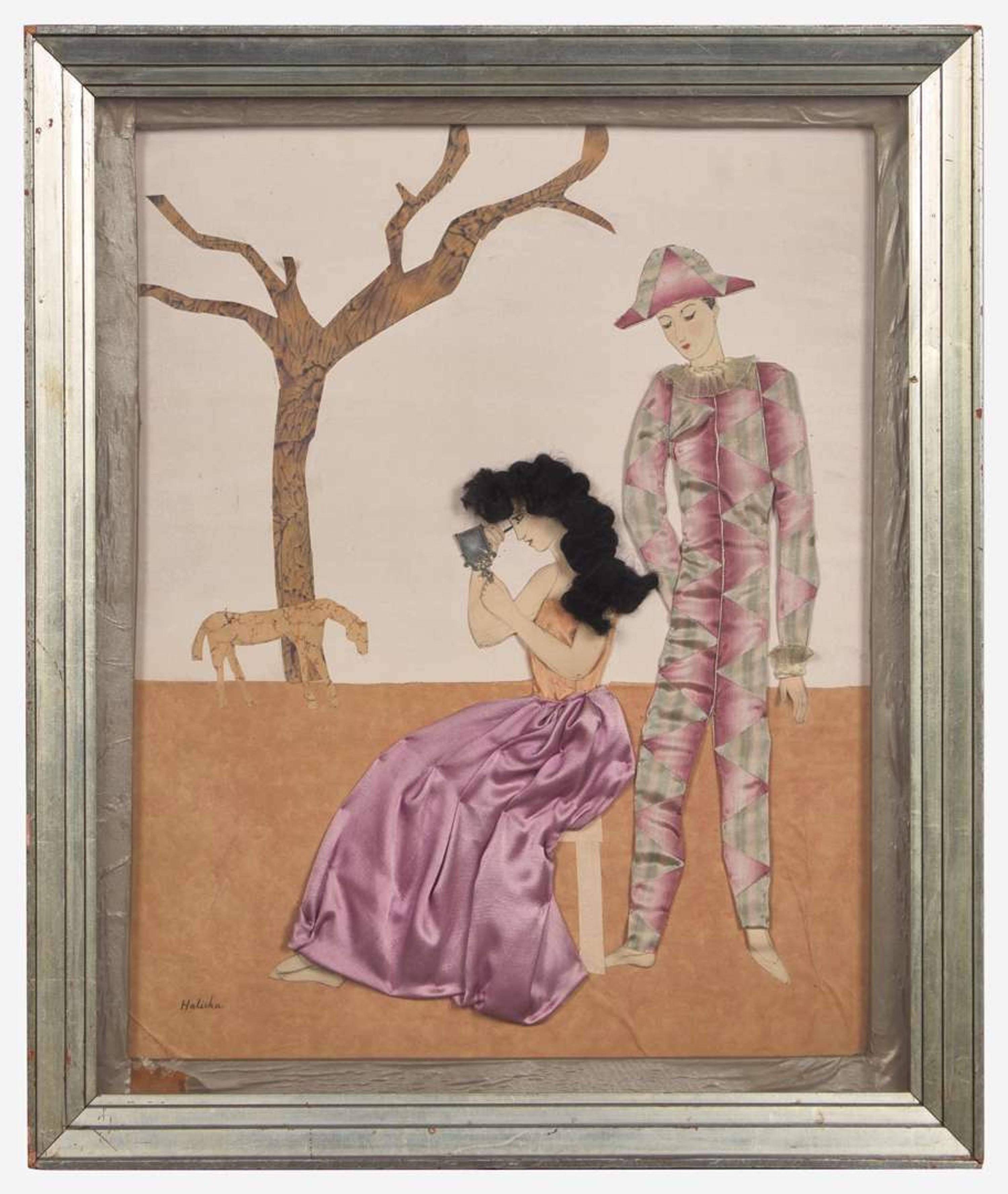
Following this breakthrough, and in between the two wars, Halicka explored a different path than pure painting. Drawing upon her experience in fabric design and her strong interest in decorative arts, she moved to composing small, three dimensional images made from a great variety of materials: scraps of (sometimes luxury) fabrics, buttons, paper, wire, pears, feathers etc - as exemplified here. She exhibited such creations at Galerie Drouet in 1924, but it was not until her show at Galerie Georges Petit in 1930 that she found success with them, her friend Princess Murat referring to them as Romances Capitonnées (Embossed Romances).
Simple in appearance and charming in execution, the present work depicts a seated woman applying make up, while an Harlequin stands behind her in what appears to be a savannah forest decor. Through its title and its overall color palette, Halicka appears to offer her own response to Picasso's Pink Period, and subsequent Cubist efforts. According to renowned Greek art critic Tériade, “Contrary to what one might think these Romances are not simple women’s needlework." Here, Halicka invents a world beyond the brush and the canvas, charged with intense poetry, and humor that recalls Polish folk art, and which would later inspire the display of fashion shop windows in America. Spontaneously created, and illustrating a romantic, or at least sentimental, episode, such a work would gain popularity among the general public beyond Europe.
Albert C. Barnes liked Halicka's playful constructions and technical innovations and collected her work avidly, which inspired Mr. Rothberg to do so.
The Collection of Sidney Rothberg, Philadelphia, Pennsylvania.
In overall very good condition. The work was not examined out of its framed. We notice some ridges in the paper at bottom right quadrant (around the Harlequin's legs, on the ground), as well as at bottom left, below the signature: this is likely a result of the artist's technique, and not a defect which appeared over time. Small loss on the horizon lane, right behind the seated figure (at the juncture of her skirt and top). One branch of the tree (the third from the left) at upper left is slightly peeling off. We do notice several minuscule pinholes across the composition, which appear to be a result of the artist's working method: to the right of the Harlequin, around the woman's waist, at her feet etc.). Those are not at all obtrusive to the general composition. With minor surface soiling in the sky at center left (light scuffing). No other sign of repair or restoration.
The physical condition of lots in our auctions can vary due to age, normal wear and tear, previous damage, and restoration/repair. All lots are sold "AS IS," in the condition they are in at the time of the auction, and we and the seller make no representation or warranty and assume no liability of any kind as to a lot's condition. Any reference to condition in a catalogue description or a condition report shall not amount to a full accounting of condition. Condition reports prepared by Freeman's staff are provided as a convenience and may be requested from the Department prior to bidding.
The absence of a posted condition report on the Freeman's website or in our catalogues should not be interpreted as commentary on an item's condition. Prospective buyers are responsible for inspecting a lot or sending their agent or conservator to inspect the lot on their behalf, and for ensuring that they have requested, received and understood any condition report provided by Freeman's.
Please email for any additional information or questions you may have regarding this lot.