Sale 6380
| Philadelphia
| Philadelphia
Estimate$10,000 – $15,000
Provenance:
Collection of Pierre Louis Paul Randon de Boisset, Paris.
His sale, Paris, February 27, 1777, lot 177
Acquired directly from the above sale.
With Rémy.
Collection of Nicolas Beaujon, Paris, by May 1785.
His sale, Paris, sale of April 25, 1787, lot 94.
Collection of Jean-Antoine Chaptal, comte de Chanteloup, Paris.
His sale, Paris, sale of December 23, 1816, lot 92.
(Possibly) Phillips, London, sale of June 28, 1822, Lot 60.
(Likely) acquired directly from the above sale.
Private Collection, Vienna.
Dorotheum, Vienna, sale of June 20, 2006, lot 36 (sold as ‘Anton Wilhelm Tischbein’)
Acquired directly from the above sale by the present owner.
Exhibited:
Montpellier, Musée Fabre, Jean Raoux (1677-1734): Virtuose et Sensuel, November 28, 2009 - March 14, 2010, no. 17
Literature:
Pierre Marie Gault de Saint-Germain, Les Trois Siècles de la Peinture en France, Belin, Paris, 1808, p. 214, note 1.
Charlotte Guichard, "La Signature dans le Tableau aux XVIIe et XVIIIe siècles : Identité, Réputation et Marché de l'Art," Sociétés & Représentations, Éditions de la Sorbonne, 2008, I, n° 25, p. 172.
Michel Hilaire and Olivier, Jean Raoux (1677–1734): Virtuose et Sensuel, exhib cat., Paris, 2009, pp. 108-109, no. 17, illus.
Connaissance des Arts, Paris, Vols. 676-677, 2009, p. 102.
William Sharpe, Grasping Shadows: The Dark Side of Literature, Painting, Photography, and Film, Oxford University Press, 2017, p. 364 (mentioned in footnote note 43).
Lot Essay:
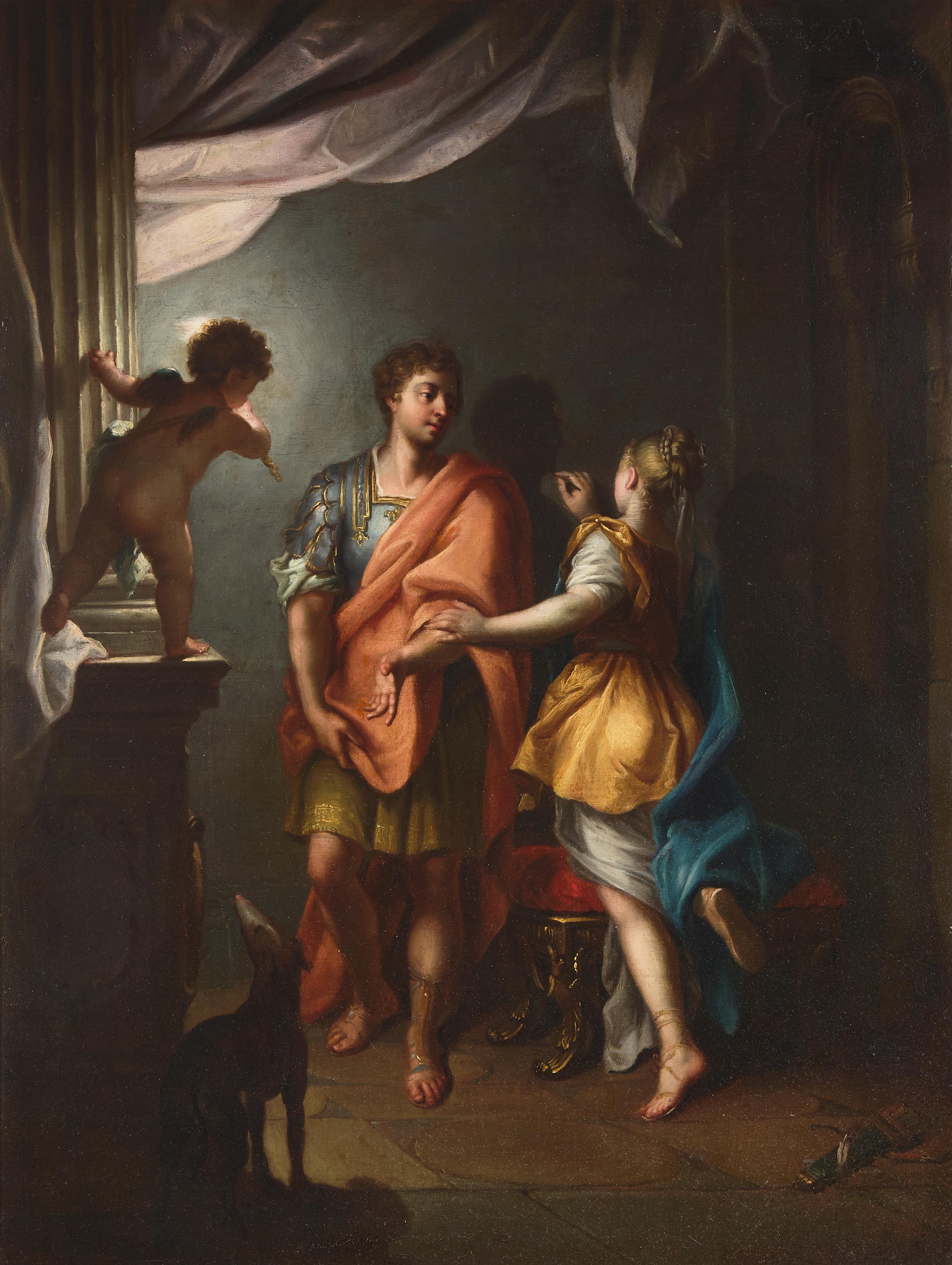
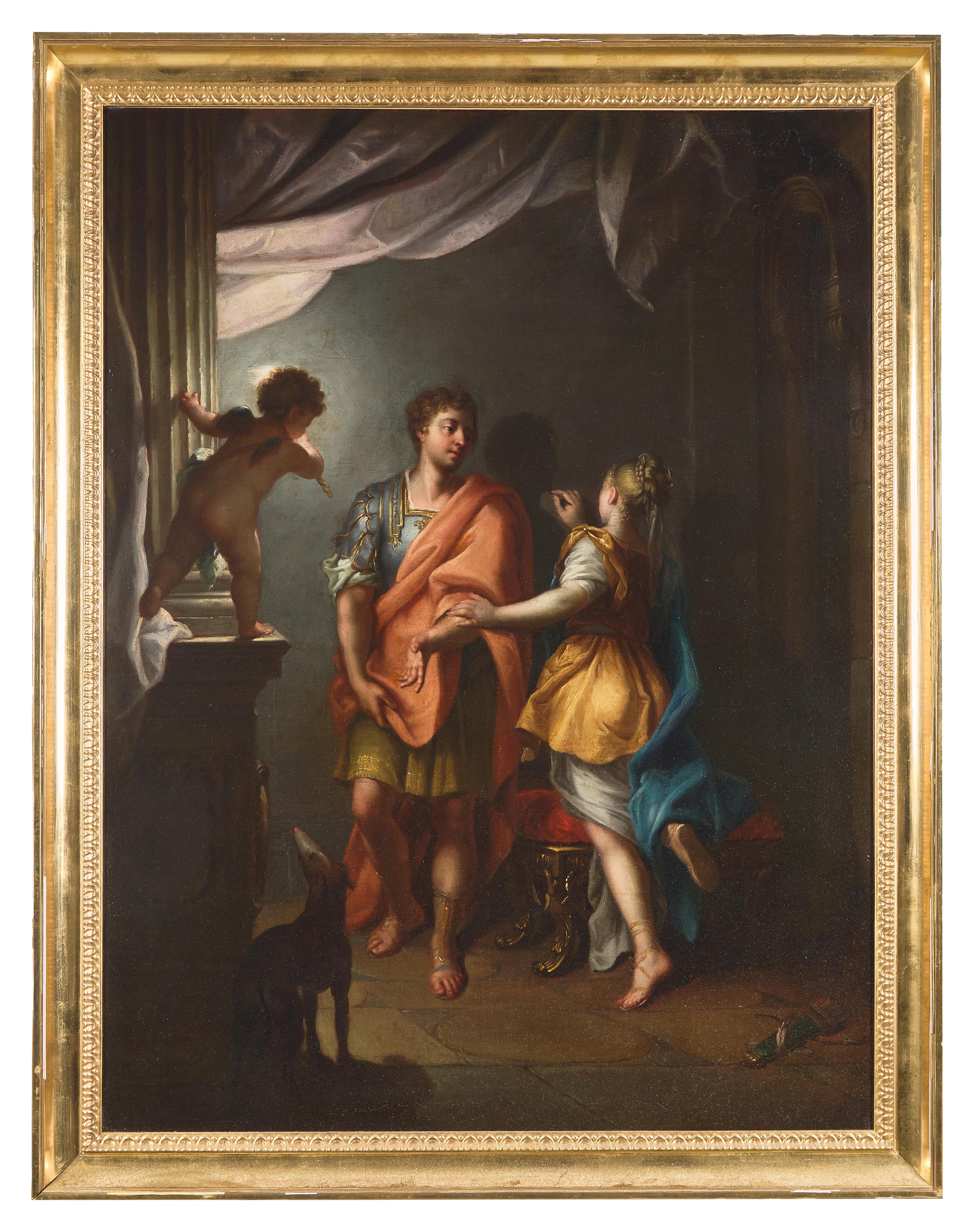
The Invention of Painting is a relatively recent rediscovery. Originally sold anonymously in a European salesroom as a work by Tischbein, it was later reattributed to Jean Raoux and exhibited at the Musée Fabre in the artist’s native Montpellier from November 2009 to March 2010. The exhibition, titled Virtuose et sensuel, paid homage to the lyrical grace, warm tonality, and masterful interplay of light and shadow that characterize this Peintre sous la Régence.
Often considered the pendant to Raoux’s Pygmalion Amoureux de sa Statue (the work that secured his admission to the Académie and which illustrated the birth of sculpture), The Invention of Painting illustrates the myth of Dibutade, guided by Cupid’s torch as she traces the outline of her lover’s shadow. According to the legend, Dibutade, the daughter of a sculptor from Corinth, wished to preserve the image of her beloved as he set out for a distant voyage, and drew the outline of his shadow on the wall; her father then filled the traced form with clay, thus creating the first sculpted portrait. In both works, love itself becomes the animating force, the divine spark that inspires creation, a notion central to artistic theory since the Renaissance.
Belonging successively to three distinguished collectors, The Invention of Painting exemplifies Jean Raoux’s inimitable style, instantly recognizable in the woman’s golden hair and that of her lover, rendered with the same refined sensuality found in his celebrated Pygmalion,. The painting displays Raoux’s exceptional command of light and shadow and his judicious attention to detail: the archer’s quiver, the giltwood chair, and the faithful dog—all few in number yet executed with exquisite precision, each contributing meaningfully to the narrative.
In this composition, Cupid stands at left, balancing against a column while holding a torch that illuminates the scene from left to right, casting a shadow behind Dibutade’s lover draped in Graeco-Roman attire. His silhouetted outline is carefully traced by Dibutade herself, similarly dressed, who kneels gracefully upon a velvet-covered bench, steadying herself with one hand on the man’s arm. As the viewer witnesses Raoux’s poetic vision of the birth of painting, a small dog in the lower left corner looks upward toward Cupid, subtly anchoring the scene in domestic intimacy.
Trained first under Jean Ranc and later as a pupil of Bon de Boullogne, Raoux traveled to Italy to study the great masters before returning to France, where he distinguished himself among patrons as a painter of elegant figures, softened forms, and diffused light. The inclusion of the small dog in the present work recalls the Venetian compositions the artist would have studied during his Italian sojourn and has led scholars to situate the present work either during Raoux’s stay in Italy or shortly after his return to Paris, around 1714-1717.
Framed: 50 x 39 in.
The physical condition of lots in our auctions can vary due to age, normal wear and tear, previous damage, and restoration/repair. All lots are sold "AS IS," in the condition they are in at the time of the auction, and we and the seller make no representation or warranty and assume no liability of any kind as to a lot's condition. Any reference to condition in a catalogue description or a condition report shall not amount to a full accounting of condition. Condition reports prepared by Freeman's staff are provided as a convenience and may be requested from the Department prior to bidding.
The absence of a posted condition report on the Freeman's website or in our catalogues should not be interpreted as commentary on an item's condition. Prospective buyers are responsible for inspecting a lot or sending their agent or conservator to inspect the lot on their behalf, and for ensuring that they have requested, received and understood any condition report provided by Freeman's.
Please email [email protected] for any additional information or questions you may have regarding this lot.